A bedtime routine chart that gets kids to bed is seven steps in the same order every night, on a board with flip tabs a kid physically turns, mounted at a 9-year-old's eye level in the hall every kid walks through, under a light bright enough to read it by and dim enough to be bedtime, and it costs under $20 and cut our evening chaos by about 60 percent. Bedtime in a house with five kids at four stages used to feel like a minor emergency every night; the board didn't solve everything, and 60 percent is the difference between a stressful evening and a manageable one. This post is the seven steps and why seven, the flip tabs and why they're physical, where the board lives and why the hall, the sconce above it and its 30 percent, the icons for the pre-reader, the older kids' version, the times on the board, the parent's view from the hallway, what happens when a tab doesn't flip, the board's Sunday reset, the toddler's row, the teen's row, making it for under $20, the routine's lights room by room, what it didn't fix, mistakes, and the cost.
The seven steps
Homework checked, backpack packed, shower or bath, pajamas, teeth, reading time, lights out; the same seven in the same order every night for every kid, and the order's the point, because a kid who knows what's after teeth doesn't ask. Seven's the number because five to seven is what a kid can hold in a sequence and more than that's a list nobody reads; the classroom's morning routine was six, and the seventh here is the one that's the goal.
The flip tabs
Each step's a tab on a hinge, white on the to-do side and green on the done side, and the kid flips it as the step's done; the physical act's the whole thing, because a checkbox on paper's a thing a parent marks and a tab a kid flips is a thing the kid did. Five rows of seven tabs, one row per kid, and a kid who's flipped six tabs knows the seventh's next without being told. It's the same reason the classroom had a job chart with clothespins: a hand moving a thing is a brain marking it done.
Where it lives
At the top of the stairs, mounted at eye level for a 9-year-old, which is 50 inches, on the wall every kid passes between their room and the bathroom; it's in the natural flow of bedtime traffic, unavoidable without being intrusive. A board in a bedroom is a board one kid sees; a board in the kitchen is a board nobody sees at 7:30 pm. The hall's the route, and the board's on the route.
The sconce above it
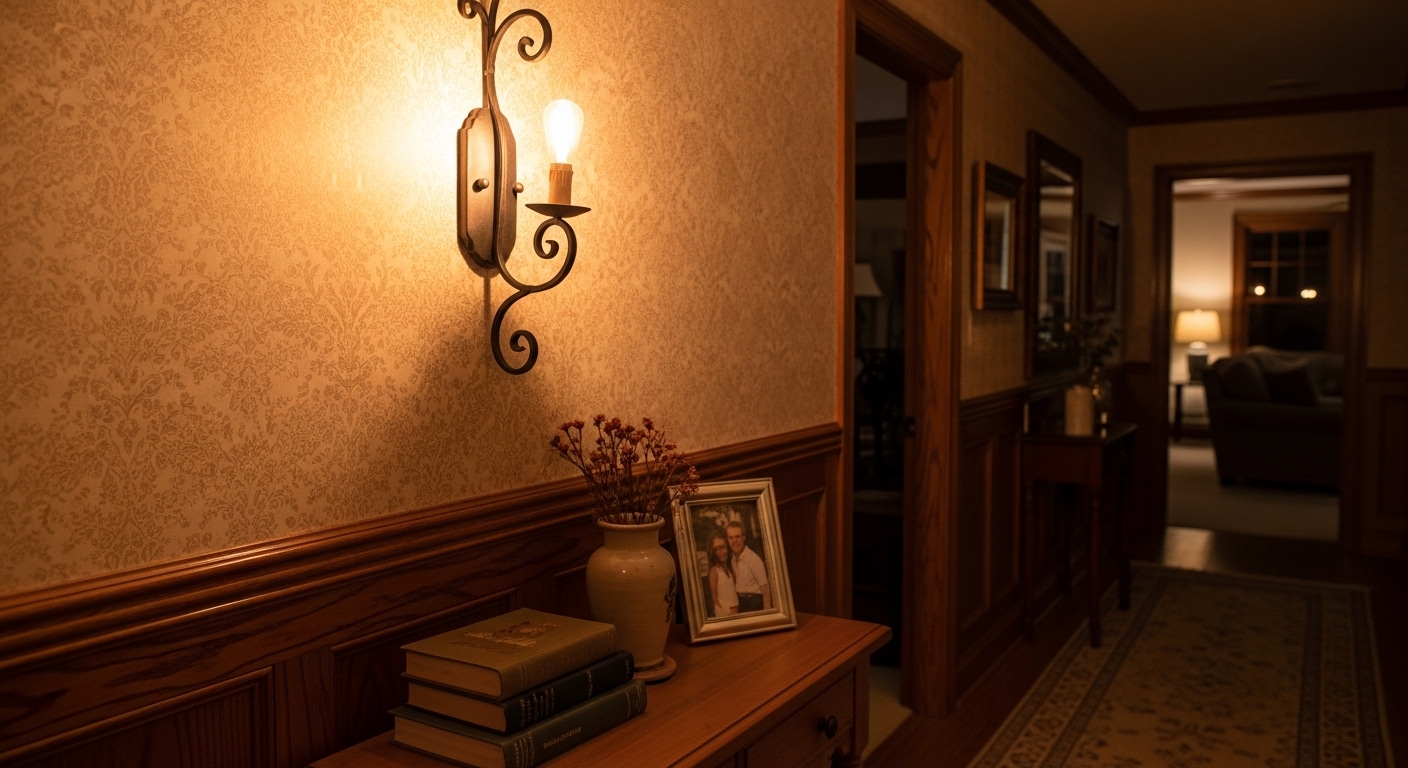
A wall sconce mounted directly above the board at 66 inches, wired to the hallway's dimmer with the other four from the hallway post; at 30 percent in the evening it lights every tab and keeps the hall in wind-down mode, and at 20 percent overnight it's the light the last tab's flipped under. A routine board that's hard to read in dim evening light doesn't get used consistently, and the sconce isn't an afterthought; it's part of the system. The board was at the top of the stairs for a month under nothing before the sconce, and the tabs stopped flipping around 8 pm because nobody could see them.
The icons for the pre-reader
The 4-year-old's row has a picture on each tab, a bathtub, a toothbrush, a book, drawn with a marker, and she flips by picture; the 7-year-old's row has the word and the picture, and the older three have the word. A pre-reader with her own row on the same board as her 14-year-old sister is a pre-reader who's part of the same routine, and she flips her tabs with the seriousness of a bank teller.
The older kids' version
The 12- and 14-year-olds don't need visual prompts and still use the board as a self-check: backpack packed, retainer in, phone charging in the kitchen, which is the 14-year-old's own added tab and the one that matters most. The board works through about ten as a prompt and past that as a checklist, and the physical act of flipping provides closure that "it's bedtime" from a parent doesn't. The 14-year-old flips hers with a sigh and flips them, and that's a win.
The times
A strip along the top with the times: 7 for the 4-year-old's lights out, 7:30 for the 7-year-old, 8 for the 9-year-old, 8:30 for the 12-year-old, 9 for the 14-year-old, and the reading tab's the one that stretches. The times are on the board so a kid who asks "when" gets pointed at the board, and so the 9-year-old can't claim the 12-year-old's time. Five bedtimes on one board is the thing that makes five bedtimes in one house possible.
The parent's view
From the hallway I can see where everyone is in the routine without asking or walking into each room: a row with four greens is a kid at pajamas, a row with six is a kid reading, a row with two at 7:45 is a kid who needs a visit. It's the classroom's job chart read from the door, and it's the reason bedtime stopped being five conversations and became one glance and one visit.
When a tab doesn't flip
A tab that's white at the kid's time is a step that didn't happen, and the rule is that the next step doesn't start until the white one's green, which is a rule the kids enforce on each other; the 7-year-old's told the 9-year-old that teeth are white and reading can't start, more than once. A tab that's flipped without the step being done is the one lie the board allows, and it's caught at the teeth check, which is the one step I verify.
The Sunday reset
Every tab back to white on Sunday night, part of the week's reset, and the times checked against the week's schedule for a late practice or an early bus; the board's the same every day and the reset's what makes Monday the same as Friday. Thirty seconds, and the 4-year-old likes to do the flipping.
The toddler's row
The 4-year-old's row is pictures, her tabs are lower on the board so she can reach them from a step stool, and her seventh tab's a moon; the toddler room post is the lights her row ends under, the sconce for the book and the nightlight for the moon. A toddler with a row on the family's board is a toddler whose bedtime's the same shape as everyone's, and the 4-year-old's routine is the smoothest of the five, because she's never known a bedtime without the board.
The teen's row
The 14-year-old's row has an eighth tab she added, phone in the kitchen, and it's the tab that's made the most difference in her sleep; the board gave her a place to put a rule she'd have fought if I'd made it. Her lights-out is 9 and her reading tab's the swing-arm sconce from the teen bedroom post, and her row's the one that proves the board scales past the age the routine-board posts say it stops.
Making it for under $20
A 24-by-18 piece of foam board, $6; 35 tabs cut from card stock, folded over a strip of tape as the hinge, $4; markers for the words and pictures; a strip of tape along the top for the times; two adhesive strips to mount it, $4. An hour on a Sunday with the 12-year-old, and it's been up three years with the tabs replaced once. A laminated one from a shop is $40 and doesn't have the 4-year-old's bathtub drawing on it.
The routine's lights, room by room
Homework's checked at the island's pendants at full. The bath's under the bathroom's sconces at 50 from the bathroom post. Pajamas and teeth are the bedroom's ceiling at 30. Reading's the sconce at the bed. Lights out is the nightlight and the hall at 20. The board's seven steps are seven lights getting dimmer, and the routine's a house that goes from full to 20 percent in ninety minutes, which is the thing the kids' bodies read even when the kids don't.
What it didn't fix
The 9-year-old's forty-minute shower. The 7-year-old's third glass of water. The 12-year-old's "one more chapter." The 4-year-old's stuffed animal audit. The board fixed the order and the asking, which is 60 percent, and the other 40 is kids, which no board fixes. A parent who expects a board to fix bedtime is a parent who'll take it down in a month; one who expects it to fix the order keeps it three years.
The board and the hallway sconces, as one system
The board's under the third of the five hallway sconces, and the hallway's dimmer schedule is the bedtime's: 40 percent at 7 for the 4-year-old's row, 30 at 8 for the middle three, 20 at 9 for the 14-year-old's last tab, and 20 all night for the trips; the board's readable at every setting and the hall's never bright after 7. A bedtime board and a hall on a dimmer are the same project, and the hallway's five sconces were hung partly so the board would have a light. A board in a hall with a ceiling light at full is a board in a hall that's daytime, and the routine's a wind-down that a bright hall undoes.
Traveling with it
A paper version, seven rows of seven checkboxes, goes in the suitcase for a hotel or a grandparent's house, and a kid who's used to flipping tabs checks boxes without a fuss; the routine's the same in any room and the board's the reminder that it is. Three trips and it's worked in all three, and the grandparents have asked for a copy for the summer week, which is the version they run with a marker on the fridge.
The board for a family of two kids, or one
One row, seven tabs, the same seven steps, at the kid's eye level on the route to the bathroom, under a light; the board works for one kid the way it works for five because the tabs are the routine and not the count. A friend with one kid made hers on a clipboard and hung it on the bathroom door, and it's the same board. The sconce above it's the part that doesn't scale down: one kid's board in a dark hall is still a board nobody flips after 8.
Mistakes
A board in the kitchen for a month, seen by nobody at 7:30. A board with twelve steps, in the first house, read by nobody. No light above it, and the tabs unflipped after 8. Checkboxes on paper before the tabs, marked by me. And a board without the times, and five kids claiming the latest one.
In one paragraph
Seven steps, same order, every night. Flip tabs, white to green, one row per kid. At the top of the stairs at a 9-year-old's eye level, on the route to the bathroom. A sconce above it at 30 percent on the hall's dimmer. Pictures for the 4-year-old, words for the rest, an eighth tab the teen added. Times along the top. One glance from the hall. Under $20 and an hour, and 60 percent less chaos, which is the difference between a stressful evening and a manageable one.
What it cost
Foam board, card stock, tape and markers, about $14. The sconce above it, $64, on the hallway circuit that was already there. About $80 for a board that runs five bedtimes a night, and the $64 sconce is the part the under-$20 posts leave out and the part that makes it work after dark.
Shop this post: wall sconces for above the board, on the hallway's dimmer