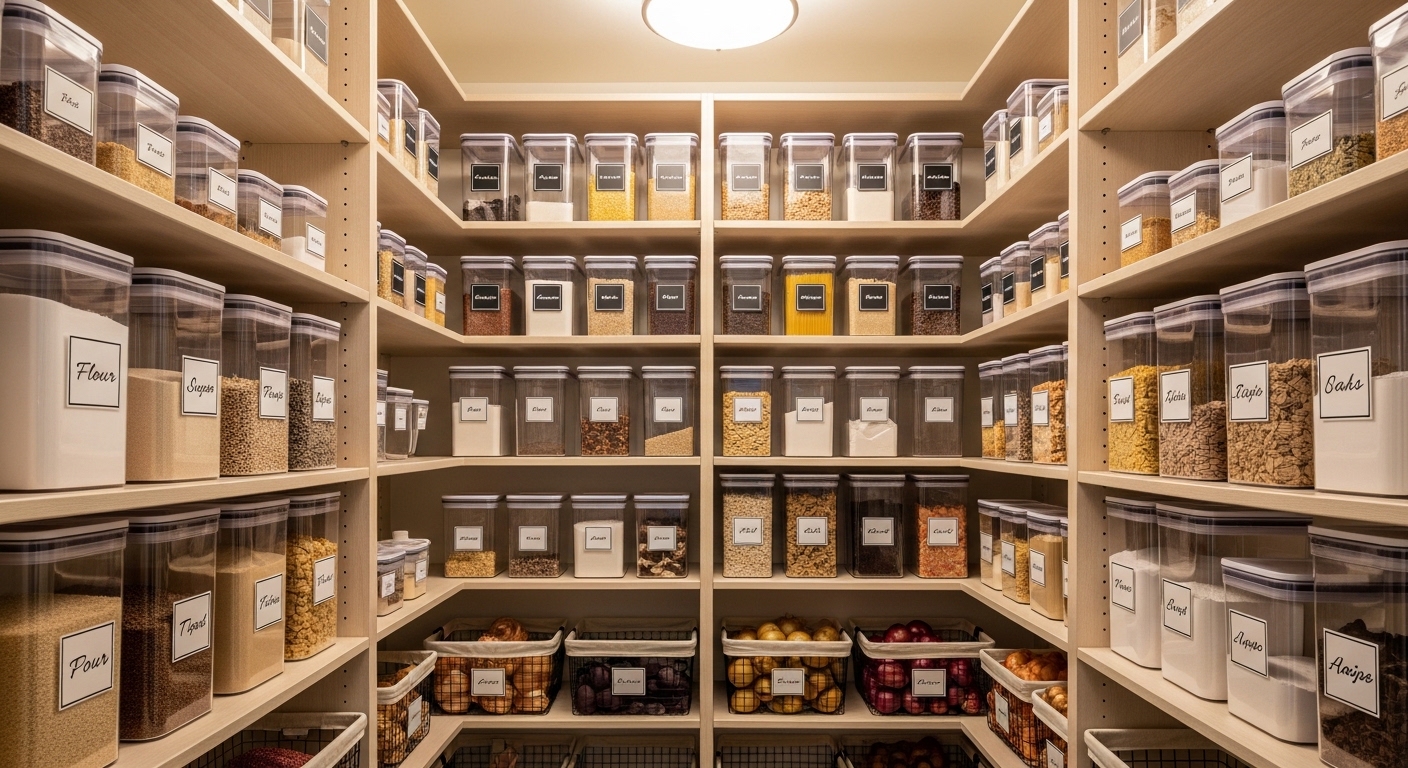
Pantry organization for a family of seven comes down to zones by meal, clear bins with one category each at the height of the person who uses them, a stockroom shelf for the bulk that the kitchen doesn't hold, and a light inside the door so you can see the back of the shelf, and the before photos are the reason this post exists. Our pantry is a 4-by-6 walk-in off the kitchen with shelves on three walls, and for three years it was a closet where food went to be forgotten; the before photo has four open bags of the same pasta on three shelves. This post is the empty-it-first rule, the five zones and which shelf each is on, the bins and the decanting rule and what doesn't get decanted, the kids' shelf at 36 inches, the stockroom shelf, the appliance shelf, the door's back, the label system, the light and why it was the fourth thing and should have been the first, the weekly restock from pantry to kitchen, the monthly inventory, what we stopped buying, mistakes, and the cost.
Empty it first
Everything out onto the island, on a Saturday morning, and the shelves wiped; it's the garage rule and the classroom rule, and it's the step everyone skips because it looks like it makes things worse. On the island, sorted by category, the pantry showed its truth: eleven cans of black beans, four pastas, three open oatmeals, and a bag of flour from before the renovation. Two trash bags out, one box to the food bank, and the pantry got organized around what was left, which was about 60 percent of what went in.
The five zones
Breakfast on the left wall at eye height: cereals, oatmeal, the pancake mix. Lunch on the left wall below it, at kid height: the bread, the snack bins, the lunch things. Dinner on the back wall at eye height: pasta, rice, cans, sauces. Baking on the back wall above it: flours, sugars, chocolate, the things used weekly for the sourdough and the birthday cakes. Stockroom on the right wall, top to bottom: the backup of everything. Each zone is a shelf or two, labeled on the shelf's edge, and a thing that's in the wrong zone is the thing that gets lost.
Bins and the decanting rule
Clear bins, 8 by 12, one per category, so the category's visible and the bin's the thing that gets pulled off the shelf: a "pasta" bin, a "rice and grains" bin, a "granola bars" bin. Decanted into canisters: flour, sugar, oats, rice, cereal, the things bought in bags that tear and that are measured, because a canister with a scoop is a thing a 9-year-old can use for pancakes. Not decanted: cans, boxes with directions on them, anything with an expiration date a kid needs to read, and anything we buy one of. Decanting everything is a job; decanting the six things that are used daily is the system.
The kids' shelf at 36 inches
The lunch zone's lower shelf is the kids' shelf: two snack bins, one "any time" and one "after homework," the bread, the granola bars, the fruit cups, the cereal's canister on the shelf above with the scoop. The 7- and 9-year-olds pack their own lunches from it and the 4-year-old gets her own snack, and it's the shelf that ended "can I have a snack" as a question I answer twenty times a day. The two bins have a rule on the label, and the "any time" bin is the one that gets restocked with the healthier things.
The stockroom shelf
The right wall, five shelves, is the backup: the 25-pound flour, the case of black beans, the six spare cereal boxes, the paper towels, the extra oil; it's the store, and the kitchen's cabinets and the pantry's other four zones are the shop. The kitchen organization post is the shop; the stockroom is what keeps the shop from overflowing. When the zone's bin is empty it gets refilled from the stockroom, and when the stockroom's low the item goes on the list, which is the whole inventory system.
The appliance shelf
The bottom shelf of the back wall, at floor level: the toaster, the stand mixer's bowl and attachments, the slow cooker, the waffle iron, the big stockpot, the things used weekly but not daily, off the kitchen counter and one step away. An appliance in the pantry is an appliance that's used, because it's visible; one in a cabinet's back is one that's forgotten. The counter's five things rule holds because this shelf exists.
The door's back
An over-the-door rack with six wire baskets, $28: spices we buy in bulk, the foil and wrap, the bag clips, the lunch bags, the lightbulbs and batteries, and the birthday candles. It's 30 square feet of storage on a surface that was nothing, and it's where the small things go that used to float between shelves. The clips basket is the one that gets used most, because a pantry of opened bags is a pantry of stale things without it.
Labels
Every bin, every canister and every shelf edge, in the label maker's plain font, and the two snack bins with the rule written out. The classroom rule again: a label replaces the person standing there saying where it goes, and it lets Matt, a babysitter or a 7-year-old put groceries away in the right place without asking. Labels on the shelf edge, not just the bin, so an empty bin's place is known and the bin goes back there.
The light
A motion-sensor LED strip along the inside of the door frame, 3000K, plugged into the outlet the pantry has for the toaster, $32, that comes on when the door opens and lights the shelves from the front; before it, the pantry was lit by the kitchen's light through the door, which reached the first shelf and left the back wall black, which is how eleven cans of beans happens. The light was the fourth thing I did and it should have been the first, because a pantry you can't see is a pantry you can't organize. The laundry room lighting post is the same strip in the other room nobody lights.
The weekly restock
Sunday, ten minutes, part of the kitchen reset: the kitchen's canisters refilled from the pantry, the kids' shelf's bins refilled from the stockroom, the two snack bins restocked, the empty spots on the shelf edges noted on the list on the door. The pantry feeds the kitchen and the stockroom feeds the pantry, and Sunday is when it flows. The 12-year-old runs it with the list, and the list goes to the grocery order Sunday night.
The monthly inventory
First Saturday, twenty minutes: every bin checked, dates read, the oldest to the front, anything past its date out, and the stockroom counted against the list. It's the step that prevents the eleven cans; a pantry that's counted monthly is a pantry that gets bought for correctly. The 9-year-old does the counting because he likes it, and he's caught three things I'd have bought twice.
What we stopped buying
Four pasta shapes, now two. Six cereals, now three. The variety pack of anything, because the one nobody likes sits. Single-serve everything, because a family of seven eats in bulk and packs in containers. And the things bought "for a recipe" that were never made; a recipe's ingredient goes on the list the week it's cooked, not the week it's seen. The pantry got smaller by a third and we eat the same.
The before photos, and what they showed
Four open pastas on three shelves. Cereal boxes on their sides on the floor. A shelf that was entirely things nobody had opened. The mixer on the counter because the pantry's floor was covered. The photo I'd have been embarrassed by is the one that made the Saturday happen, and it's the one I'd tell anyone to take first, because the before photo is the plan: every problem in it is a zone that doesn't exist yet.
The pantry with five kids in it
A pantry the kids can use is a pantry the kids will mess up, and the answer is the same as the garage: each kid owns a piece. The 9-year-old counts, the 12-year-old restocks, the 7-year-old's job is the snack bins' lids, and the 4-year-old puts the granola bars in the bin one at a time, which takes her ten minutes and which she'd do for an hour. A kid with a job in the pantry is a kid who notices when the pasta's in the wrong bin, and the 9-year-old's told Matt about it twice.
The grocery unload
Groceries come in through the garage to the island, get sorted by zone on the island, and go into the pantry by zone, one trip per zone, with a kid per zone on a Saturday; the stockroom's shelf gets the cases, the zones get one of each, the fridge gets its shelves. Twelve minutes for a week's groceries for seven, and the label on the shelf edge is what tells the 7-year-old where the crackers go. An unload without zones is a pantry that's re-sorted Sunday, and it was.
A pantry that isn't a walk-in
A cabinet pantry gets the same five zones, one shelf each, with the stockroom moved to the garage's shelving or the basement; the bins are what make a shallow cabinet work, because a bin pulls out and shows its back. The motion strip goes under the cabinet's top shelf the same way. The rules don't need the room; they need the shelves, and the first house's pantry was a cabinet and ran the same system with the flour in the garage.
The pantry at 4:15
The snack is the pantry's busiest minute: five kids, two bins, the "any time" one and the "after homework" one, and a rule that one thing from each is the limit. The kids' shelf at 36 inches means the 4-year-old gets hers and the 14-year-old gets hers and nobody asks; the "after homework" bin has the things that are the incentive, and the homework station post is what the incentive's for. The pantry's a snack system at 4:15 and a stockroom the rest of the day.
What the light showed
The week the motion strip went in, the back wall's bottom shelf turned out to hold a case of tomatoes I'd bought twice, a bag of rice from the first house and the birthday candles I'd bought three times. A lit pantry is an honest one, and the strip's $32 paid for itself in the first month's grocery order by about $40. If there's one thing to take from this post, it's the strip before the bins, because the bins organize what you can see and the strip is what lets you see it.
Mistakes
Three years without emptying it. Decanting everything in the first pass, which was six hours and thirty canisters and two that never got used. Bins with lids, which nobody put back on. The kids' snacks at eye height, which was my eye height. And the light last, after two years of a black back wall.
In one paragraph
Empty it. Five zones by meal: breakfast, lunch at kid height, dinner, baking, and a stockroom wall. Clear open bins, one category each, and canisters for the six daily things. A kids' shelf with two snack bins and a rule. Appliances on the bottom shelf. A rack on the door. A label on everything. A motion strip inside the door, first. Ten minutes Sunday, twenty minutes monthly. Two pastas, three cereals, and no eleven cans of anything.
What it cost
Bins, $96. Canisters, $70. The door rack, $28. The label maker's tape, $12. The motion strip, $32. About $240 for a pantry that feeds seven and gets counted, and the $32 strip is the part I'd buy for anyone's pantry before a single bin.
Shop this post: lighting for the rooms nobody lights, the pantry first