Dining room lighting ideas for a family that eats together every night come down to one fixture over the table, sized to the table and hung at 32 inches above it, on a dimmer that gets used at every single meal, and the fixture is a drum chandelier because a drum hides the bulbs from seven pairs of eyes and takes a thrown roll. The drum chandelier over our dining table is the single piece I'd keep in every future house, and the dimmer under it has been turned 365 nights a year for five years. This post is the fixture and why a drum, the size arithmetic for a table that seats eight, the height and the one exception, the dimmer and the three meal settings, the bulbs and how many, the two sconces on the buffet wall that came later, the finish, the table that's also the homework table on weekends, the chandelier and the ceiling fan that came down, the dining room's window, what we skipped, the room for a birthday, mistakes, and the cost.
Why a drum
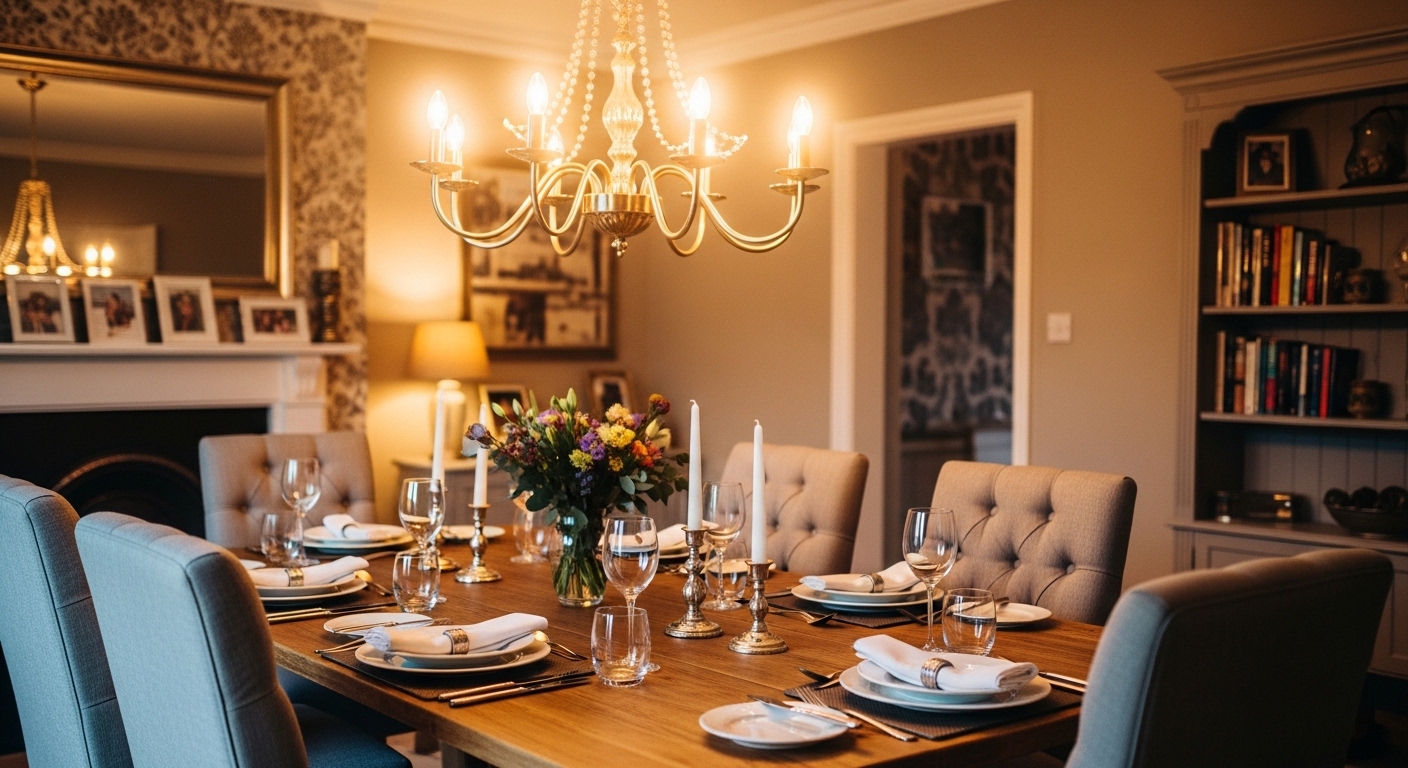
A drum chandelier is a fabric or metal cylinder with the bulbs inside, so from any seat at the table you see a glowing shape and not three bare bulbs at eye level; a candle-style chandelier with exposed bulbs at 32 inches over a table is a row of glare for anyone under 5 feet, which is five people at our table. The drum diffuses, it's one shape instead of twelve arms, and it's survived a roll, a spoon and a balloon. The semi-flush post is where a chandelier belongs and where it doesn't, and over a table is where it belongs.
The size arithmetic
A fixture's diameter should be about half to two-thirds of the table's width, so a 42-inch-wide table takes a 22- to 28-inch drum, and ours is a 24-inch drum over a 42-by-96 table that seats eight. A fixture that's too small over a big table looks like a lamp on a string; too big and it's a ceiling. Length matters too: a long table can take a linear fixture or two drums, and we chose one drum centered because one fixture on one box was the electrician's afternoon and two was the electrician's day.
The height
Thirty-two inches from the table top to the bottom of the drum, which is above the sight line across the table for a seated adult and below the point where the light spreads past the table's edges; the rule is 30 to 36, and 32 is where it lands for a 9-foot ceiling with a family that's mostly seated. The exception is a ceiling over 9 feet, where it goes up 3 inches per foot of ceiling so it doesn't look like it's dropped from a great height. Measure with the table in place and someone seated, and cut the chain after.
The dimmer and the three settings
Full for homework on Saturday mornings and for the once-a-week deep clean. Sixty percent for weeknight dinner with seven people and food to see. Thirty for a weekend dinner or a night with guests, when the room's supposed to feel like a room and not a cafeteria. The dimmer's a $22 slide and it's used at every meal; a dining room with a chandelier and no dimmer is a room that's only ever bright, and bright is the wrong setting for six of seven dinners.
The bulbs
Four 2700K dimmable LEDs inside the drum, 600 lumens each, 2,400 total, which for a 12-by-14 dining room is the whole room's light at full and the table's light at 60 percent; CRI 90 because food is looked at here and a plate of chicken and broccoli should look like one. Four bulbs bought together and changed together, because a drum with one warmer bulb has a bright spot in its side. The bulbs are behind the drum's diffuser and they've been changed once in five years.
The sconces on the buffet wall
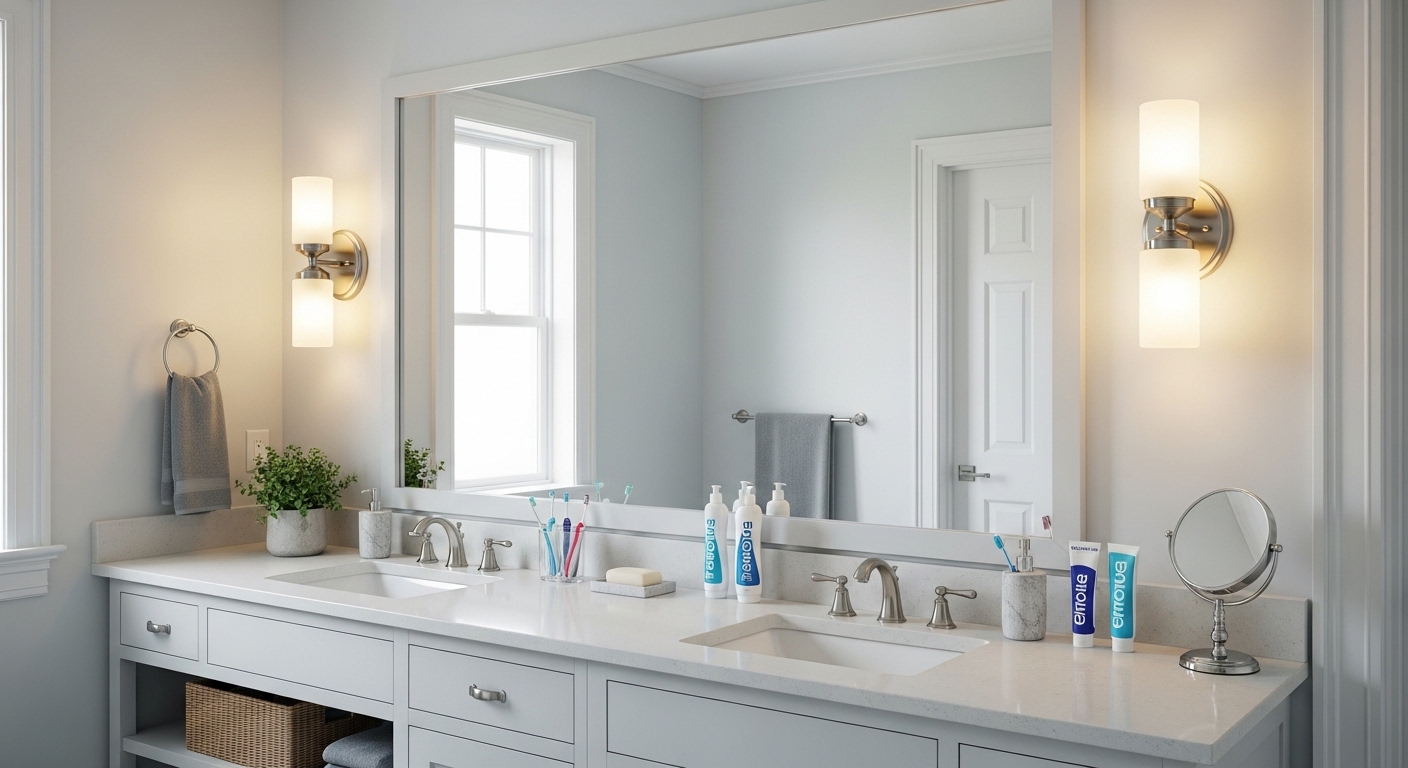
Two wall sconces at 60 inches on the wall behind the buffet, 30 inches apart, on their own dimmer, added in year three when the drum at 30 percent was the only light and the room's walls were black at dinner; they light the wall, the buffet and the 14-year-old's self-portrait above it, and they make the room at 30 percent feel lit rather than dim. A dining room with a chandelier alone is a table in the dark; the sconces are what make the walls part of the room. They're plug-in with cords behind the buffet, because the wall wasn't open.
The finish
A linen drum in oatmeal with a brushed nickel frame, matching the sconces and the kitchen's pendants, which are visible from the table through the opening; a house of five kids is a house of one metal finish per floor, and this floor's is nickel. A dark drum, charcoal or black, in a room with dark walls; a linen one in a room with pale walls and a wood table. The drum's fabric gets vacuumed twice a year with the brush attachment, and in five years it's clean.
The table as the weekend homework table
Saturday morning the table's the project desk: the 12-year-old's science fair board, the 9-year-old's diorama, the 4-year-old's painting on a mat, and the drum at full is 2,400 lumens over 32 square feet, which is a work light. The homework station post is the island on weekdays; the dining table is the big-project version on weekends, and the chandelier at full is what makes it work. A dining room that's only lit for dinner is a room that's empty 22 hours a day.
The fan that came down
The room came with a ceiling fan with a light kit, which is the fixture most family dining rooms have and the wrong one: the light's above the fan blades and dim, the fan's over the food, and the whole thing's at one brightness. It came down the first month, the drum went up on the same box with a brace, and the room's temperature is what the air conditioning's for. A fan over a dining table is the fixture I'd remove first in any house.
The window
The dining room has a west window, which is the best light in the house at 5 pm and a glare at 6 in June; a linen curtain on a rod, drawn at dinner in summer, and the drum at 60 does the rest. The window's why the sconces face away from it, and why the drum's the only light needed until October. Daylight's free and a dining room with a window is lit for breakfast and lunch without a switch.
Sizing for the future table
The table seats eight and it'll need to seat ten when the kids bring people, and the drum's 24 inches is sized for a 42-inch width, which won't change when the table gets a leaf; the fixture's sized to the width, not the length, which is why one drum works for a table that grows. A linear fixture is sized to the length and has to grow with it. That's the argument for a drum over a long family table: the table gets longer and the drum doesn't care.
The room for a birthday
Twelve kids, the table with the leaf in, the drum at full for the cake and at 30 for the singing, the sconces on, the streamers on the drum's frame because it's the one fixture in the house strong enough to hang them from. Five birthdays a year and the drum's been decorated for every one of them, and it's taken a balloon to the side without moving. A family's dining room fixture is a fixture that gets touched, and a drum is the one that doesn't mind.
What we skipped
A candle-style chandelier with exposed bulbs, for the glare. A crystal one, for the cleaning and for the kids. A single pendant, which is a fixture for a table of four. Recessed cans, which light a table like a store. Anything with a pull chain. And a fixture that couldn't take a dimmer, which most cheap chandeliers can't; check the box.
Installing it
A drum chandelier is a fixture on a chain on a canopy, and it's a two-person job on the existing box if the box is braced for the weight; ours is 18 pounds and the builder's box wasn't rated for it, so the electrician added a brace bar, $140, and Matt and the 14-year-old hung the fixture after. The chain's cut with bolt cutters after measuring with the table in place, and the canopy covers the box. An afternoon, and the dimmer's another twenty minutes at the switch.
The dining room off the kitchen, and the two fixtures seen together
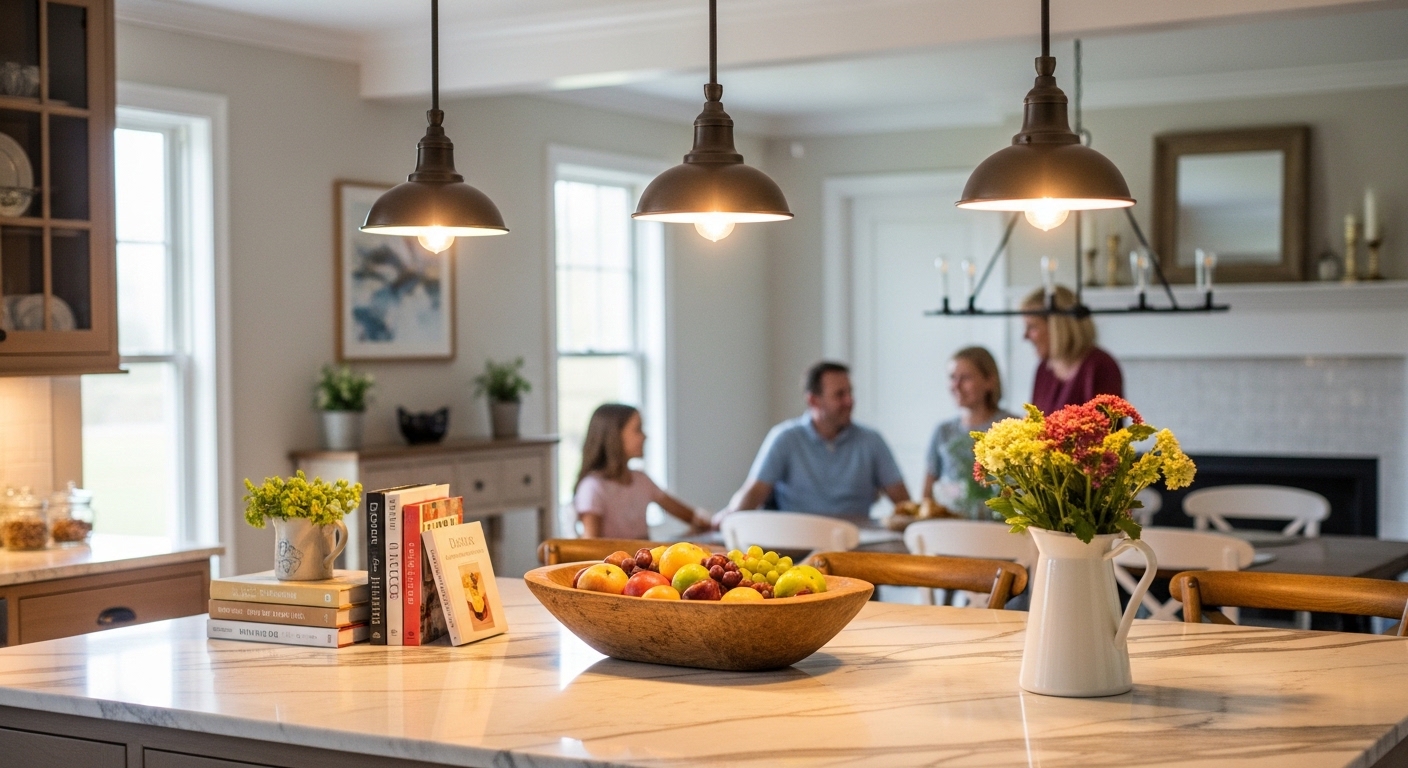
The dining room opens off the kitchen, and from the table you see the island's three pendants through the opening, which is why they're the same finish and the same bulb color; a drum at 2700K and pendants at 3000K, seen at once, is a house with two ideas. At dinner the pendants are at 25 and the drum's at 60, and the two rooms read as one warm room with a brighter table. The island lighting post is the pendants; the rule that they match the drum is in both posts.
Family dinner, which is the point
Seven people at 6 pm, every night we can, which is five of seven, and the drum at 60 percent is the light that says this is dinner and not a snack at the island; the kids notice when the dimmer's at full and ask why, because full means cleanup. A room with a fixture and a dimmer that's used at every meal is a room where the light's part of the ritual, and a dining room lit for the table, and only the table, is a room where the family faces each other. That's what the drum does, and the reason I'd keep it over the kitchen's pendants if I had to choose.
Cleaning a drum
Twice a year with the vacuum's brush attachment, outside and, with the diffuser off, inside; the bulbs wiped at the same time. A linen drum collects dust on its top edge and nothing else, and it's a five-minute job on a stool. A crystal chandelier over a family table is a monthly job with a cloth and a ladder, which is on the list of reasons there isn't one.
The dimmer's setting, by who's at the table
Seven of us, 60 percent. Guests, 40, with the sconces at 50, because adult faces across a table are lit best from below the fixture's full. Kids' birthday, full for the cake and 30 for the singing. Two of us after the kids are down, 20, with the sconces off, which is the setting the dining room gets about twice a year and the one that makes it feel like a restaurant. The drum's one fixture and the dimmer makes it four rooms.
Mistakes
The fan-light, for a month. A candle chandelier in the first house, with a 6-year-old who complained about the lights in her eyes every dinner for a year. Hanging the drum before the table was in, 4 inches off center, and rehanging it. No sconces for three years, and black walls at dinner. And not checking the box for the brace, which was a second electrician visit.
In one paragraph
One drum chandelier, 24 inches over a 42-inch-wide table, bottom at 32 inches above the top, on a braced box. Four 2700K bulbs at CRI 90. A dimmer used at every meal: full for projects, 60 for weeknights, 30 for weekends. Two sconces on the buffet wall on their own dimmer. Brushed nickel and linen. The fan down, the window curtained in June. Five birthdays a year with streamers on the frame, and the one fixture I'd take to every house.
What it cost
The drum chandelier, $240. The brace and the electrician, $140. The dimmer, $22. Four bulbs, $24. Two plug-in sconces, $110, and their dimmer, $14. About $550 for a dining room that's lit for seven dinners a week and five birthdays a year, and the dimmer's the $22 that's been touched two thousand times.
Shop this post: wall sconces for the buffet wall, and pendant lights for a table of four