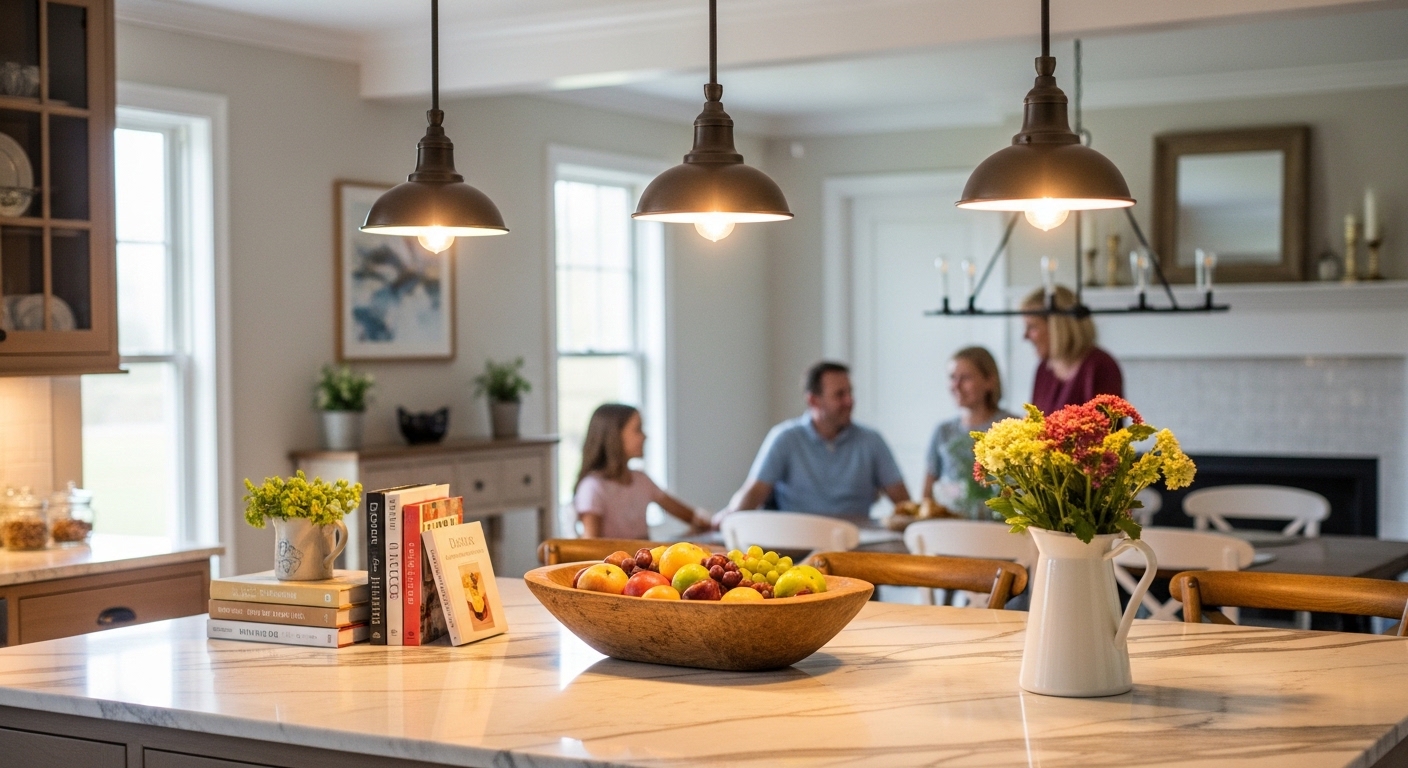
Kitchen island pendant lighting for a big family is three pendants over an 8-foot island, 30 inches apart, bottoms at 32 inches above the counter, 800 lumens each at 2700K, on their own dimmer circuit, with shades that close over the bulb so nobody at the far end is looking into a filament, and it's the best decision in our whole renovation. Our island is 8 feet after we added 18 inches, seats four on one side, and is the prep counter at one end and the homework desk at the other, and the three pendants light both jobs. This post is the number of pendants and the arithmetic, the spacing and the height, the lumens for a work island, the shade rule and the glare, the dimmer and its own circuit, the finish that survives fingers, the size of each pendant relative to the island, the bulb, the pendants at three times of day, the two ends and their two jobs, the pendants and the overhead fixture that's still too dim, what to skip, cleaning, mistakes, and the cost.
How many pendants
One pendant per 30 to 36 inches of island, rounded down, with the outer ones 12 to 15 inches in from the ends: an 8-foot island gets three, a 6-foot gets two, a 10-foot gets three big or four small. Ours are 30 inches apart, with 15 inches from each end to the outer pendant's center, which lights the whole counter with no dark band at the ends where the stools are. Two on an 8-foot island leaves the ends dim and a kid doing homework at the end in the shadow, which was the first plan and which the electrician talked us out of.
Spacing and height
Thirty inches center to center, and the bottom of each shade at 32 inches above the counter, which for a 36-inch counter is 68 inches off the floor: above the eye line of a seated adult and below the line of sight across the island for a standing one, so Matt at 6 feet sees over them and I at 5 foot 5 see under. The rule is 30 to 36 inches above the counter; we're at the low end because the shades point down and the light needs to reach the board. Measure with the stools in and someone sitting on one before the electrician cuts the cords.
Lumens for a work island
An island that's a prep counter and a desk needs about 40 lumens per square foot of its top, so an 8-by-3 island needs about 1,000 at the surface, which is three 800-lumen pendants at full with the loss to the shades. At 50 percent it's a dinner-serving light, at 25 it's the after-dinner glow. An island lit for looking at is 400 lumens; an island lit for chopping and fractions is 2,400 on a dimmer, and the dimmer is what lets it be both.
The shade rule
A shade that closes over the bulb from the side: a metal dome, an opaque cone, a frosted glass cylinder, so that a person seated at the island's end looking across it sees the shade and not the bulb. A clear glass globe with an exposed bulb is a pendant for a photograph, and at 68 inches over a counter where five kids sit it's a bare bulb at eye height for a 9-year-old on a stool. Ours are 10-inch metal domes in brushed nickel, and the light goes down and the glare goes nowhere. The island pendant review is the fixtures we tested.
The dimmer and its own circuit
The three pendants on their own circuit and dimmer, separate from the under-cabinet strips and the overhead, which is the three-circuit plan from the renovation post and the $800 to the electrician that I'd pay twice. Before, one switch ran everything; after, the pendants can be at full for homework while the strips are off and the overhead is off, or at 25 for the evening while the strips do the dishes. Three circuits is the difference between a kitchen that's on or off and a kitchen that's set.
The finish
Brushed nickel, matching the faucet we should have chosen instead of polished chrome; the pendants hang where hands reach up to adjust them and where steam from the stove drifts, and brushed nickel wipes clean and shows nothing. Matte black works with a white kitchen and shows dust on the top of the dome; brass warms a kitchen and needs polishing where fingers go. The finish choice is the same as every other fixture in a house with five kids: the one that hides.
Pendant size relative to the island
A pendant's diameter in inches should be about the island's width in feet times 3 to 4, so a 3-foot-wide island takes 9- to 12-inch pendants, which is our 10-inch domes. Smaller looks like three bulbs on strings; bigger and three of them read as a ceiling. If the island's 4 feet wide the pendants go to 12 to 14 inches and there are three, or two at 16. The size is what makes three pendants read as one fixture, and the review post has the sizes we tried.
The bulb
2700K, 800 lumens, dimmable, an A19 in the standard socket, CRI 90 because food is prepped under it and the 9-year-old's produce job needs true color. Three identical bulbs bought together, because a pendant row with one different bulb is the thing everyone notices and nobody can name. A pendant at 3000K over an island is fine in a kitchen that's mostly work; ours is also dinner, and 2700K on the dimmer at 25 percent is the dinner light.
Three times of day
Seven am: pendants at full, strips at full, five lunches down the island in a line. Four-thirty: pendants at full, the two oldest at the far end with math, me at the sink end with onions, strips on over the stove. Seven pm: pendants at 25, strips off, overhead off, dinner served from the island's far end and a kitchen that's a warm room instead of a work room. Same three fixtures, three settings, and the dimmer's the switch that makes the kitchen change jobs.
The two ends
The sink end is prep and the far end is homework and serving; the outer pendant at each end lights its job, and the middle one lights the middle where the stools are. The homework station post is the far end; the kitchen organization post is the zones the island sits in. An 8-foot island is two rooms, and three pendants light two rooms in a way that two pendants don't.
The overhead that's still too dim
The original flush mount in the center of the kitchen ceiling is on its own switch, 1,200 lumens, and it's the kitchen's weakest light; it's on the list to become a 2,500-lumen flush mount, and it's stayed on the list for two years because the pendants and the strips made it unnecessary. A kitchen with island pendants and under-cabinet strips can have a bad overhead and nobody notices, which is the argument for spending on the pendants first.
What to skip
A single linear fixture over an 8-foot island, which lights the middle and not the ends and can't be dimmed in zones. Clear globes with exposed bulbs. Pendants hung at 36 inches or higher, which put the light on the top of everyone's head. A fourth pendant, which on 8 feet is crowded. Mixed finishes, one brass and two black, which is a store. And any pendant that needs a ladder to change the bulb, because with five kids it'll be changed while a kid's eating under it.
Cleaning
Monthly, the domes wiped inside and out with a damp cloth from a step stool, because a metal dome over a stove-adjacent island collects a film; the bulbs wiped at the same time, because a dusty bulb is a dim bulb. Ten minutes, the 14-year-old's chore, and pendants that are five years in and look like the showroom.
The pendants during the renovation
The pendant boxes went into the ceiling before the drywall closed, on their own circuit, at the marks I'd taped on the subfloor with the island's outline; the electrician set the cords long and cut them to 68 inches after the counter was in, with a stool and the 12-year-old sitting on it. The order is: island position, then pendant marks, then boxes, then drywall, then counter, then cord length. A pendant hung before the island's final position is a pendant that's 6 inches off, and the review post's first fixture was.
Pendants in a kitchen with a low ceiling
An 8-foot ceiling with a 36-inch counter leaves 60 inches, and pendants at 32 inches over the counter would hang at 68, which is fine, but the cord's only 16 inches and the pendant reads as a flush mount on a string; the answer is a shorter, wider pendant, a 12-inch shallow dome, or a semi-flush linear over the island's center with two small pendants at the ends. Our ceiling's 9 feet and the domes have 28 inches of cord; a friend's 8-foot kitchen took the shallow domes at 30 inches over the counter and it works. The rule that doesn't bend is the 30-inch minimum over the counter, because below that a pendant's a thing a standing person's forehead finds.
Pendants over an island with a sink or a cooktop
An island with a sink gets the same three pendants, and the middle one sits over the sink at 32 inches, where it lights the dishes and stays out of the splash; an island with a cooktop needs a hood, and the pendants go either side of it, two instead of three, at 34 inches to clear the steam. Ours has neither, which is why it's a prep and homework island and why three pendants at 32 worked. The kitchen organization post is why the sink stayed on the wall.
The pendants and the stools
Four stools on the long side, and each stool's seat is under the gap between pendants or under a pendant's edge, never under its center, because a pendant centered over a stool lights the top of a kid's head and shadows her plate; the 30-inch spacing over an 8-foot island with 24-inch stool spacing means every stool's plate is lit from two pendants at an angle. Draw the stools on the subfloor tape with the island; it's the detail that makes the far end a homework desk instead of a dark seat.
The pendants as the kitchen's after-hours light
At 9 pm the pendants are at 10 percent and they're the only light in the kitchen, enough to find a glass of water and not enough to wake anyone up through the hall; it's the same job the hallway sconces do at 20, and it's why the pendants' dimmer is a smart one on the house's night schedule. A kitchen with one overhead is a kitchen that's either bright or black at 9 pm; a kitchen with pendants on a dimmer has a night setting, and a kid getting water after bedtime doesn't need a switch.
Mistakes
The first plan, two pendants, and a dark far end on paper. Clear globes in the first house, and a 9-year-old's complaint about the bulb. Pendants at 36 inches in the first house, lighting hair. And the polished chrome faucet under three brushed nickel pendants, which is the mismatch I look at daily.
In one paragraph
Three pendants on an 8-foot island, 30 inches apart, 15 in from the ends, bottoms at 32 inches over the counter. Closed metal domes, 10 inches, brushed nickel, 800-lumen 2700K bulbs at CRI 90. Their own circuit and dimmer: full for lunches and homework, 25 for dinner. Marks on the subfloor before the drywall, cords cut after the counter. The best decision in the house, and the overhead's still on the list.
What it cost
Three pendants, $285. The circuit and dimmer as part of the electrician's $800 three-circuit job, call it $300 of it. Bulbs, $18. About $600 for the island's light, on a renovation that cost sixty times that, and it's the $600 everyone who visits comments on.
Shop this post: kitchen pendant lighting and pendant lights with closed shades