A drop zone is the spot inside the door where everything that comes in or goes out of the house lands, keys, bags, mail, the library books, the permission slip, and the reason ours works is that it's small, lit, and has exactly one place for each thing. For fifteen years the answer to "where are my keys?" in this house was "I don't know." Coat pocket, counter, car, on top of the refrigerator for reasons nobody can explain. Same for permission slips, library books, the 12-year-old's retainer, and anything else that had to leave the house on a schedule. We built a drop zone by the back door three years ago, for about $210. Keys have been lost twice since, and both times they weren't in the drop zone, which is the whole argument. This post is the build with measurements, the seven-hook rule for a family of seven, the three baskets and what goes in each, the motion-sensor light that makes it work, the drop zone ideas that didn't survive, and how to set one up in an entryway with no wall to spare.
Where the drop zone goes, and why not the front door
At the door the family actually uses, which in our 1960s ranch is the back door from the driveway into the mudroom hall, not the front door that guests use twice a year. A drop zone at the wrong door is a shelf that collects dust. The wall it's on is the first wall you touch coming in, on the right, before the kitchen, so a bag can come off a shoulder and a key can come out of a hand before the coat's off. If you have a mudroom, it goes there, on the wall opposite the bench and cubbies. If you have a hall, it goes on the wall nearest the door. If you come in through the garage into the laundry room, it goes in the laundry room, and the front hall gets a mirror and nothing else.
The physical build
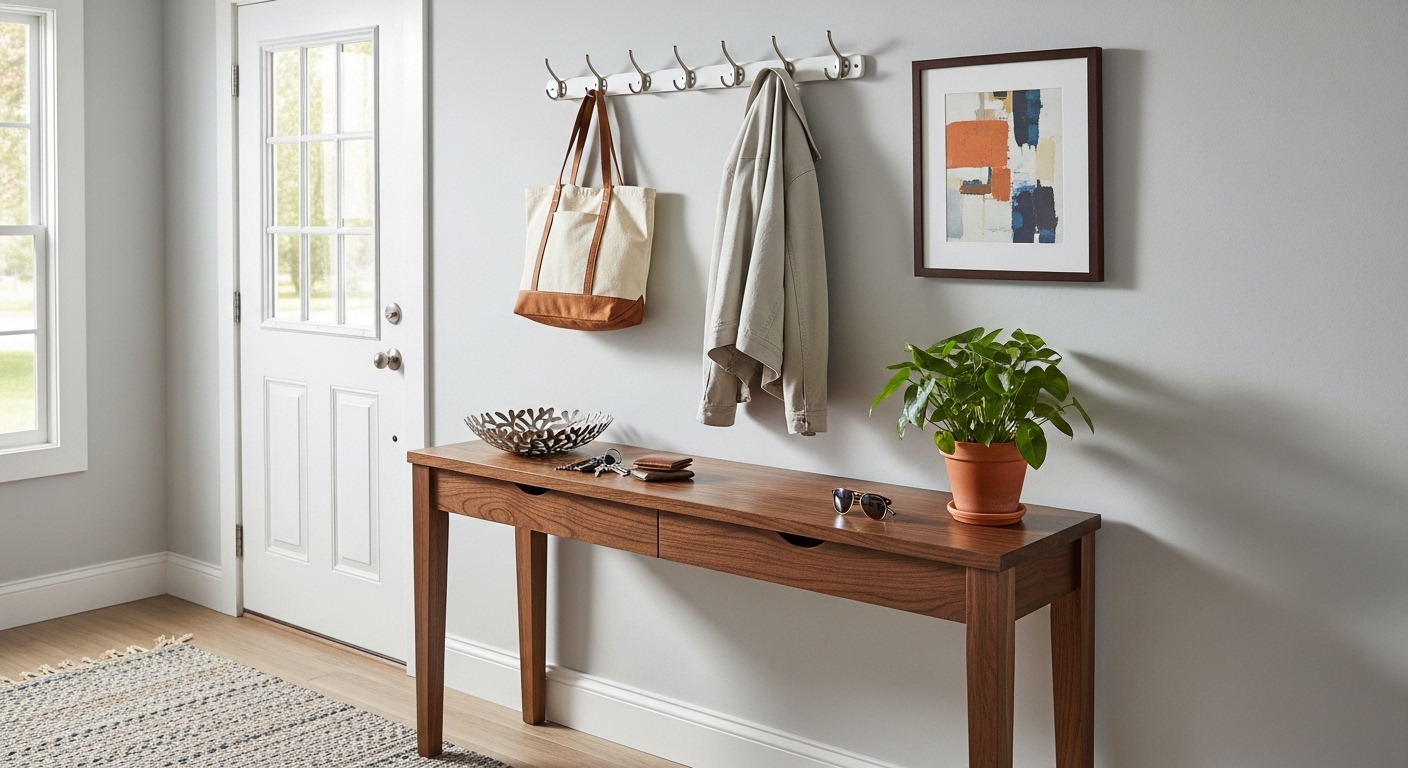
A floating shelf, 36 inches wide and 10 inches deep, mounted at 42 inches from the floor, which is counter height and the height at which an adult drops something without bending and a 9-year-old can reach. Seven hooks on a rail below it at 34 inches, one per family member with a small name tag above each, plus one household hook at the right end for the dog's leash. Three small baskets on the shelf, left to right: incoming mail, outgoing mail, and "needs action today," which is the permission slip, the library book, the check for the field trip. A key hook on the right end of the shelf, a single brass hook, for car keys only, always the same hook; the house keys live on the family hooks with the bags. A small tray at the left end for sunglasses and the mail key. The 4-year-old's hook is the lowest, at 30 inches, on its own, because a hook she can reach is a hook she uses.
The seven-hook rule
One hook per person, labeled, and nothing else on it. A backpack on a hook you own is a backpack you can find at 7:10 am; a backpack on a pile of five backpacks is a search. This is the same rule as a classroom cubby, and it works for the same reason: ownership. When the 7-year-old's hook is empty at bedtime, the backpack is somewhere it shouldn't be, and we go find it then rather than in the morning. The rule that took a year to enforce is that a hook holds one bag and one coat, and the second coat goes in the closet; in a house with five kids the hooks otherwise turn into a wall of fabric and the drop zone becomes a closet without a door, which is what our hallway was for fifteen years.
The three baskets, and the daily sort
Incoming mail: everything that comes through the door that isn't for a kid, dropped without looking. Outgoing: anything going to the post office or to school in an adult's hand, stamped and ready. Needs action today: the basket I empty every evening at the command center after dinner, which is where the slip gets signed and the date goes on the board. The baskets are shallow, 4 inches, on purpose; a deep basket holds a month of mail and a shallow one holds a week and forces the sort. Anything in "needs action" for more than two days gets done or recycled. Library books have a fourth basket on the floor under the shelf, because they're heavy and because the fines were the thing that finally made me build this.
The light that makes the drop zone work
A wall sconce above the shelf at 66 inches, on a motion sensor, 2700K. When anyone comes through the door, the light comes on before the door closes behind them, and the shelf, the hooks and the baskets are lit before the coat's off. The items that need to be deposited are visible, so they get deposited; the things that need to leave are visible, so they leave. Before the sconce, the drop zone was in the shadow of the hall light and the keys went on the kitchen counter under the pendants because that's where the light was. Nothing misses the drop zone anymore because the drop zone makes itself visible, and I'd put the sensor sconce ahead of the shelf if I could only do one. It's the same principle as the light over the mudroom cubbies: lit surfaces get used and dark ones get walked past.
The morning and the evening, as they actually go
Evening: bags on hooks by the kid who owns them (chores chart, from age 7), tomorrow's things in the "needs action" basket, keys on the key hook by whoever drove. I sort the baskets after dinner, ten minutes. Morning: the sconce comes on at 6:40 when the first kid comes down, each kid takes their bag from their hook, the adult driving takes the keys from the key hook and the outgoing basket's contents, and the 4-year-old takes hers from the low hook with the seriousness of someone leaving for a business trip, which is how a 4-year-old treats preschool. Twenty-one hook-checks a week times five kids, and the number of forgotten library books in three years is two, which the fines say is down from about thirty.
What goes in a drop zone, and what doesn't
In: keys, bags, one coat per person in season, the mail, the outgoing things, library books, the dog's leash, sunglasses, the mail key, and for one week in August, the school supply lists. Out: shoes (rack in the mudroom), phones (kitchen), water bottles (dishwasher, then the shelf by the fridge), sports equipment (garage, with a basket per sport), lunch boxes (kitchen counter, unpacked the same evening), and anything that's staying in the house for more than a day. The test I use is the one from the classroom: is it coming in or going out? If it's neither, it's not a drop zone item, it's clutter with a bag strap. The zone holds the house's traffic, not its inventory, and the day it starts holding inventory is the day it stops working.
Teaching five kids to use it
Two weeks of walking each kid to their hook, by hand, every afternoon, the way I'd teach a cubby routine in September. A name tag, at their eye level, in their color from the command center. The rule that a bag not on its hook at bedtime is found before bed, not in the morning, which is the consequence that makes the habit. Praise for the hook, never the pile, and never in front of the sibling who missed. The 14-year-old was the last to comply and the first to complain when her sister used her hook, at which point I knew it had taken. Ages 4 and 7 took about a week; 9 took a month; 12 and 14 took the two weeks of walking plus a month of reminders. After that, nothing. A system that needs reminding forever isn't a system, and this one stopped needing it around the sixth week, which matches every routine I ever taught to a class.
Seasonal changes
In winter the hook rail holds coats and the bags go on a second rail I add below it at 26 inches, because a winter coat and a backpack on one hook is a 9-pound lump that pulls the rail; the second rail is $18 and lives in the garage from April to November. In summer the baskets hold sunscreen and pool cards instead of permission slips. In August the "needs action" basket is replaced by a bigger one for two weeks while the school forms come in, and the whole zone gets the same reset as everything else in the back to school reset: new name tags, a wipe, a fresh bulb in the sconce. That's the only maintenance the drop zone has ever needed, which is more than I can say for the corkboard it replaced.
Drop zone ideas that didn't survive
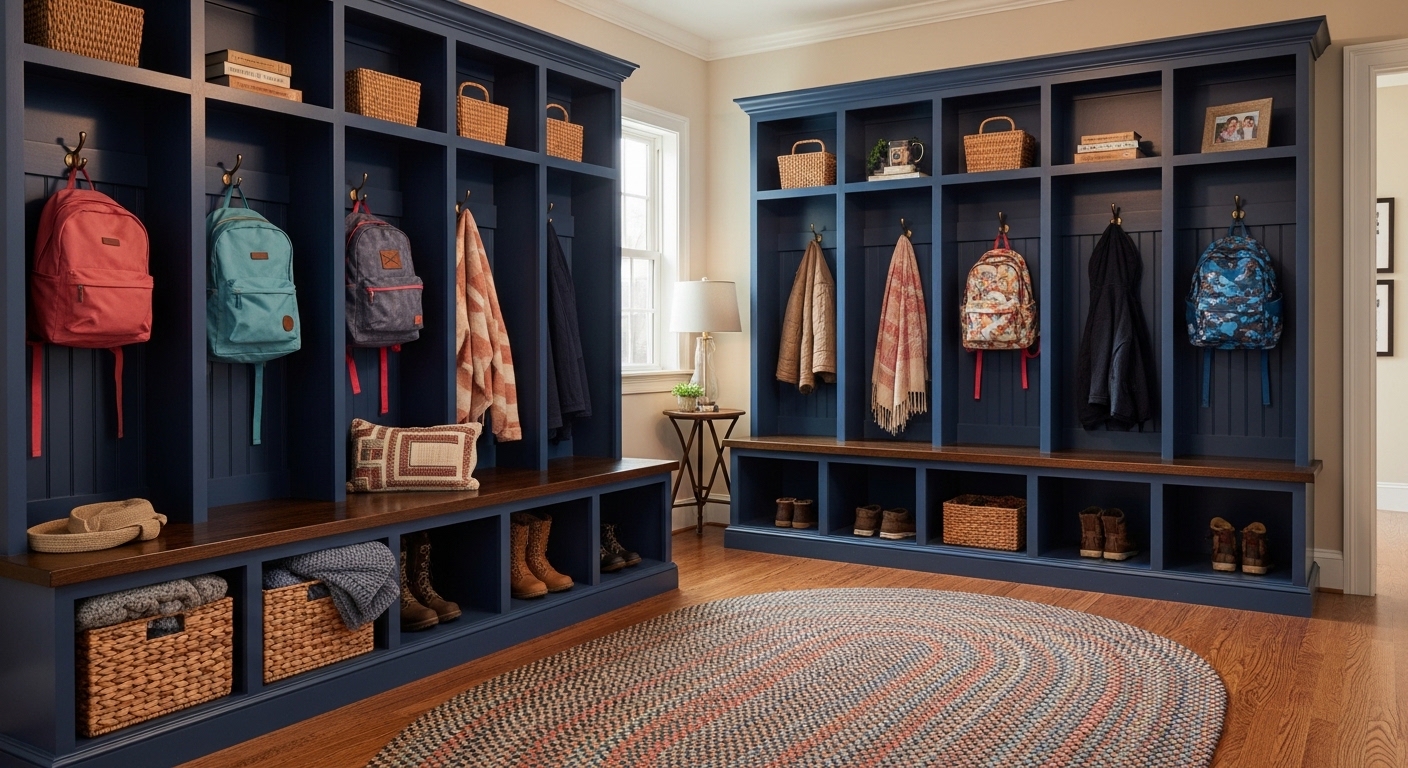
A charging station on the shelf, which turned the drop zone into a phone pile and the mail into a phone pad; phones charge in the kitchen now. A bench under the hooks, which became a shelf for shoes and then for everything; shoes have a rack by the bench in the mudroom and the drop zone floor is bare except for the library basket. A chalkboard "message center" on the wall beside it, which nobody read because the command center already exists and one board is enough. A basket per kid instead of a hook per kid, which filled with things that weren't going anywhere. And an open-front cubby unit, the classic mudroom lockers, which I'd loved in photos and which cost $1,400 and which would have been a very tidy place to lose things; the shelf-and-hooks version is $210 and the things on it are all visible.
An entryway drop zone with no wall to spare
A 24-inch version works: shelf at 42 inches, four hooks, two baskets, one sconce, on the side of a cabinet or the wall behind a door that opens the other way. In an apartment with a hallway 36 inches wide, a shallow floating shelf 6 inches deep with a hook rail under it and a rechargeable sensor sconce above, no wiring, and the baskets replaced with a single tray. The rule that doesn't change at any size: one hook per person, one place for keys, one light, and the drop zone at the door people actually use. A friend with two kids in a 900-square-foot townhouse has the 24-inch version inside her front door and says it's the best $90 in the house, which is about what the sconce, the shelf and the hooks cost, and less than one year of the library fines it replaced.
What it cost, and the three-year report
Floating shelf, $48. Hook rail with seven hooks, $34. Brass key hook, $9. Three baskets, $27. Library basket, $16. Name tags, $8. The sconce and the motion sensor switch, $68 plus an hour of the electrician who was already at the house for the kitchen. About $210. Three years: keys lost twice, both times found in a coat pocket in the car, neither time in the drop zone. Library fines, down from something I'm embarrassed to print to under $5 a year. Permission slips missed, zero since the "needs action" basket. The hook rail has held a combined weight I don't want to calculate, and the 4-year-old's low hook is the single most-used object in the house. If you're building one thing from this blog, build this, and light it.
Shop this post: wall sconces for a drop zone and rechargeable wall sconces for entries without wiring