Kitchen organization ideas for a family that cooks three meals a day for seven people come down to zones by task, everything a kid uses at kid height, and one drawer per job, and the layout matters more than any container you can buy. I plan around the sentence "three meals a day for seven people," which is 21 meals a week, about 60 plates a day and a dishwasher run every night, and the kitchen is organized so that the three most-used things in each zone are the easiest to reach. This post is the five zones and what's in each, the prep zone and the knife rule, the cooking zone and the pan drawer, the serving zone and the plate stack, the kids' zone at 36 inches and why it's the one that changed the mornings, the cleanup zone and the dishwasher rule, the pantry's link to the kitchen, the drawer-per-job rule, the counter rule, the island's two ends, the labels, the light on every zone, what we got rid of, the weekly reset, mistakes, and the cost.
Start with the Monday
Before any container, I walked a Monday: breakfast for seven at 6:45, five lunches packed by 7:20, dinner prep at 4:30 with homework at the island, dinner at 6, cleanup at 6:45. Every place I crossed the kitchen twice for one job went on a list, and the list, not the mood board, is what the zones came from. It's how I planned a classroom: watch the day, mark the friction, move the supplies. The renovation post has the layout the walk produced; this is what's in the drawers.
The five zones
Prep, between the sink and the stove, 4 feet of counter. Cooking, the stove and the 2 feet either side. Serving, the counter by the dining room door. Kids, the lower cabinets and the drawer at the island's end. Cleanup, the sink, the dishwasher and the trash. Everything in the kitchen belongs to one zone, and a thing that's used in two zones lives in the one it's used in first. The zones are 3 to 4 feet apart, which is one step, and a kitchen where every job is one step is a kitchen where seven people can be in it at once.
Prep: the knife rule and the three things
A knife block on the counter against the backsplash, out of the 4-year-old's reach, which is the one thing that stays on the prep counter; cutting boards in a vertical rack in the cabinet below; a drawer of prep tools, peeler, grater, measuring cups and spoons, in a divided insert. The three most-used things, the chef's knife, the big board and the salt, are within a hand's reach of the prep spot without opening anything. Everything else in the prep zone is one drawer or one door away, and nothing prep-related is across the kitchen.
Cooking: the pan drawer
A deep drawer under the stove for the six pans we use, standing on edge in a rack, lids in a rack on the door of the cabinet beside it; oils, salt and pepper in a tray on the counter to the right of the stove; spatulas and tongs in a crock to the left. The pan drawer is the one where the cheap organizer, a $14 wire rack, made the biggest difference, because six pans stacked is a landslide and six pans on edge is a filing cabinet. Spices in a drawer insert beside the stove, alphabetical, which the 9-year-old maintains.
Serving: the plate stack and the island's end
Plates, bowls and cups in the upper cabinet nearest the dining room door, in stacks of eight, because seven people plus one; the everyday set is the only set that lives in the kitchen, and the good dishes are in the dining room. The island's dining-room end is the serving counter: dinner goes there in its pots and everyone fills a plate, which is how seven people eat without a waiter. The dining room post is where the plates go next.
The kids' zone at 36 inches
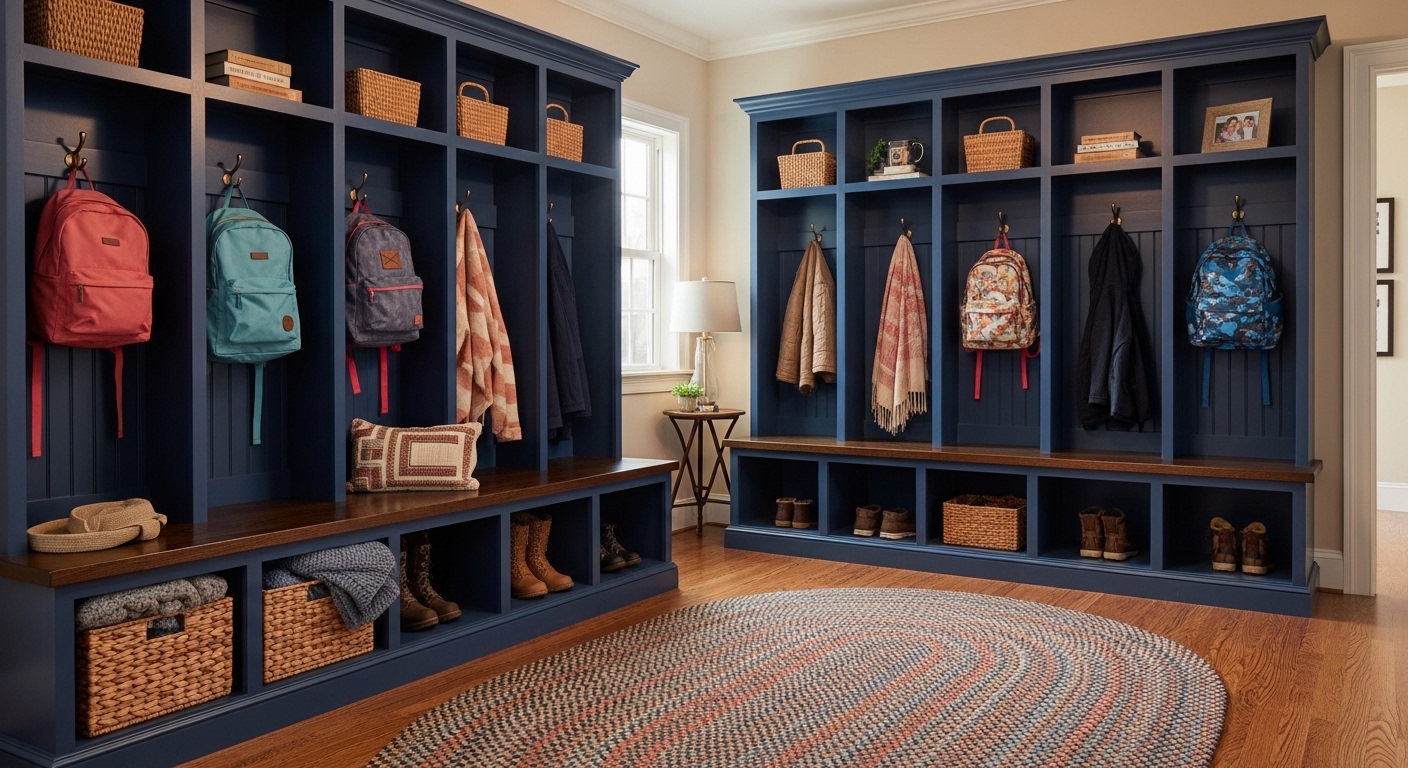
One lower cabinet and one drawer, at the island's far end, with the kids' plates and cups, the cereal, the snack bins, the water bottles and the lunch containers; everything a kid under ten needs to get breakfast or pack a lunch without asking, at a height the 4-year-old reaches. It's the zone that changed the mornings: the 7- and 9-year-olds pour their own cereal and pack their own lunches from the bins, and I'm at the stove instead of the cabinet. A kid who can reach the cup gets his own water, which in a house of five kids is a hundred "can I have" a week.
Cleanup: the dishwasher rule
The dishwasher's beside the sink, the trash and recycling in a pull-out beside that, and the rule is that the dishwasher is always either running or open for loading, never full and clean with dishes waiting on the counter; whoever's on dishes empties it at 7 am and it runs at 7 pm. Dish towels in the drawer above, soap under the sink, and the compost bin on the counter by the sink. A cleanup zone that's one step from the table is a cleanup that gets done; the 12-year-old clears in four minutes.
The pantry link
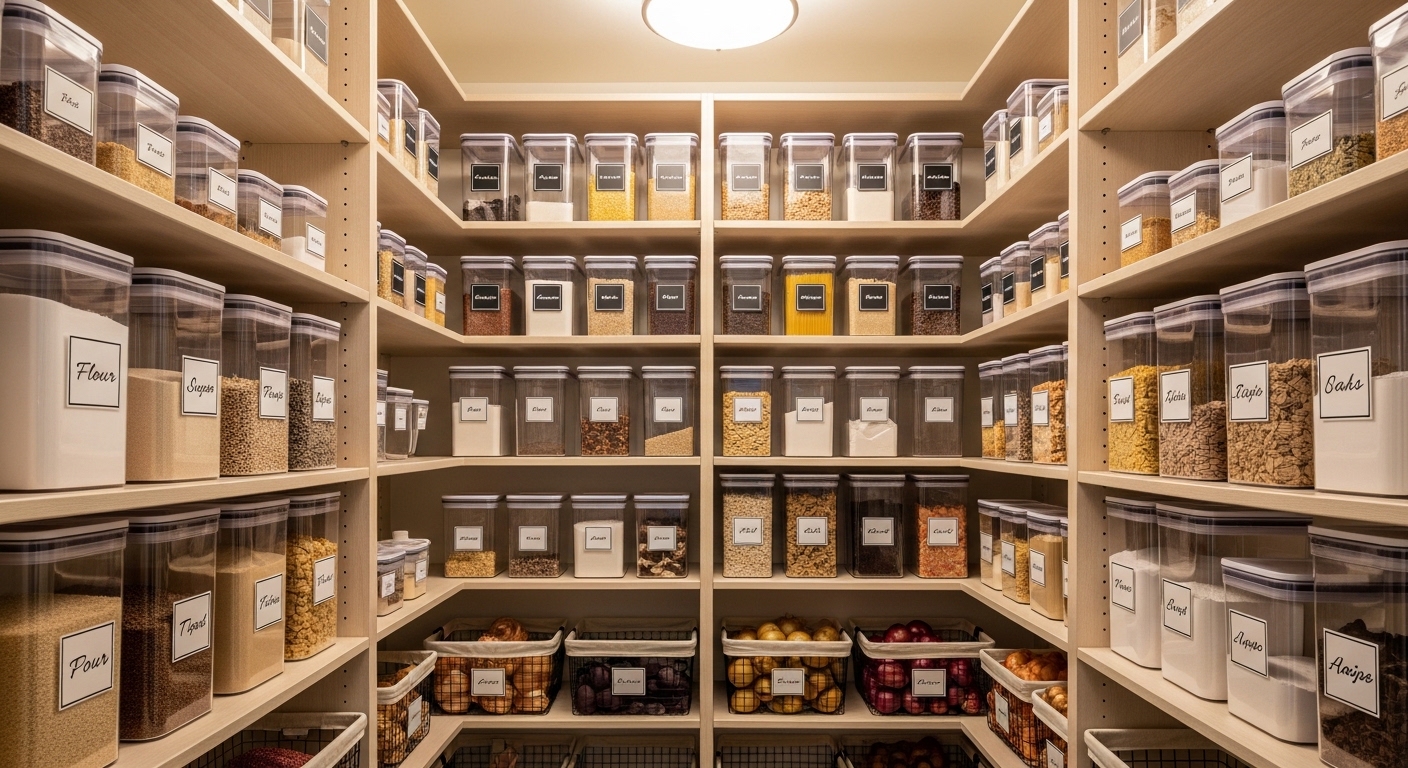
The pantry's the room off the kitchen and it's its own post, the pantry post; the link is that the kitchen holds one week of everything and the pantry holds the backup, so the kitchen cabinets never overflow. Flour and sugar in the kitchen in canisters; the 25-pound bags in the pantry. Cereal in the kids' zone; the six spare boxes in the pantry. Snacks in two bins in the kids' zone; the bulk in the pantry. The kitchen is the front and the pantry is the stockroom.
One drawer per job
Every drawer has one job and a label inside its front edge: prep tools, cooking tools, spices, foil and wrap, dish towels, lunch containers, kids' cups, the junk drawer, which is allowed to exist as long as it's the only one. A drawer with two jobs is a drawer that gets rummaged, and rummaging is what makes a kitchen feel disorganized even when nothing's on the counter. The label inside is for the kids and for Matt, who puts things away and needs the rule written down.
The counter rule
Five things on the counter, and it's a list: the knife block, the oil tray, the utensil crock, the coffee maker and the fruit bowl. The stand mixer lives in the cabinet on a lift. The toaster's in the pantry on the appliance shelf. A counter with five things is a counter that's wiped in one pass and has 8 feet of prep, and a counter with fifteen is a counter that's cleaned around. In a kitchen that feeds seven the counter is the workspace and it's kept the way I kept a desk in a classroom.
The island's two ends
The island is 8 feet after we added 18 inches, and it has two jobs: the sink end is prep, and the far end is homework and serving. The two older kids do homework at the far end at 4:30 while I prep at the sink end, and the three island pendants on their dimmer light both, at full for prep and 50 for homework. The homework station post is that end; the island lighting post is the pendants.
Labels
Inside every drawer and on every bin, in the label maker's plain font, and on the kids' zone at 36 inches in pictures for the 4-year-old, a cup drawn on the cup drawer. The classroom rule: a label is a substitute for a person standing there saying where it goes. Labels are also what let a babysitter or a grandparent run the kitchen for a weekend without a tour.
Light on every zone
LED strips under every upper cabinet, on a dimmer, so every zone's counter is lit from the front; the three pendants over the island; the overhead flush mount, still too dim, on its own switch and on the list. Three circuits, three switches, the electrician's $800 that I'd pay again. A kitchen zone without light on it is a zone that gets used less, and before the strips the prep counter was the darkest 4 feet in the kitchen, which is why prep happened on the island, which is why the island was always covered.
What we got rid of
The second set of everyday dishes. Four of the ten pans. The juicer, the bread machine and the rice cooker, to a cousin. Twelve mugs of the thirty. The plastic storage that didn't have lids. Every duplicate spatula. The kitchen holds what seven people use in a week and nothing else, and what left filled two boxes for the church sale. Getting rid of things is the organization; the containers are just where what's left sits.
The weekly reset
Sunday afternoon, thirty minutes: the fridge cleared and wiped, the kids' zone restocked from the pantry, the lunch containers counted, the counter's five things wiped, the spice drawer straightened, and the meal plan on the fridge. It's the reset the command center runs on, and thirty minutes on Sunday saves a chaotic Wednesday. The 12-year-old does the fridge, the 9-year-old the kids' zone, and it's on the chore chart.
The fridge, which is a zone too
Top shelf: leftovers in clear containers with a tape date, because a leftover you can't see is a leftover you throw out. Second shelf: the week's prepped things, the washed produce in bins, the marinating chicken. Door: condiments, alphabetical, because the 9-year-old set it up that way and it's held. Bottom drawer: the kids' zone again, cheese sticks, yogurts, the cut fruit, at a height the 4-year-old opens. The fridge is cleared and wiped Sunday and it's the zone with the most turnover, so it's the one with the strictest rule: nothing goes in without a container or a label.
Lunch packing as an assembly line
Five lunches at 7:10 is an assembly line or a disaster, and the line is: containers out of the kids' drawer, the main from the fridge's second shelf, the fruit from the bottom drawer, the snack from the bin, the water bottle from the kids' cabinet, in that order, down the island. The 7- and 9-year-olds pack their own from the line; the 12- and 14-year-olds pack theirs the night before; I pack the 4-year-old's. Twelve minutes for five lunches, and it's the zone system working at its hardest, because every item is one reach from the line.
Where the tools that aren't daily live
The turkey roaster, the cake stands, the ice cream maker, the twelve serving platters: on the top shelf of the pantry and in the dining room's buffet, not in the kitchen, because the kitchen is for the week and those are for the year. A kitchen that holds Thanksgiving every day is a kitchen with no room for Tuesday. The rule for a thing in a kitchen cabinet is "used this month," and the things that fail move out and come back for their day.
Mistakes
Three years of the kids' cups in an upper cabinet, and three years of "can I have." A prep zone across from the stove instead of beside it, in the old kitchen. The stand mixer on the counter, where it was a shelf for mail. Two junk drawers. And organizing the containers before getting rid of anything, in the first house, which is organizing a pile.
In one paragraph
Walk a Monday and list the friction. Five zones, one step apart. The knife block and three things in prep, pans on edge in cooking, plates in stacks of eight by the dining room door, a kids' zone at 36 inches for cups and cereal and lunches, the dishwasher always running or open. One drawer per job with a label. Five things on the counter. Light on every zone. Get rid of the duplicates first. Thirty minutes on Sunday. A kitchen that feeds seven three times a day and isn't covered at 7 pm.
What it cost
Drawer inserts and dividers, $120. The pan rack and lid rack, $32. Bins for the kids' zone, $40. Canisters, $60. The label maker, $35. The mixer lift, $90, installed by Matt. About $380 for the organizing on top of the renovation, and the kids' zone's $40 of bins is the part that gave me back the mornings.
Shop this post: kitchen pendant lighting for the island's two ends