Garage organization ideas for a big family come down to three rules: divide by category and by how often it's used, get everything off the floor onto walls and shelves, and light the place so you can find things, and the third rule is the one nobody's garage organization post mentions. Ours is a two-car garage that held zero cars for the first three years we lived here, because seven people's bikes, balls, strollers, coolers and Christmas decorations were on the floor in a layer, and it took one Saturday, about $600 and two LED shop lights to get both cars back in. This post is the zones we set up, the wall track system for the bikes, the fourteen labeled bins and the rule about them, the steel shelving and what goes on which shelf, the sports equipment wall, the seasonal rotation to and from the attic, the kid-height hooks, the donate-one-in-one-out rule, the lights and why we should have hung them first, the workbench that's Matt's, the mistakes, and what it cost.
Start with the floor empty
Everything out onto the driveway, on a Saturday when Matt had the kids at the pool until 2. It's the classroom trick: you can't organize a room you can't see, and a garage full of stuff has no walls, only piles. With the floor empty I could see the outlets, the studs, the one window and the water heater's corner, and the plan drew itself: bikes on the wall to the left of the door, shelving along the back wall, sports gear on the right, and the cars in the middle with 30 inches between them. Four hours of carrying, and the sorting on the driveway happened as things came out: keep, donate, trash, and "ask a kid."
The zones
Five zones, one per wall and one for the ceiling. Bikes and scooters on the left wall on a track. Shelving on the back wall: bins above, coolers and camping below. Sports equipment on the right wall in a rack and two mesh bins. Seasonal on the ceiling-hung platform over the hood of one car. Matt's workbench and tools in the far right corner. The zones are by category first and by frequency second: the bikes are used daily and they're by the door; the Christmas bins are used once a year and they're on the ceiling. Nothing is stored where it isn't used, which is the rule the garage broke for three years.
The bike wall
Seven bikes and three scooters, on a horizontal track with hooks, $65 for the track and $4 a hook, screwed into studs at 16-inch centers. The kids' bikes hang vertically by the front wheel at heights the kids can reach: the 4-year-old's at 36 inches, the 7- and 9-year-olds' at 48, the 12- and 14-year-olds' at 60, and Matt's and mine at 72. A kid who can hang up her own bike does; a kid who has to ask leaves it in the driveway. The scooters hang by their handlebars on the same track, and the helmets on hooks below each bike, which is the rule that made helmets happen.
The fourteen bins
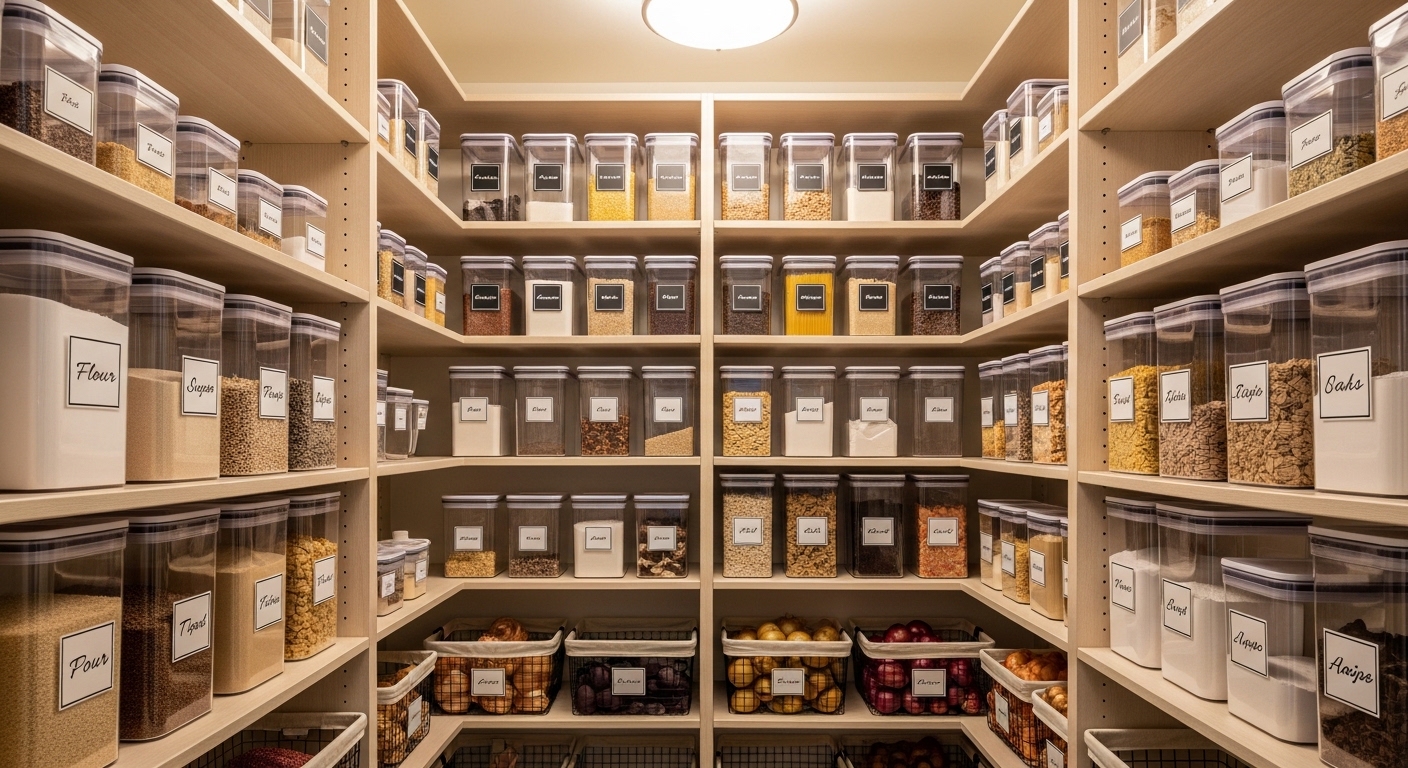
Clear 66-quart bins with lids, labeled by single category with a label maker: Christmas lights, Christmas ornaments, Halloween, Easter, pool toys, beach, camping kitchen, camping sleeping, sports balls, outdoor games, party supplies, paint and touch-up, car care, and "kid outgrown, to pass down." Fourteen, and the rule is one category per bin and no bin called "misc," because a misc bin is a floor pile with a lid. They live on the back wall shelving, seasonal ones on the top shelf, and the labels face out at a height a kid can read, because the 9-year-old is the one who fetches the pool toys.
The shelving
Two steel shelving units, five shelves each, 48 inches wide by 24 deep by 72 tall, $89 each at the hardware store, anchored to the wall studs with a strap because a 9-year-old will climb them. Top shelf: seasonal bins. Second: camping and party. Third, at eye height: the bins we use monthly. Fourth: coolers, the picnic basket, the folding chairs. Bottom: the heavy things, the water jugs, the bag of sidewalk salt, and a bin of rags. Everything on a shelf, nothing on the floor under the bottom shelf, and the floor is what gets swept.
The sports wall
A ball rack, $35, that holds nine balls in a claw so they can be pulled from the front, two mesh bins on hooks for the small things, gloves, shin guards, goggles, and a rail of hooks for bats, rackets and the lacrosse sticks. Five kids at three schools is four sports in any given season, and the sports wall is the zone that changes most; the rule is that a season's gear is at the front and the off-season's is in the "sports balls" bin on the shelf. Cleats on a boot tray under the rack, which stopped the driveway from being a cleat graveyard.
The ceiling platform
A ceiling-mounted storage rack, 4 by 8 feet, $140, bolted into the joists over the hood of Matt's car, holding the Christmas tree box, the four Christmas bins and the two big Halloween bins; Matt hung it on a Sunday with the 14-year-old holding the ladder. It's the only zone that needs an adult and a ladder, and it's the one used once a year, so that's fine. Everything on it is a bin with a label facing down, so you can read it from the floor.
Lighting, which should have been first
The garage had one bare bulb in the middle of the ceiling, and the organized garage was unusable after dark until we hung two 4-foot LED shop lights, one over each bay, $38 each, plugged into the ceiling outlet and daisy-chained, at 4000K, which is the one place in the house a cool white is right. They went in after the shelving, and they should have gone in before, because half the sorting on the driveway was because you couldn't see inside. A motion-sensor fixture by the door into the laundry room, so a kid with an armful of gear doesn't need a hand for the switch. The outdoor lighting post has the driveway side.
Kid-height hooks
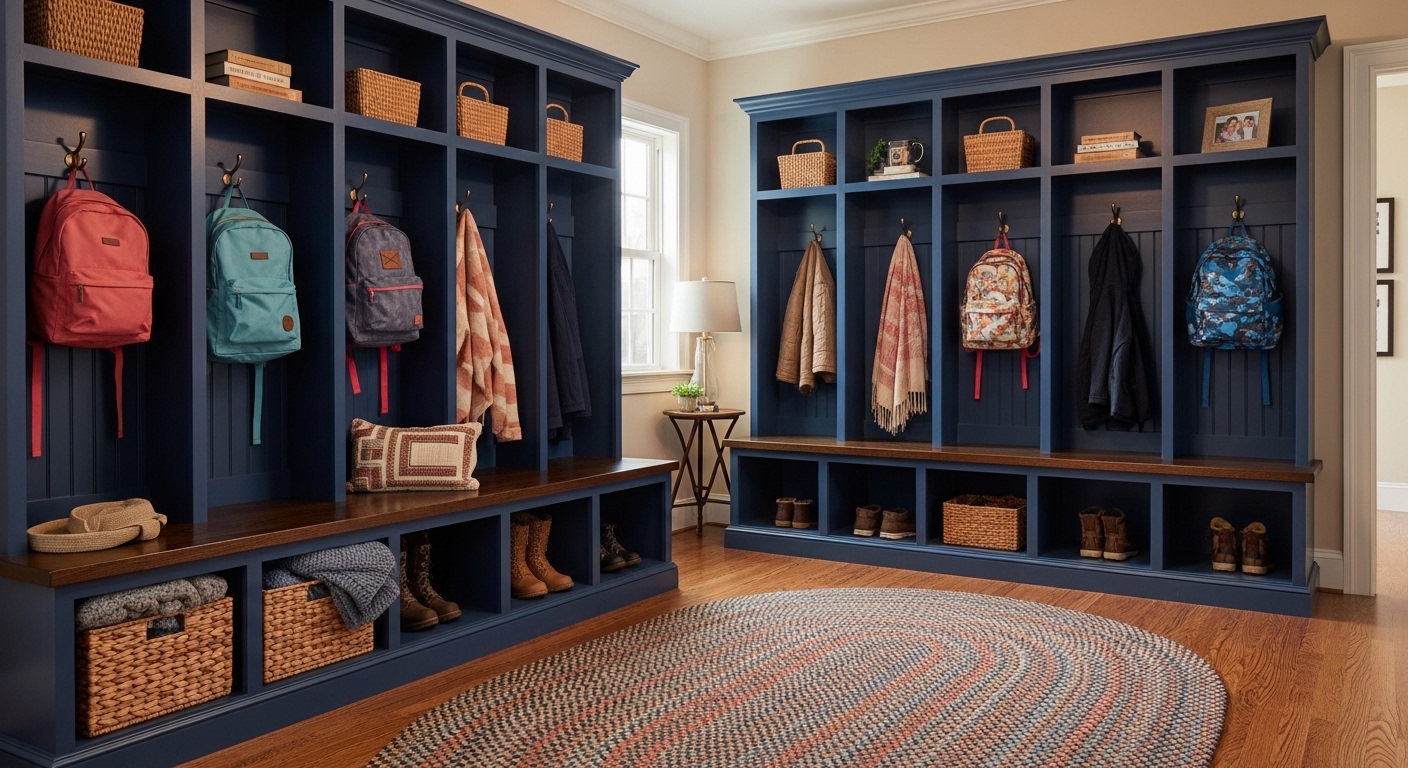
A hook rail at 40 inches along the wall by the door into the house: the 4-year-old's hook, then the 7's, then the 9's, for their outdoor things, the helmets, the bike locks, the jump ropes. Kid height is the whole system in our house, from the mudroom to the garage, because a hook a kid can reach is a hook that gets used and a hook a kid can't is a pile underneath it. The rail moves up 2 inches a year, and the screws' old holes get a dab of filler.
The seasonal rotation
Twice a year, the first weekend of May and the first of November, the seasonal bins swap between the top shelf and the ceiling platform, the sports wall changes over, the sidewalk salt goes up and the pool toys come down or the reverse. Two hours with the 12-year-old, who runs the label maker, and a list on a strip of painter's tape on the wall of what moved where. The rotation is what keeps the garage from becoming the "everything" room again; without a date it doesn't happen.
One in, one out
For every new bin that goes on a shelf, one comes off and gets donated; for every new bike, one goes to a cousin or the curb. The garage has fourteen bins because fourteen is what fits on two shelving units with a shelf left for coolers, and the number doesn't grow. The "outgrown" bin is the pressure valve: a kid's outgrown cleats go in it, and when it's full it goes to the school's swap. The 4-year-old outgrew three bikes and they went to cousins.
The workbench
Matt's, in the far right corner: a 6-foot bench from a sheet of plywood on two sawhorses, a pegboard above with the tools outlined in marker so a missing one shows, a clamp light on the pegboard's edge, and one drawer unit for screws and fasteners. It's the one zone the kids don't touch, the one with the sharp things, and it's the corner the shop light was aimed at first. The pegboard outlines are the classroom trick again: a shape on a wall says "put it back here" without a word.
What stays on the floor
The cars. A boot tray. The trash and recycling bins on wheels by the door. The lawnmower in its corner. That's it, and it's the rule that keeps it that way: if it's on the floor and it isn't on that list, it's in the wrong place. The 7-year-old checks on Saturdays as part of his chores and gets a quarter per item found, which has cost me about $6 in two years.
Getting the kids to use it
The same way a classroom of 25 learns where the scissors go: a label, a walk-through, and a week of reminders. Each kid got shown their bike hook and their door hook the day the system went up, the 12-year-old got the label maker and the job of labeling the sports bins, and the 9-year-old got the pool-toy bin as his responsibility because he's the one who wants the pool toys. A system a kid has a job in is a system a kid defends, and the 9-year-old has told a cousin off for putting a ball in the wrong bin. The first week I stood in the garage at 5 pm and pointed; the second week I didn't have to.
The five-minute Saturday reset
Every Saturday morning before the sports runs, five minutes: bikes on hooks, balls in the claw, cleats on the tray, anything on the floor back to its zone, and the 7-year-old's quarter check. It's the same reset the mudroom gets, and five minutes a week is what keeps a Saturday in May from becoming the four-hour driveway sort again. The list of the five things is on the painter's tape next to the rotation dates, and Matt and I trade weeks.
The garage in winter, and in the week before a birthday
Winter is when the garage earns its shelving: the salt bag on the bottom shelf, the snow shovel on the sports rail where the bats were, the kids' sleds on the bike track hooks, and the bikes pushed to the back of the track because nobody's riding in January. The week before a birthday, the party bin comes down off the second shelf, gets refilled after, and goes back up, and it's the reason a party for twelve kids doesn't start with a run to the store for candles. A garage with zones is a garage that changes with the calendar without anyone reorganizing it, and the only thing that moves is what's at the front.
The garage door into the house
The door from the garage into the laundry room is the real front door of a family house, and the 40-inch hook rail beside it is where the kid-height rule starts: helmets and outdoor shoes on the garage side, backpacks and coats on the laundry side, and the boot tray in between. The motion light over that door comes on when the door opens, which means nobody with an armful is in the dark, and it's the fixture that gets used two hundred times a day. The mudroom post covers what happens on the other side of the door; the garage side is the rail, the tray and the light.
Mistakes
Three years of no system, which is the main one. Buying bins before measuring the shelves, so the first six bins were 2 inches too tall for the shelf spacing. A misc bin, in year one, that was a pile with a lid within a month. Hanging the bikes at adult height so I was the only one who could put them away. And hanging the lights last, after a whole Saturday of sorting in a dim garage.
What it cost
Two shelving units, $178. The bike track and hooks, $105. Fourteen bins, $168. The ceiling rack, $140. The ball rack and mesh bins, $55. Hook rails, $30. Two shop lights, $76, and a motion fixture, $32. Labels and tape, $20. About $800 for a two-car garage that holds two cars and everything seven people own that lives outside, and $108 of it, the lights, is the part I'd tell anyone to buy first.
In one paragraph
Empty the floor. Bikes on a wall track at each kid's height. Bins by single category on anchored steel shelving, seasonal ones on the ceiling. Sports gear on a rack with the season at the front. Hooks at kid height by the door. Shop lights over each bay and a motion light at the door, hung first. One in, one out, and a rotation twice a year with a date on the wall. Both cars in the garage, for the first time in three years.
Shop this post: lighting and outdoor wall lights for the door and the driveway