Homework station ideas that get used are the ones that put the station where the parent already is, at the kitchen island's far end, with a drawer of supplies, a light that's bright enough, and a rule about phones, and the desk in the bedroom that every homework station post recommends is the one that gathers laundry. We tried three: a desk in each older kid's room, a homework nook in the family room, and the island's far end, and the island is the one that's been used every school day for two years. This post is why the island and not the bedroom, the two seats and the two ages, the supply drawer and what's in it, the light and why 3000K and full, the phone rule and the basket, the timer, the bulletin board and the folder system, the 4:30 to 6 schedule, the little kids' version at the coffee table, the weekend version at the dining table, what the teacher in me knows about where kids work, the mess and the 6 pm clear, the older kid who graduated to her room, mistakes, and the cost.
Why the island and not the bedroom
A homework station works when a parent's within earshot without hovering, and at 4:30 I'm at the sink end of the island with the onions; the far end is 6 feet away, close enough for "what's a numerator" and far enough that I'm not reading over a shoulder. A desk in a bedroom is a desk in a room with a bed, a door and no adult, and for a 9-year-old that's a nap, and for a 12-year-old it's a phone. Eight years of teaching taught me that kids work where the work is expected and someone's around, and the classroom's version is the island's version at home.
The two seats
Two stools at the island's far end, the 9-year-old on the left and the 12-year-old on the right, with the 7-year-old at the coffee table in the family room for his reading log and the 14-year-old at the dining table or her room, because at fourteen she's earned the room. Two seats at the island is the right number because two kids can work side by side and three is a conversation; the kitchen organization post is why that end of the island's kept clear.
The supply drawer
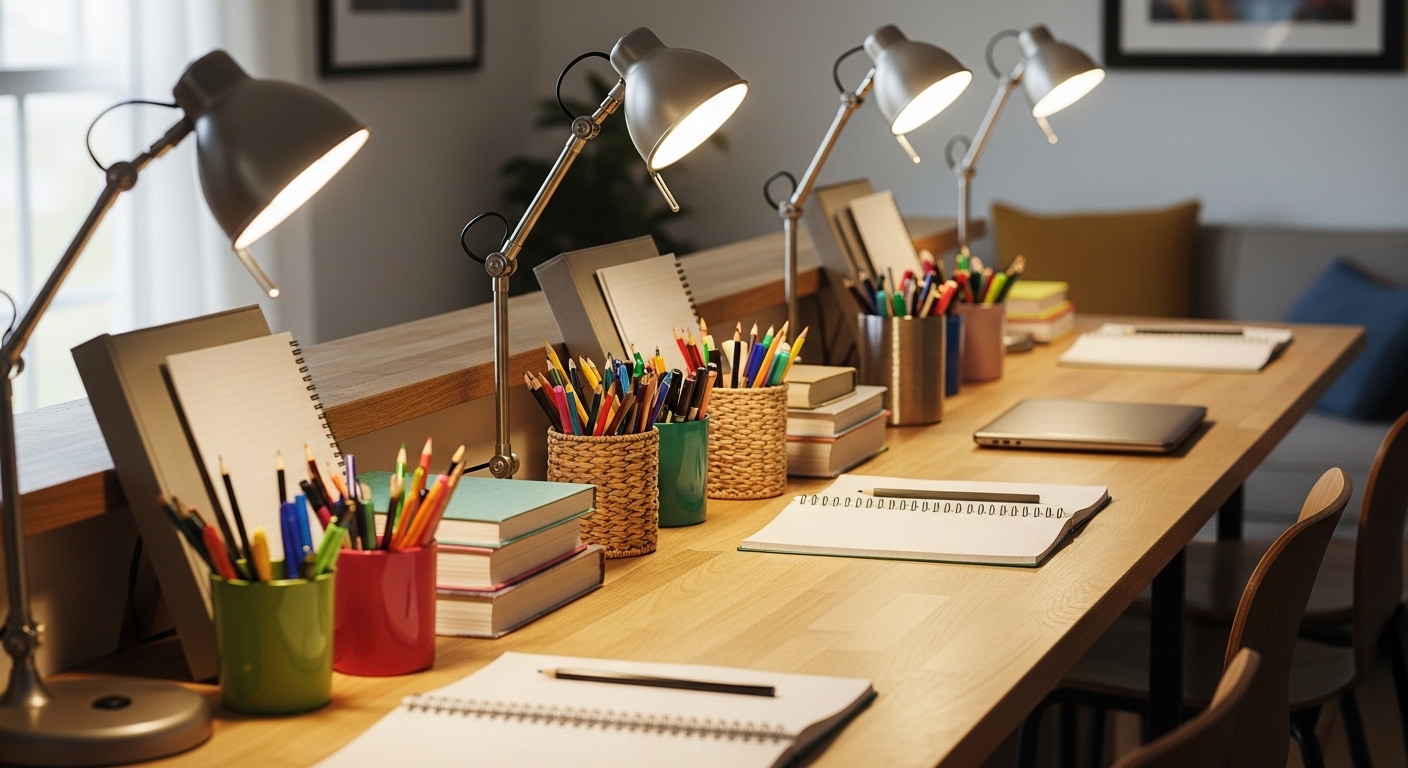
The island's end drawer, with a divided insert: pencils, a sharpener, erasers, a ruler, scissors, glue sticks, a stapler, colored pencils, index cards, a calculator, and the lined paper, and it's restocked from the back-to-school bin in August. Everything a kid needs for any assignment within arm's reach, so "I need a" doesn't mean a trip upstairs and a lost ten minutes. The drawer's labeled inside and the rule is that what comes out goes back at 6, which the 9-year-old does and the 12-year-old is reminded to.
The light
The island's three pendants at full for homework, 2,400 lumens on the counter, which is more than a desk lamp and lit from above and both sides so a right-handed kid's hand doesn't shadow the page; the pendants are 2700K and homework at 2700K is fine, though the island lighting post notes I'd have gone 3000K if the island were only a desk. The under-cabinet strips at the far end are on too, for the counter behind the stools. A homework station with a single desk lamp is a station where the kid's hand is in the way; a lit island has no shadow anywhere.
The phone rule and the basket
A basket on the counter by the stools, and the 12-year-old's phone goes in it at 4:30 and comes out at 6 or when the homework's checked, whichever's later; the 14-year-old's rule is the same at the dining table. It's the rule that made the island work for the 12-year-old, who'd been doing homework in her room with the phone face-down and a lot of very short breaks. A basket is a physical rule and a physical rule is one a kid can see herself following.
The timer
A kitchen timer on the counter, the visual kind with a red disc that shrinks, set for 25 minutes of work and 5 of break, which is the classroom's version and which the 9-year-old runs himself; the 12-year-old ignores it and does 45 and 10, which is fine because she's the one who set that. The timer turns "how much longer" into a thing a kid can see, and it turns the 4:30 to 6 block into three rounds instead of a wall.
The bulletin board and the folders
A cork board on the wall at the island's end, at 54 inches, with three sections: this week's assignments, the permission slips, and the reading log; and a folder per kid in a rack below it for the papers that go back to school. The board's the command center's homework half, and it's cleared Sunday. A homework station without a place for the paper that goes back to school is a station that produces a backpack full of loose paper, and it did, for a year.
The 4:30 to 6 schedule
Snack from the pantry's kids' shelf at 4:15, at the island, so the snack's done before the homework starts and the counter's wiped. Four-thirty, homework, phones in the basket, pendants to full, timer set. Five-thirty, the dinner prep at the sink end reaches the point where I need the whole island, and the kids who are done clear and the ones who aren't move to the dining table. Six, dinner. The schedule's on the board and it's the same every day, because the same every day is the thing that makes it happen without a fight.
The little kids' version
The 7-year-old's homework is a reading log and a worksheet, and it happens on the floor at the family room's coffee table at 60 percent with the table lamp on, with the 4-year-old beside him "doing homework" with crayons; it's the family room's homework setting, and it's near enough to the kitchen to hear. A 7-year-old doesn't need a station; he needs a surface, a light and a sibling doing the same thing, and the coffee table is all three.
The weekend version
Projects, the science board and the diorama, go to the dining table on Saturday morning under the drum chandelier at full, because they need 32 square feet and a light that covers it; the dining room post is the chandelier as a work light. The island's for the daily work and the dining table's for the big work, and the split is what keeps the island clear at 5:30 on a weekday.
What the teacher knows
Kids do work where work is expected, near an adult, with the supplies at hand, in a set block, with a visible clock, and with the distractions physically removed; that's a classroom and it's the island at 4:30. The bedroom desk fails every one of those except the supplies. The family room nook, which we tried second, failed the "near an adult" test at 4:30 because I was in the kitchen. The island passes all six, and it's the reason the station's the island and not the $200 desk in the 12-year-old's room, which holds her laundry.
The mess and the 6 pm clear
At 6 the island's end is cleared: supplies to the drawer, papers to the folders, the basket's phones returned, the stools pushed in, the counter wiped for dinner service. It's two minutes and it's on the schedule as the last step, and it's the step that lets the station exist on a kitchen counter without the kitchen becoming a classroom. A homework station that isn't cleared daily is a pile by Wednesday, which was the family room nook's fate.
The kid who graduated
The 14-year-old moved to her room at thirteen, with the phone basket rule kept, the supply drawer copied into her desk, and a sconce over the desk at 48 inches from the teen bedroom post. The island's a station for the middle years, nine to twelve, when a kid needs an adult nearby and hasn't earned the door; the graduation's the goal, and it happens when the kid's shown she can run the timer and the basket herself. The 12-year-old's a year off.
The kid who won't start
The 9-year-old's the one who'd rather do anything else, and the station's setup is the answer more than any talk: the snack's done, the phone isn't a factor, the timer's set, the pendants are at full, and the supplies are in the drawer, so there's nothing to do before starting except start. In the classroom the fix for a kid who won't start was to remove every reason to delay, and it's the same at the island. The 25-minute timer's the other half; a kid who won't start an hour will start 25 minutes.
Checking the work
At 5:30, before the clear, each kid's work gets a two-minute look from me at the sink end: done, not done, or a question, and the folder gets the done things. Not a correction session, which is the teacher's job and not the dinner cook's; a check that it exists and a note on the board if it doesn't. A homework station where the work's never checked is a station where the work's sometimes not done, and the check is the two minutes that makes the rest of it real.
Supplies for five kids at three schools
The drawer's stocked for the youngest and the oldest at once: fat crayons and a calculator, safety scissors and a compass, and the back-to-school post is the August restock by age. The drawer's the one place in the house where every kid's supplies are, and it means a 4-year-old's glue stick and a 12-year-old's protractor are in the same insert, which sounds like chaos and is a labeled insert.
Where it goes in a house without an island
The kitchen table's end, or a counter's end, or a desk pushed against the kitchen's wall; the location rule is "within 10 feet of where the parent is at 4:30 and in sight," and any surface that passes it works. The first house had no island and the station was the kitchen table's far end with a drawer unit beside it on wheels, and it worked the same, with the drawer unit rolling to the closet at 6. It's the adult, the supplies, the light and the basket that make it a station, and the island's just our surface; a friend runs hers at a dining room's end with a lamp, and the lamp's the weak point.
Mistakes
Three desks in three bedrooms, $600, and three laundry shelves. The family room nook, out of earshot at 4:30. No phone basket for the first semester of the 12-year-old's phone. Supplies upstairs, and the ten minutes every trip. And no clear at 6, in the nook, which is why it became a pile and then a plant stand.
In one paragraph
Two stools at the island's far end, 6 feet from the stove. A supply drawer with everything. The pendants at full. A phone basket at 4:30. A visual timer. A cork board and a folder per kid. Snack at 4:15, homework at 4:30, clear at 6. The little ones at the coffee table, the projects at the dining table, the 14-year-old in her room. Where the parent is, with the supplies at hand and the phone in a basket; the classroom, at home.
What it cost
The drawer insert and supplies, $60. Two stools, already owned. The timer, $12. The basket, $8. The cork board and folder rack, $35. About $115 for a homework station that's used 180 days a year, and the $600 of desks that preceded it are the reason I write these posts.
Shop this post: kitchen pendant lighting, the homework light that has no shadow