Laundry room organization for a family of seven comes down to a basket per person, a sorting rule that happens before the room, a schedule on the wall, a folding surface that's nothing else, and enough light to tell navy from black, and the last one's the one I got wrong. Our laundry room is 7 by 9, off the garage door, with a front-load pair, a counter over them, a sink and a shelf, and for three years it was the room I dreaded most in the house because it was the room where fourteen loads a week went to pile; it's fine now, which for a laundry room is the goal. This post is the fourteen loads and the schedule that spreads them, the basket per person and the color system, the sort that happens in the bedrooms, the folding counter and its one rule, the shelf and what's on it, the drying rack and the wall it lives on, the sink's job, the light and why it should have been brighter, the door from the garage and the drop zone it isn't, the kids' jobs by age, the lost-sock bin, the supplies and the rule about them, the twelve-year-old's takeover of her own laundry, mistakes, and the cost.
Fourteen loads and the schedule
Seven people is about fourteen loads a week: two of sheets, two of towels, and ten of clothes, and the schedule on the wall spreads them so no day's more than two: Monday sheets, Tuesday the boys, Wednesday the girls, Thursday towels, Friday ours, Saturday the 12-year-old's own, Sunday nothing. A laundry room without a schedule is a room where Saturday's six loads, and the schedule's the thing that made the room fine; it's on a card by the door, in the same font as everything else.
A basket per person
Seven baskets, one per person, in each kid's color from the linen closet post's system, in the bedrooms not the laundry room; a kid's basket comes to the laundry room on their day, gets washed as one load, and goes back full of their clean clothes to their room, where they put it away. A load per person means no sorting whose sock is whose, which with five kids is the job that made laundry a job. The laundry room holds no baskets between loads; it holds the machines, the counter and the shelf.
The sort happens in the bedroom
Each kid's basket has a divider, lights and darks, and the sort happens as the clothes come off, in the bedroom, by the kid; the laundry room gets a basket that's already sorted, and the 12-year-old's first month of laundry included a red sock in the whites because I'd assumed she'd absorbed sorting and she hadn't. The divider's a $6 mesh insert and the rule's taught at five with a game about which pile the shirt goes in. The laundry room's job is washing, and the sorting's been done before the basket gets there.
The folding counter's one rule
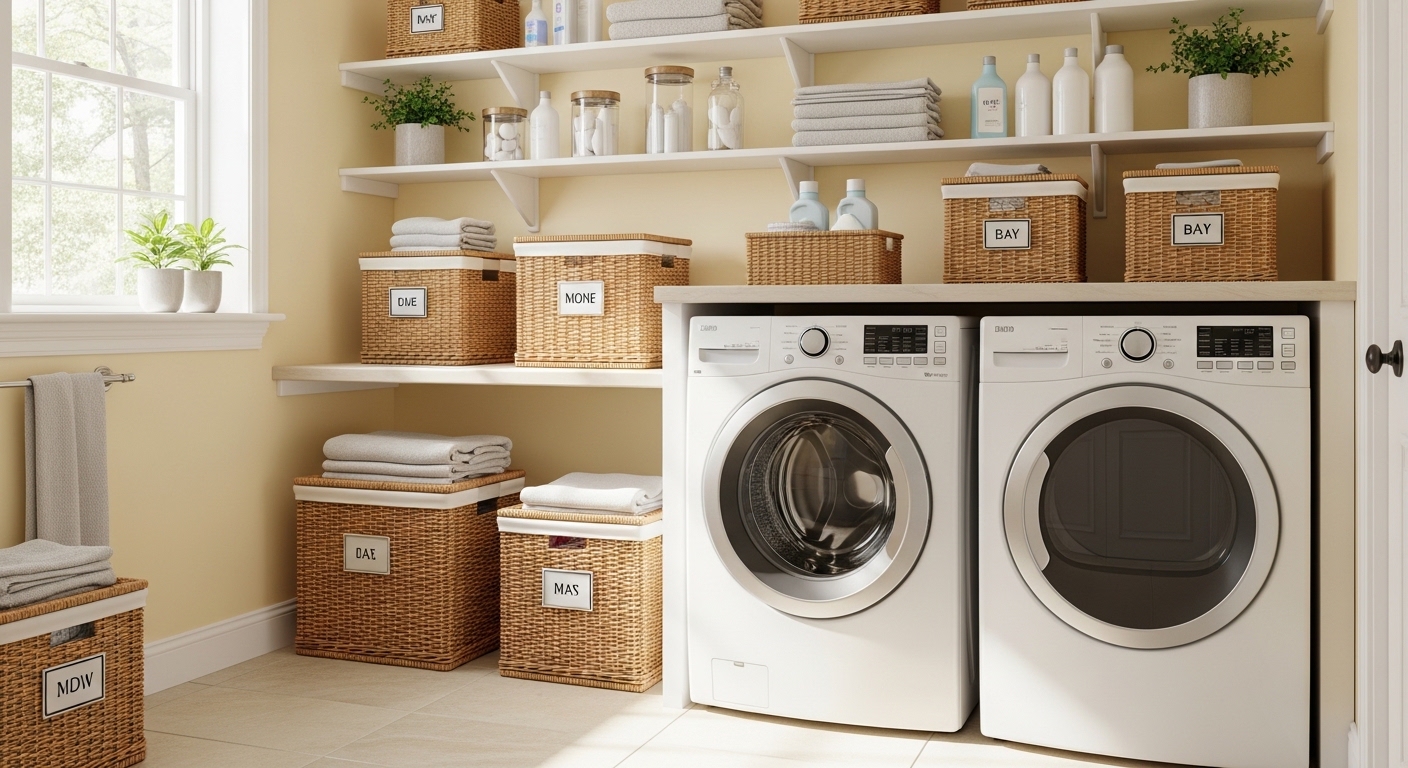
The counter over the machines is 60 inches of surface and its rule is that nothing lives on it: no baskets, no supplies, no things on their way somewhere. It's for folding, and a folding counter with a basket on it is a counter where folding happens on the floor. The rule's the same as the kitchen's five things, with the number set to zero, and it's held for two years because everything that used to live on the counter got a shelf.
The shelf
One shelf above the counter at 60 inches, 12 inches deep, holding the detergent in a pump dispenser, the stain spray, the dryer sheets in a bin, the mesh bags for the delicates, and the lost-sock bin; that's it, and the backup of everything is in the pantry's stockroom. A laundry shelf that holds six months of detergent is a shelf that's a store; one that holds the month's is a shelf you can see. The pantry post is the stockroom.
The drying rack
A wall-mounted accordion rack on the wall beside the sink, folded flat when empty, out for the 14-year-old's things that don't go in the dryer and for the swim suits in summer; a floor rack in a 7-by-9 laundry room is the floor, and the wall rack's $40 and 4 inches deep when closed. Below it a hook rail for the hangers that come out of the dryer with the shirts on them, which is the 12-year-old's method and a good one.
The sink
The utility sink's for the muddy cleats, the paint water and the pre-soak, and its rule is that it's empty by bedtime, because a laundry sink with something soaking in it is a sink that's soaking for a week. A bucket under it for the pre-soak that needs longer, and the sink's clear. It's the second-most-used sink in the house, and it's the reason the kitchen's sink isn't for cleats.
The light, which should have been brighter
The room had a single flush mount at 800 lumens and 2700K, and for three years I sorted navy from black by taking things to the kitchen; the fix was a 2,400-lumen 4000K LED flush mount, $48, which is the one room in the house besides the garage where a cool white is right, and an LED strip under the shelf over the counter at 4000K for the folding, $28. A laundry room's a work room and it needs 50 lumens a square foot, which for 63 feet is 3,000; the room's now at 3,200 and I can see a stain. The laundry room lighting post is the fixtures; this is the room around them.
The garage door and the drop zone it isn't
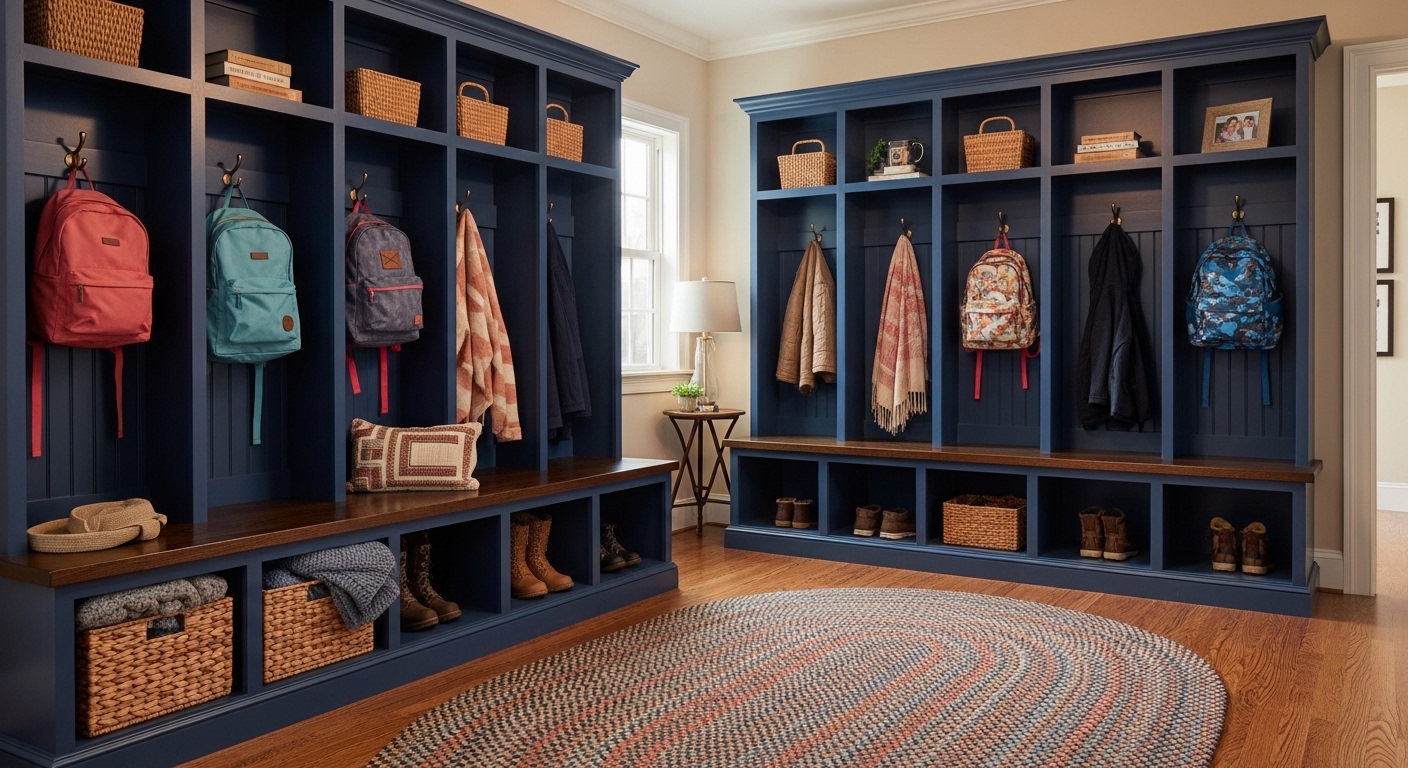
The laundry room's the door from the garage, which means it's the first room a kid with a backpack hits, and the rule is that nothing's dropped in it: the hook rail's outside the door in the garage for the outdoor things, and the mudroom is the room after for the backpacks. A laundry room that's also the drop zone is a room with fourteen loads and five backpacks in it, and it was, and the backpacks moved 8 feet.
The kids' jobs by age
At four: put your clothes in the basket, light side or dark side. At seven: carry your basket to the laundry room on your day and put the clean clothes away. At nine: start the machine, with the pump dispenser measured, and move the load to the dryer. At twelve: the whole thing, your own load, start to folded. At fourteen: the same, plus the towels on Thursday. Each job's on the chore chart and each one was taught the way a classroom job is, with a demonstration and a week of checking.
The lost-sock bin
A small bin on the shelf for the single socks, emptied monthly with the whole family matching on the family room floor, and the unmatched after that go to the rag bag; the bin's the answer to a family of seven's sock problem, which is about eight a week. The matching's a game the 4-year-old likes and it's fifteen minutes a month, and it's the reason there's no drawer of singles anywhere in the house.
The supplies rule
One detergent, in a pump, because seven people's laundry doesn't need four kinds and because a pump's a measure a 9-year-old gets right; one stain spray; dryer sheets or wool balls, not both; and the mesh bags. The supplies fit on 3 feet of shelf and the backup's in the pantry, and the laundry room's not a store. It's the pantry's "what we stopped buying" rule with soap.
The twelve-year-old's takeover
She asked at eleven, because she was tired of her sister's clothes ending up in her drawer, and she's done her own Saturday load for a year: sort in the room, carry, wash, dry, fold on the counter, put away. The red sock was week one, and the lesson after it was the divider. A kid who does her own laundry is a kid who's learned the whole room, and it's the job I'd give any kid who asks, at whatever age they ask.
Sheets Monday and towels Thursday
The two loads that aren't a person's: sheets on Monday, stripped by each kid old enough and by me for the 4-year-old, washed in two loads, and back on the same beds the same day, with the 9-year-old's bundle in the linen closet as the spare. Towels Thursday, two loads, back to the linen closet's color stacks. The two house loads are the two the schedule protects, because they're the ones that get skipped when the week's a mess, and a skipped sheets day is a house of seven beds that smell like it.
The laundry room's five minutes a day
A load in at 7 am before the school run, moved to the dryer at 3, folded at 5 while the pasta boils, delivered by the kid whose basket it is at 6; five minutes at each of four moments and the day's laundry's done without a laundry hour. The room's designed for that rhythm: the counter's clear for the 5 pm fold, the basket's by the door for the 6 pm delivery, and the machine's a front-loader with a delay start for the mornings I forget. Fourteen loads a week is two a day, and two a day is five minutes four times, which is the arithmetic that made the room fine.
Cleaning the room itself
Saturday: the lint trap, the sink wiped, the counter wiped, the floor swept, the dryer's vent checked monthly, and the washer's gasket wiped, which is the thing that keeps a front-loader from smelling. It's the 14-year-old's chore with the towels, ten minutes, and it's the reason a room that processes fourteen loads doesn't smell like it. A laundry room that's cleaned weekly is a room that stays fine, and the lint trap's the one thing on the list that's a fire.
Where the clean clothes go, which isn't here
A kid's basket goes back to their room full and the putting-away's theirs, by the dresser's labeled drawers from the shared room post; the laundry room never holds clean clothes overnight, which is the rule that stopped the counter from becoming a wardrobe. The 4-year-old's basket goes back with me and she puts her socks in the sock drawer, which takes her ten minutes and is the beginning of the job she'll have at seven.
A kid who puts her own socks away at four is a kid who runs her own load at twelve, and the laundry room's the room where that line's shortest.
Mistakes
Three years of one dim light. Baskets in the laundry room, seven of them on the floor. Sorting everyone's clothes together, and the sock problem that made. No schedule, and six-load Saturdays. A floor drying rack that was the floor. And assuming a kid had absorbed sorting, which cost one white load.
In one paragraph
Fourteen loads on a schedule, two a day. A basket per person in their color with a divider, sorted in the bedroom, washed as one load, returned full. A folding counter with nothing on it. One shelf, one detergent in a pump, a lost-sock bin. A wall rack. A sink that's empty at night. 3,200 lumens at 4000K. Backpacks in the next room. Jobs by age from four to fourteen, and a 12-year-old who does her own. From dread to fine, which is the laundry room's ceiling.
What it cost
Seven baskets and dividers, $110. The wall rack, $40. The hook rail, $18. The pump dispenser and bins, $30. The flush mount, $48, and the strip, $28. The schedule card, free. About $275 for a laundry room that runs fourteen loads a week with five kids doing most of the carrying, and the $76 of light is the part I'd have paid triple for in year one.
Shop this post: ceiling lights and lighting for the room that needs 3,000 lumens