Organizing a shared kids' bedroom comes down to three decisions: mirror-image zones so neither child can claim the other got more, a neutral strip down the middle that belongs to both, and separate lights on separate switches so bedtime doesn't become a negotiation. Our two boys, ages 7 and 9, share a 12 by 13 room in our Nashville ranch, and for the first six months it was the least peaceful room in a house with five kids in it. Two under-bed bins at $25 each solved most of the clutter. The bedtime light war took longer and was solved by something embarrassingly simple. This post is the zone layout with measurements, the storage that gives each kid exactly the same amount, the lighting that ended the fights, the rules that hold, the beds question, how it changes as they grow, and what it cost, which was under $300.
The zone rule: two mirror images
Each child has a zone: one side of the room, one bed, one dresser, one shelf, one side of the shared closet, one hook rail, one bin under the bed. The zones are mirror images of each other: same furniture, same storage, same number of hooks, in the same positions on opposite walls. Nothing creates more friction between siblings than perceived inequality in physical space, and a 7-year-old can count hooks. The line down the middle is invisible but real, and both boys know where it is to the inch. This is a classroom principle: two kids at identical desks with identical supplies argue about the work, not the desk, and two brothers with identical hooks argue about the game, not the hooks.
The layout, with measurements
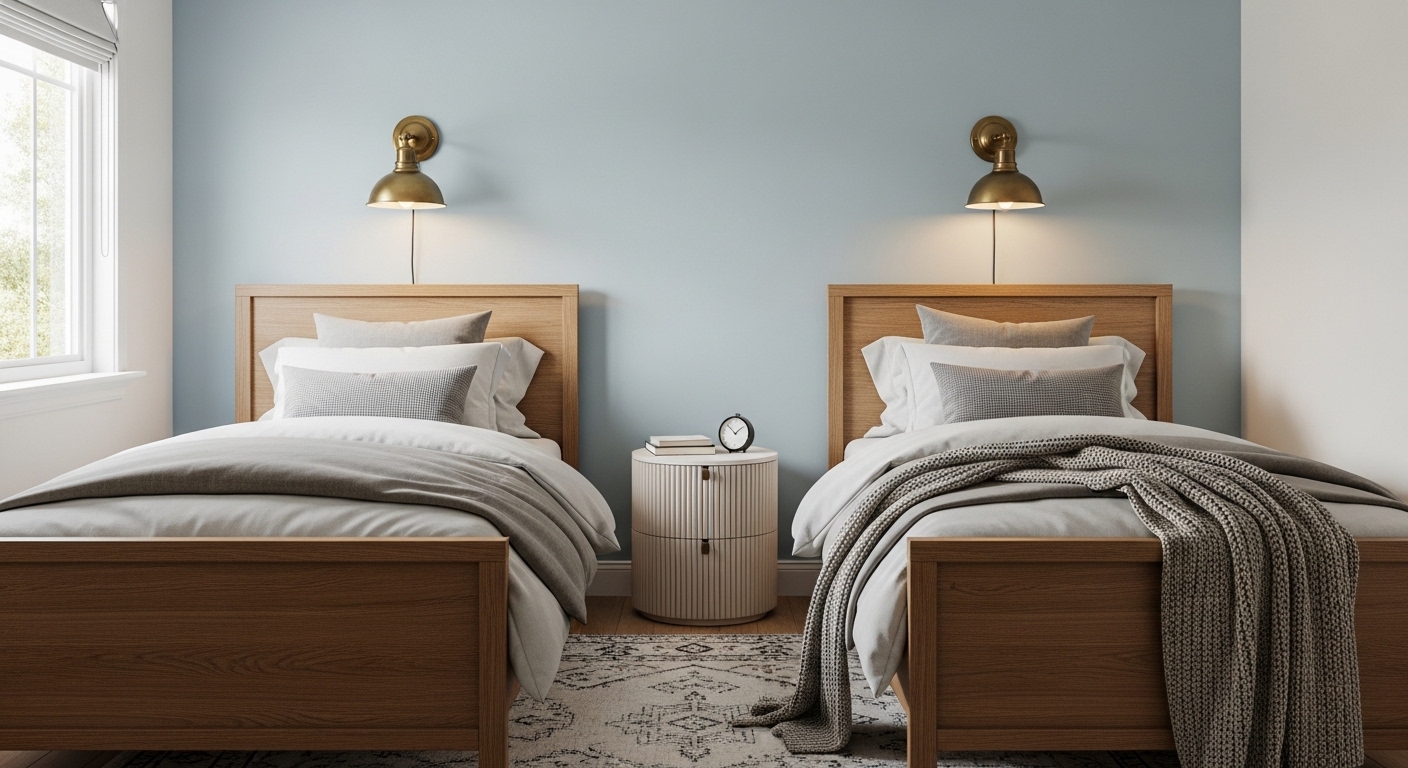
Twin beds, one on each long wall, headboards against the window wall, 5 feet apart. Between the headboards under the window, a shared bookshelf 36 inches wide and 30 tall. At the foot of each bed, that child's dresser, 30 inches wide, against the same long wall. Above each headboard, that child's wall sconce and a shelf for the things that matter (the 9-year-old's trophies, the 7-year-old's rock collection). On the door wall, the closet, with a rod at 40 inches for the 7-year-old on the left and at 55 inches for the 9-year-old on the right, and a hook rail at 48 inches with three hooks each side of the door. Under each bed, one 6-inch-deep bin on wheels for toys and one flat bin for off-season clothes. That's the whole room, and the 30-inch walkway down the middle is the neutral zone.
Storage: exactly the same amount, each
Each boy has the same six places: a dresser with four drawers, one shelf above the bed, half a closet, three hooks, an under-bed toy bin and an under-bed clothes bin. Labeled with a picture for the 7-year-old and a word for the 9-year-old, on the drawer fronts, in each kid's color. The rule is that anything that doesn't fit in your six places doesn't live in the bedroom; it goes to the playroom or the toy rotation bins in the garage. The under-bed toy bin is the piece that solved the floor: it's 6 inches deep and 30 by 20, on wheels, so a 7-year-old can pull it out, dump the day's things in, and push it back, and cleanup went from a twenty-minute argument to a three-minute race. Two bins, $25 each, and I'd have bought them the first week if I'd known.
The bedtime light war, and the sconce that ended it
The 9-year-old reads before bed. The 7-year-old needs complete darkness to fall asleep. For six months this was a nightly battle: overhead on, overhead off, a lamp that lit the whole room, a flashlight under a blanket, tears. The solution was so simple it's embarrassing that it took six months: an individual wall sconce above each bed, on its own switch, with a shade that throws the light down onto the pillow and not across the room. The 9-year-old reads by his sconce with a 2700K bulb at 400 lumens on a dimmer. The 7-year-old's side stays dark, and a shade directing the light down means the far bed is in shadow even with the near sconce on. No overhead light after 7:30. No conflict. Everyone sleeps. The full lighting plan for that room and the others is in my kids' room lighting post; the sconces were $130 for the pair and the electrician added the two boxes in an hour.
The neutral zone
The shared bookshelf under the window holds books and games that belong to both, and the walkway between the beds is communal, nobody's territory. This boundary is respected better than I expected, because the personal zones are so clearly defined that the shared part reads as shared rather than contested. The rule for the bookshelf: anything on it can be used by either boy without asking, and anything that a boy doesn't want shared lives on his own shelf above his bed. That one rule ended about half the arguments, because it turned "he took my book" into "then it goes on your shelf," which is a sorting decision rather than a fight.
Shared bedroom ideas for siblings of different ages, or a boy and a girl
The mirror-image rule bends when the ages are far apart: a 4-year-old and a 12-year-old don't need identical dressers, but they need the same number of places, and the older one's places are higher. Same six categories, different heights, same labels in their colors. For a brother and sister sharing, the neutral zone gets wider and the divider question comes back; a bookshelf run down the middle at 40 inches high, with the backs facing each way, gives each side a wall to face without cutting the light or the airflow, and it's the one divider that survived in a friend's house. Teens sharing, which happens more than people admit, want the zones to be as far apart as the room allows and the light rule enforced like a contract, and the sconce on a dimmer with the switch at the pillow is the whole peace treaty.
The clothes, which are the real clutter
Toys get blamed, but the floor of a shared kids' room is mostly clothes: worn once, not dirty, not put away. Each boy has a hamper in his zone, a hook rail for the worn-once things, and a rule that clothes on the floor at bedtime go in the hamper whether they're dirty or not, which costs me an extra load a week and buys a clear floor. The dresser drawers are labeled top to bottom in the order they get dressed: underwear and socks, shirts, pants, pajamas, so a 7-year-old can dress himself from the top drawer down. The off-season bin under the bed holds the shorts in January and the sweaters in July, swapped in the same August week as the school reset. Twelve years of five kids' rooms, and the drawer order is the single change that most reduced the morning.
The weekly reset, and who does it
Sunday, ten minutes, each boy in his own zone with a timer: bins out, floor clear, drawers closed, shelf straightened, bin back. I check from the doorway, the same four-second check as the chores chart, and I don't go in unless something's on fire. The 9-year-old finishes in six minutes and the 7-year-old in ten with a reminder at minute five. The neutral zone is mine, ninety seconds, because a shared job with two kids is a job that gets done by the older kid and resented by both. Once a season we do the closet together, one at a time, and whatever's outgrown goes into the hand-me-down bin for the 4-year-old, which is the one perk of five kids that the 7-year-old resents and the 4-year-old is delighted by. The bedroom stays a bedroom, the playroom holds the play, and that split is what makes ten minutes enough.
Bunk beds, or two twins
Two twins, if the room is 11 feet or wider, because bunks make the mirror-image rule impossible: somebody has the top, and the top is better. Bunks are the right answer under 10 feet wide, and if you go that way, the rule is that the bunk assignment rotates every school year and the bottom bunk gets the better sconce and the reading shelf as compensation. Trundles are a third option for a room that's really a single, and we used one for two years before the boys moved into this room. A loft bed with a desk under it is for a 12-year-old with a room of her own, which is a different post.
Rules that hold, and the ones that didn't
Hold: your zone, your rules; the neutral zone belongs to both; lights out by the clock, not the sibling; anything on the floor at bedtime goes in the bin, whoever's it is. Didn't hold: a "quiet time" rule for the reader while the sleeper fell asleep (the sconce made it unnecessary); a rule that they clean up together (the older one did it all and resented it; now it's each zone, each kid, from the chores chart); and a divider curtain, which they loved for a week and then used as a rope. The lighting and the bins did more than any rule, which is usually true of rules.
How it changes as they grow
The 7-year-old's closet rod goes up to 55 inches when he can reach it, around 9. The picture labels become word labels the year he reads. The under-bed toy bin becomes a clothes bin when the toys move to the playroom, around 10, and the top shelf becomes the place for things he'd rather his brother didn't touch. The sconces don't change; they're at 26 inches above the mattress for a twin and stay right through the teens. At some point the 9-year-old will want his own room, and the plan is that the 14-year-old leaves for college first, which is five years away and which he has already calculated. Until then the room works because it's fair, lit, and sorted, in that order.
The lighting plan for a shared kids' room, in full
One sconce per bed, above the headboard at 26 inches over the mattress, with the switch on the fixture or on the wall at pillow height, a down-facing shade, a 2700K dimmable bulb at 400 lumens, and the two on separate circuits from each other and from the overhead. The overhead on a dimmer, used before 7:30 and for cleaning, and off after. A nightlight at outlet height on the sleeper's side, 2200K, the dimmest one sold, because "complete darkness" for a 7-year-old means a nightlight he can pretend isn't there. No lamps on the dressers, because lamps get knocked off dressers in a room with two boys. If there's no wiring for sconces, plug-in sconces with the cords run down behind the headboards do the same job and have in our 12-year-old's room since she was seven. Two switches, two zones, one rule, and bedtime stopped being a negotiation the first night, which I would not have believed six months earlier.
What it cost, and the six-month report
Two under-bed toy bins and two clothes bins, $84. Two wall sconces, $130, plus the electrician's hour, $110. Labels and hooks, $22. A second closet rod at the lower height, $18. About $365, more than the $300 I said at the top, because I'd forgotten the electrician, which is a mistake I make every time. Six months on: the floor is clear at bedtime nine nights out of ten, the light fights have stopped entirely, the cleanup is three minutes, and the only ongoing dispute is over the neutral bookshelf's one copy of a certain graphic novel, which I've resolved by buying a second copy, which is cheating and works.
Shop this post: individual bedside sconces and plug-in wall sconces for rooms without wiring