Family room lighting ideas that work for seven people in one room come down to a dimmable ceiling fixture for cleanup, two wall sconces flanking the TV wall for the evening, a floor lamp by the reading chair, and a table lamp at the sofa's end, on three switches, and it took one weekend and about $500 to go from one ceiling fan-light to a room that does homework, movie night and a 6 am cartoon without the same light for all three. The family room is 16 by 20, has a sectional, a reading chair, a TV on the long wall and a toy cabinet, and it was lit by the builder's fan-light at 4000K for the first three years we lived here. This post is the weekend's order, Saturday's ceiling fixture and dimmer, Sunday's sconces, the lamps and where, the four settings, the TV wall and why sconces beside it, the bulb color, the toy cabinet's strip, the outlets and the cords with five kids, the fan question, the floor lamp rule in a room with a 4-year-old, movie night, what we skipped, mistakes, and the cost.
The weekend, in order
Saturday morning: the fan-light down, a semi-flush LED fixture up on the same box, a dimmer at the switch. Saturday afternoon: bulbs to 2700K in the lamps we already owned, the lamps moved to where the light was needed. Sunday: two plug-in sconces mounted beside the TV wall with the cords run in channels to the outlets behind the console, on a plug-in dimmer. Sunday evening: the first movie night at 20 percent with the ceiling off, and Matt, who was skeptical, said it looked like a different room without being told what changed. Two days, no electrician, and the room's been the same since.
Saturday: the ceiling fixture
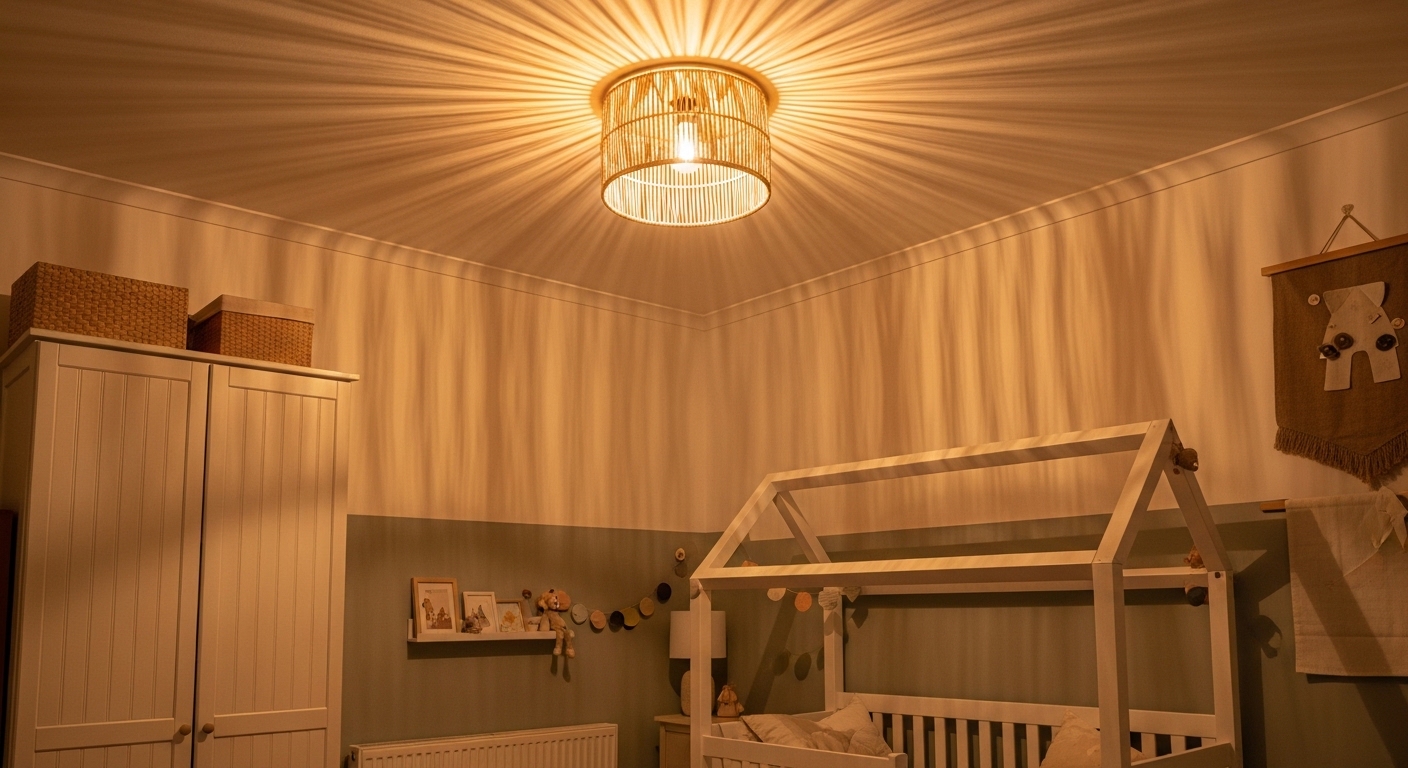
A 20-inch semi-flush drum with a frosted diffuser, 2,400 lumens, 2700K, dimmable, on the existing box; a family room that's 320 square feet needs 15 lumens a foot for cleanup and Lego, which is 4,800 at full across all sources, and the ceiling fixture is half of it. It hangs 8 inches below the 9-foot ceiling, which is under the line a thrown pillow follows and above the line a 14-year-old's hands reach. The semi-flush post is why a drum and not a chandelier in a room where things fly.
The dimmer
A $22 dimmer on the ceiling fixture and it's the most-used switch in the house: full for cleanup, 60 for homework at the coffee table, 30 for the evening, off for the movie. A family room without a dimmer is a room at one brightness from 6 am cartoons to 10 pm reading, and the wrong brightness for all of it. The dimmer took twenty minutes and it's the thing I'd tell a friend to do first, before any fixture.
Sunday: the sconces beside the TV
Two plug-in wall sconces, one each side of the TV wall at 60 inches, 30 inches out from the TV's edges, pointing up and down, at 2700K on a plug-in dimmer; they light the wall behind the TV so the screen isn't a bright rectangle in a black room, which is the thing that makes a movie night feel like a theater and not a cave. Cords in paintable channels down the wall and behind the console to the outlet the TV uses. Plug-in because the wall's finished and hardwiring would have been an electrician; nobody's noticed the channels in three years.
The lamps
A floor lamp behind the reading chair in the corner, arcing over it, 2700K on a foot dimmer, for the one person reading while the rest watch. A table lamp on the console at the sectional's end, 2700K, on a smart plug, for the room's low glow. Both were lamps we owned, with the bulbs changed; the lamps were in the wrong places, by outlets, and Saturday afternoon was an extension cord in a channel each to put them where the light was needed. A lamp where the outlet is instead of where the light is needed is the mistake I'd made in my own room for three years.
The four settings
Cleanup: ceiling at full, everything else off. Homework: ceiling at 60, the table lamp on. Evening: ceiling at 30, sconces at 50, both lamps on. Movie: ceiling off, sconces at 20, the table lamp on, the floor lamp on for the reader. Four settings across four fixtures on three switches, and the kids know them by name; "movie lights" is a thing the 7-year-old says and does.
The TV wall and why sconces
A TV is a light source, and a bright screen in a dark room is hard on eyes and makes the room feel like a bar; light on the wall around the screen, at a level below the screen's, lets the eye rest and makes the room read as a room during the movie. The sconces do that at 20 percent, and they do the evening at 50 with the TV off, lighting the wall the sectional faces. A bias light strip behind the TV does the same job smaller and cheaper, $20, and we have one of those too, on the TV's own outlet.
The bulb color
2700K in every fixture in the room, including the ceiling, because the family room is the evening room and 4000K in the fan-light was why the room felt like a waiting room for three years. The homework at the coffee table happens at 60 percent of a 2700K fixture and it's fine; the kitchen island at 3000K is where the serious homework goes. One color across five sources is the rule, and it's $30 of bulbs.
The toy cabinet's strip
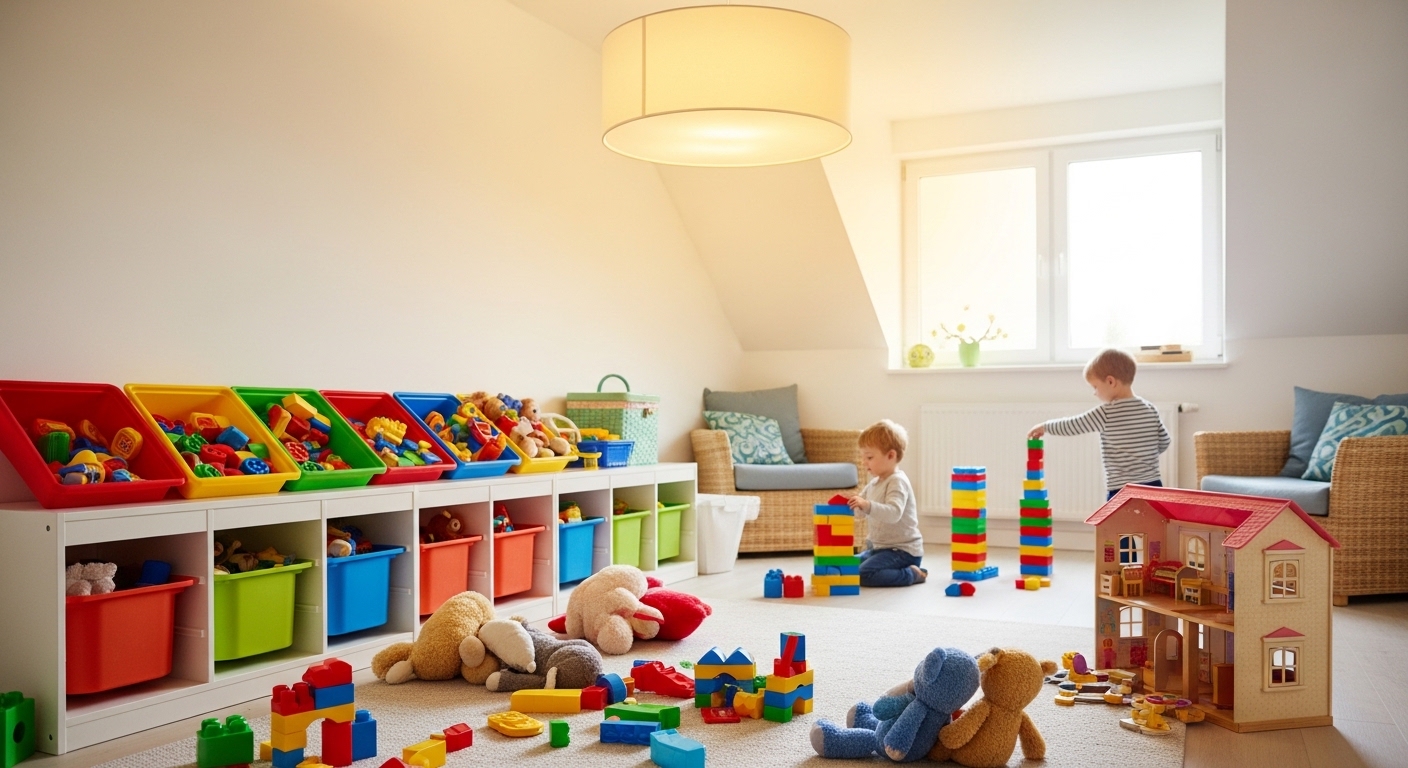
A battery LED strip inside the toy cabinet along the top of the shelf, motion-activated, $24, so a kid finding a game at 7 pm doesn't turn the ceiling to full; it's the fifth light source and the one nobody sees. The cabinet's doors close on the toys and the strip goes off, and the toy cabinet is the toy rotation post's home in this room.
Outlets and cords with five kids
Every cord in the room is in a channel or behind furniture that's anchored: the sconces' in channels, the lamps' extensions in channels along the baseboard, the TV's behind the console. The 4-year-old walks this room barefoot at 6 am, and a cord across a floor is the thing that's not allowed. Outlets that aren't in use have sliding covers. The floor lamp's base is 12 inches and weighted, because it's the one thing in the room that could fall on a kid, and it's behind the chair where the chair blocks it.
The fan question
The fan-light came down and the fan didn't go back, because a fan with a light is a fan that's always on and a light that's always dim, and Nashville summers are what the air conditioning is for; a fan without a light on a separate box is fine, and we don't have the box. If the fan has to stay, a fan with a separate light switch and a 2700K dimmable bulb kit is the compromise, and it's still a fixture that lights the room from one point.
The floor lamp rule
One floor lamp in a room with a 4-year-old, and only because it's behind a chair in a corner where she doesn't go; its base is weighted, its cord is in a channel, and it's the one exception to the no-floor-lamps rule that the playroom and the toddler room hold absolutely. A family room is a room adults are in, which is why the rule bends; the playroom isn't, which is why it doesn't. The playroom post is the strict version.
Movie night
Friday, 7:30, the ceiling off, the sconces at 20, the bias strip behind the TV, the table lamp on for the popcorn bowl, and the floor lamp on for whichever kid's reading instead of watching, which is usually the 12-year-old. Seven people in a 16-by-20 room in the dark with a screen was a headache; the same seven with the wall lit is a Friday. The sconces are the $110 that made the difference, and they were Sunday's job.
What we skipped
Recessed cans, which would have meant an electrician in the ceiling and a room lit like a hallway. A chandelier, in a room where a pillow's thrown daily. A second floor lamp. Smart bulbs in every fixture, which are $15 each and which the dimmers made unnecessary. And painting, which was the plan before the light changed and which the light made unnecessary.
The 6 am cartoon
The 4-year-old's up at 6 and the family room's her room until 7, and the light for it is the table lamp on its smart plug at 6 am and nothing else: enough for the sofa and the remote and not enough to reach the hall. Before the lamp was on a schedule, 6 am meant the ceiling at full and the rest of the house awake. The smart plug was $10 and it's the third-best thing in the room after the dimmer and the sconces.
The room when guests come
Evening setting, plus the ceiling at 40 instead of 30 so faces are lit for talking, and the sconces at 50 so the TV wall is a wall and not a black screen. A family room that's set for guests with two dimmer turns is a room that's ready in ten seconds, and the guests sit on the sectional where the light is instead of the chair where the reader's lamp is. The room's the same room; the settings are what a guest reads as "this house is nice."
The homework at the coffee table
The 7-year-old does his reading log on the floor at the coffee table at 60 percent with the table lamp on, and it's fine for reading; the math goes to the island's pendants at 3000K because a family room at 2700K is a room for winding down. A room can do homework at the light setting for reading and not at the one for arithmetic, and knowing which is which is the reason the two oldest are at the island and the little ones are on the floor.
What the room looked like before
A fan-light at 4000K in the middle of a 16-by-20 ceiling, a floor lamp by the only outlet on the window wall, a table lamp on a side table that wasn't near the sofa, and a TV that was the brightest thing in the room from 7 pm on. It was the room we used most and liked least, and the fix wasn't the renovation I'd been saving for; it was the weekend that made me realize every room in the house had the same problem and the same $200 answer. The home tour is what the house looked like after that realization spread.
Mistakes
Three years of the fan-light at 4000K. The lamps by the outlets. No dimmer, which meant the room was full or off for three years. A floor lamp in the middle of the room in the first house, and a toddler. And waiting for the "real" renovation to do the family room, when the real one was a weekend and $500.
In one paragraph
Saturday: fan-light down, a 2,400-lumen semi-flush drum up, a dimmer at the switch, the lamps' bulbs to 2700K and the lamps moved to where they're needed on channeled cords. Sunday: two plug-in sconces beside the TV at 60 inches on a plug-in dimmer, cords in channels. Four settings on three switches: cleanup, homework, evening, movie. A strip in the toy cabinet. No fan, no cans, no cords on the floor. One weekend, and a room that does everything seven people ask of it.
What it cost
The semi-flush, $140. The dimmer, $22. Two plug-in sconces, $110, and channels and a plug-in dimmer, $30. Bulbs, $30. Extension cords and channels for the lamps, $24. The bias strip, $20. The cabinet strip, $24. About $400 for a weekend that did what I'd budgeted $3,000 and an electrician for, and the sconces are the part Matt noticed.
Shop this post: plug-in wall sconces and ceiling lights, Saturday's and Sunday's fixtures