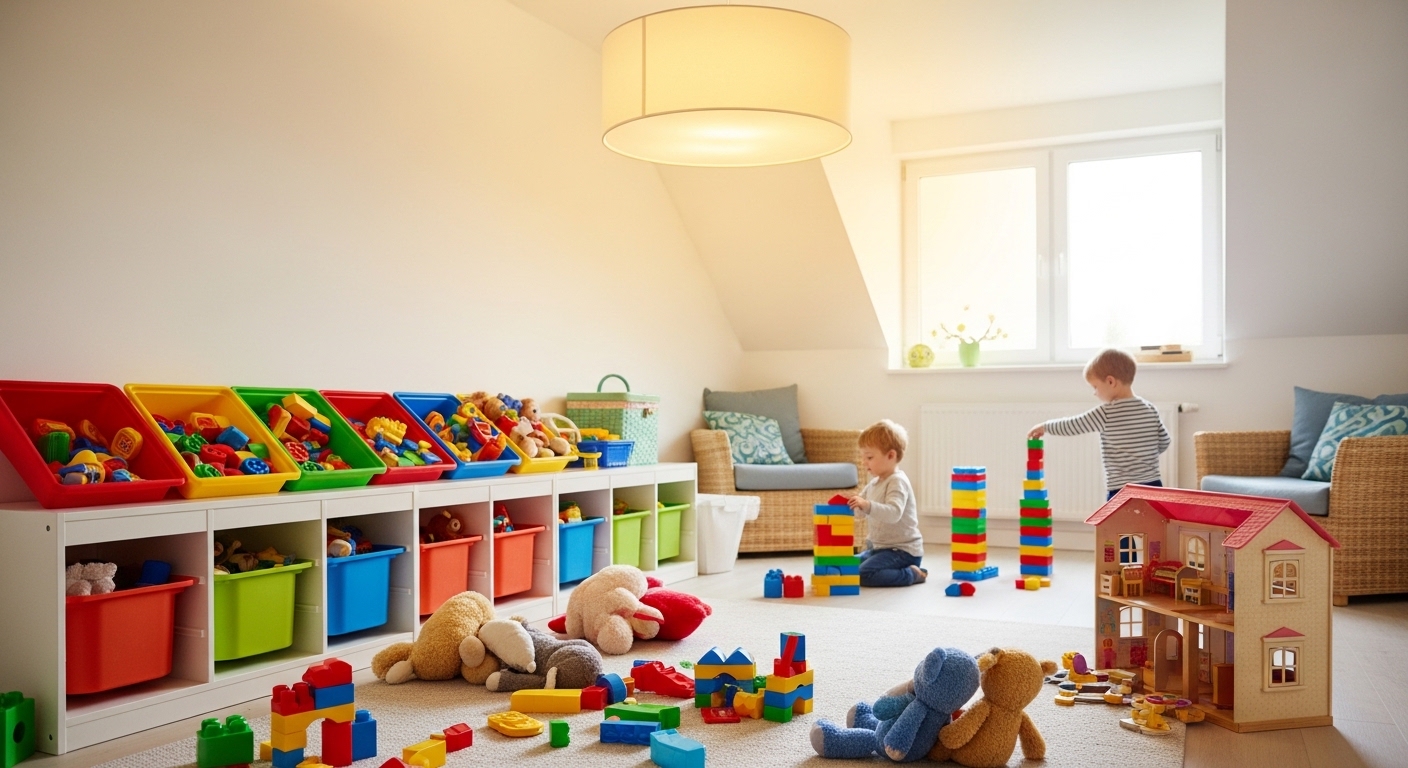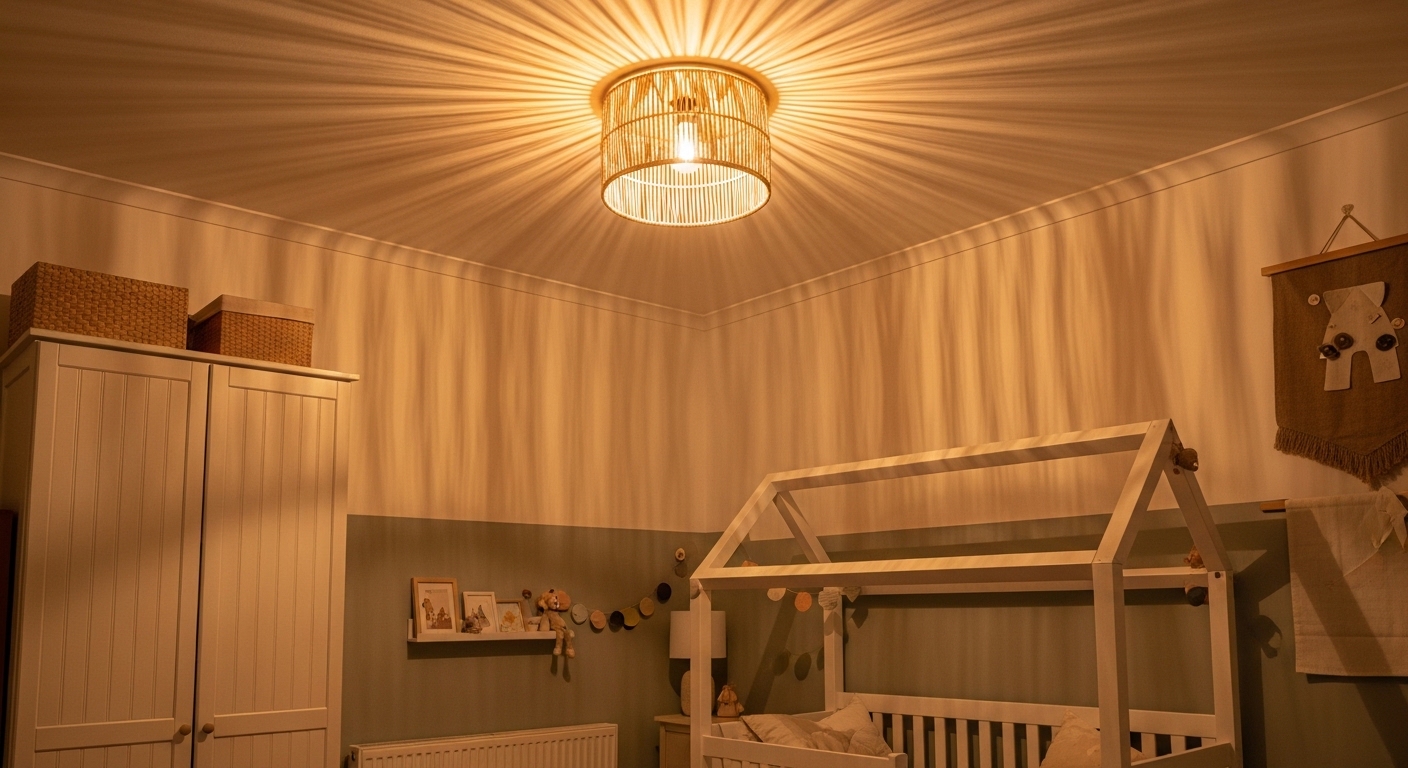
Kids room lighting ideas that grow with the kid from 3 to 13 come down to one rule, classic over cute, and one setup, a dimmable ceiling fixture plus a wall sconce at the bed, and the setup doesn't change when the kid does; what changes is the sconce's switch moving from the parent's hand to the kid's, and the desk lamp arriving at nine. I have three kids in school-age rooms and two in the preschool years, and over twelve years and five kids I've replaced every cute ceiling light that was adorable at three and hated at eight, and I've never replaced the plain ones. This post is the classic-over-cute rule and the fixtures it means, the two-zone setup and why every kid's room in the house has it, the sconce and its switch at each age, the ceiling fixture that lasts, the desk lamp at nine, the shared room's two sconces, the nightlight that leaves at seven, the bulb color by age, the lumens for homework, the fun that comes from bedding and not fixtures, the teen version, the outlet and cord rule by age, the same $52 fixture in three rooms, mistakes, and the cost.
Classic over cute
A cloud-shaped fixture is adorable at four; at nine your kid will actively hate it, and changing it is a ladder, an electrician and $200. A plain flush mount in white or brushed nickel with a frosted lens works from the crib through high school, and the fun comes from the bedding, the art, the rug and the lamp on the desk, which are the things a kid can change without a ladder. Twelve years of buying fixtures for kids' rooms and the only ones I've never replaced are the boring ones, and I've replaced a rocket, a cloud and a set of stars.
The two-zone setup
Every kid's room in our house has the same two zones: a dimmable ceiling fixture for general light, bright for homework and play and dim for bedtime, and a wall sconce or bedside light for reading, which handles a book without the whole room being lit. Two zones is what lets a kid read while a sibling sleeps, which in a house with two shared rooms is nightly. The ceiling's the room's light and the sconce is the kid's, and a room with only the ceiling is a room where the light's always for everybody.
The sconce and its switch, by age
At two, a hardwired sconce 20 inches over the mattress, switch on the fixture, operated by the parent for stories. At six, the same sconce and the switch becomes the kid's, which is a birthday-level event in this house. At nine, the sconce plus a desk lamp. At thirteen, the sconce's shade changes to a swing arm for the reader she's become, and the switch has been hers for seven years. The fixture never moved; the toddler post is the start and the teen post is the end.
The ceiling fixture that lasts
A 13-inch LED flush mount with a frosted lens, 1,200 lumens, 2700K, dimmable, $52, in white; the same one's in the 4-year-old's room, the boys' room and the 14-year-old's, bought three times over six years, and all three are up. It's low enough that nothing hits it, plain enough that nobody's outgrown it, and bright enough for homework at full. The dimmer's a $22 slide and it's the second half of the fixture.
The desk lamp at nine
A desk lamp arrives with the desk, at nine, when homework moves from the island for the projects that need a kid's own room: a metal task lamp with an adjustable arm, 3000K, 500 lumens, positioned to the left of a right-handed kid so the writing hand doesn't shadow the page. It's the only lamp allowed in a kid's room and it's allowed because a 9-year-old's past the pulling-cords age; the homework post is why the desk's for projects and the island's for daily work.
The shared room's two sconces
The 7- and 9-year-olds share a 12-by-13 room, and each bed has its own sconce with its own switch, so the 9-year-old reads at 8:30 and the 7-year-old's asleep at 8, with the ceiling off; the sconces are the only way two bedtimes work in one room. The 12- and 4-year-old's room's the same, with the 12-year-old's a plug-in behind her headboard because the wall wasn't open. The shared room post is the rest of the room; the sconces are what make it two rooms at night.
The nightlight that leaves at seven
A 2200K plug-in nightlight in every room until seven, when the kid says they don't need it, which the 7-year-old said last year and the 4-year-old will say in three; it's the third light in a room that has two zones, and it's the one that leaves. The hallway's 20 percent sconces do the walk to the bathroom after that. A nightlight in a 12-year-old's room is a nightlight that's been forgotten, not one that's needed.
The bulb color by age
2700K everywhere in a kid's room until the desk lamp, which is 3000K for the work; the ceiling stays 2700K because it's dimmed for bedtime and a 3000K bedtime is a kid who's up. A teen's room can go 3000K in the ceiling if it's mostly a work room, and the 14-year-old's is, and hers is. The nightlight's 2200K. The rule is warm for sleep, neutral for work, and a kid's room is mostly sleep until it isn't.
The lumens for homework
The ceiling at full, 1,200 lumens over a 150-square-foot room, is 8 lumens a foot, which is enough for play and not for homework at a desk; the desk lamp's 500 on the page is the homework light. A kid's room needs 10 to 15 lumens a foot for a general light and a pool of 500 on the desk, and the two-zone setup does both without a fixture that's too bright for bedtime. A brighter ceiling fixture for homework is a fixture that's wrong for the room's other 22 hours.
The fun
Bedding, a rug, art on the cork strip, a lamp shade on the desk lamp, a string of paper flags, a beanbag; all changeable in an afternoon by the kid with a birthday gift card, none requiring a ladder, and all of it is what makes the room the kid's. The 7-year-old's room is dinosaurs in the bedding and the rug and nowhere on the ceiling, and when the dinosaurs go the ceiling won't know. The artwork post's cork strip is the kid's wall, and the fixture is the house's.
The teen version
At thirteen, the ceiling fixture on its dimmer, the sconce as a swing arm over the bed, the desk lamp, and a third light she chose, a small lamp on the dresser, which is the one fixture in her room that's hers to pick and is the first pretty thing she's owned; the rule at thirteen bends to one chosen lamp, because the pulling-cords age is over and because a teen with no choices in her room is a teen who doesn't stay in it. The teen post is the room.
The outlet and cord rule by age
Under six: every outlet covered, no cords, everything hardwired or on the ceiling. Six to nine: the nightlight's the only cord, and the sconce's switch is the kid's. Nine and up: the desk lamp's cord in a channel to the outlet the desk hides. Thirteen: the chosen lamp, and the cord rule's a habit. The rules loosen as the kid does, and they loosen one cord at a time.
The same fixture in three rooms
The 4-year-old's, the boys', and the 14-year-old's have the same $52 flush mount and the same $22 dimmer, and three rooms with the same ceiling fixture is a house that reads as decided; the sconces are the same fixture too, in the same brushed nickel, and the differences between the three rooms are entirely in the things the kids can reach. A kid's room's fixtures are the house's and the rest is the kid's, and it's the split that's kept the fixtures up for six years.
What I'd tell a friend with a nursery
Buy the fixture for the 13-year-old, hang it over the crib, and put a sconce 20 inches over the mattress with the switch on the fixture; the room will grow around them and nothing on the ceiling or the wall will change for a decade. The nursery fixture that's cute is the one you'll change at eight, and the nursery sconce that's a lamp is the one that'll fall at fourteen months. It's $52, $58 and an electrician's hour, and it's the last time you'll think about that ceiling.
The boys' room at seven and nine
Two beds, two sconces, one ceiling fixture on a dimmer at the door, and a rule that the ceiling's off at 8 and the sconces are each kid's; the 9-year-old reads until 8:30 under his and the 7-year-old's is off at 8, and neither has ever needed the ceiling after dinner. The desk lamp's the 9-year-old's, on the desk they share on alternating nights for projects, and the 7-year-old gets his at nine like his brother did. Two kids two years apart in one room is the two-zone setup's hardest test, and two sconces with two switches is the answer, and it's $116.
The girls' room at four and twelve
Eight years apart in one room is the other test: the 4-year-old's bedtime is 7 and the 12-year-old's is 9, and the room's the 4-year-old's at 7, dark with the nightlight, and the 12-year-old's at 8:30, with her plug-in sconce behind the headboard at its lowest and a book. The 12-year-old's desk is in the room's far corner with its lamp, and the desk lamp's on a foot switch so it's silent. The nightlight's on the 4-year-old's side, the sconces are on each bed, and the ceiling's off from 7; the room runs on two lights that don't reach across it.
What changes at each birthday
Six: the sconce switch. Seven: the nightlight leaves. Nine: the desk and its lamp. Twelve: the cork strip gets bigger. Thirteen: the swing-arm shade and the chosen lamp. The list's on the inside of the linen closet door with the count card, and it's the reason a kid's room in this house never gets "redone"; it gets one thing at each birthday, and the fixture on the ceiling watches all of it.
The list's the one piece of paper in the house that's about lighting, and it's four lines long, which is how a house of five kids' rooms stays lit without a plan bigger than a birthday.
Mistakes
The rocket, the cloud and the stars, three fixtures, three ladders. A lamp on a dresser in the first nursery. A 3000K ceiling bulb in the boys' room for a month of late bedtimes. One sconce in a shared room, and two bedtimes that couldn't happen. And a desk lamp at seven, for a kid who didn't have a desk's worth of homework and did have a cord to pull.
In one paragraph
A plain frosted flush mount on a dimmer and a wall sconce at the bed with a switch on the fixture, in every kid's room, from the crib. The switch goes to the kid at six, the desk lamp arrives at nine, the shade changes at thirteen. Two sconces in a shared room. A nightlight until seven. 2700K for sleep, 3000K on the desk. The fun in the bedding and the rug. The same $52 fixture in three rooms, six years, and no ladders.
What it cost
Per room: the flush mount, $52; the dimmer, $22; the sconce, $58, and the electrician's hour, $120; the nightlight, $9. About $260 a room, $780 for the three kids' rooms, plus $35 a desk lamp at nine. And $0 in replacements since, which is the number the cute fixtures never got to.
Shop this post: ceiling lights and wall lights for the bedroom, the two fixtures a kid's room keeps