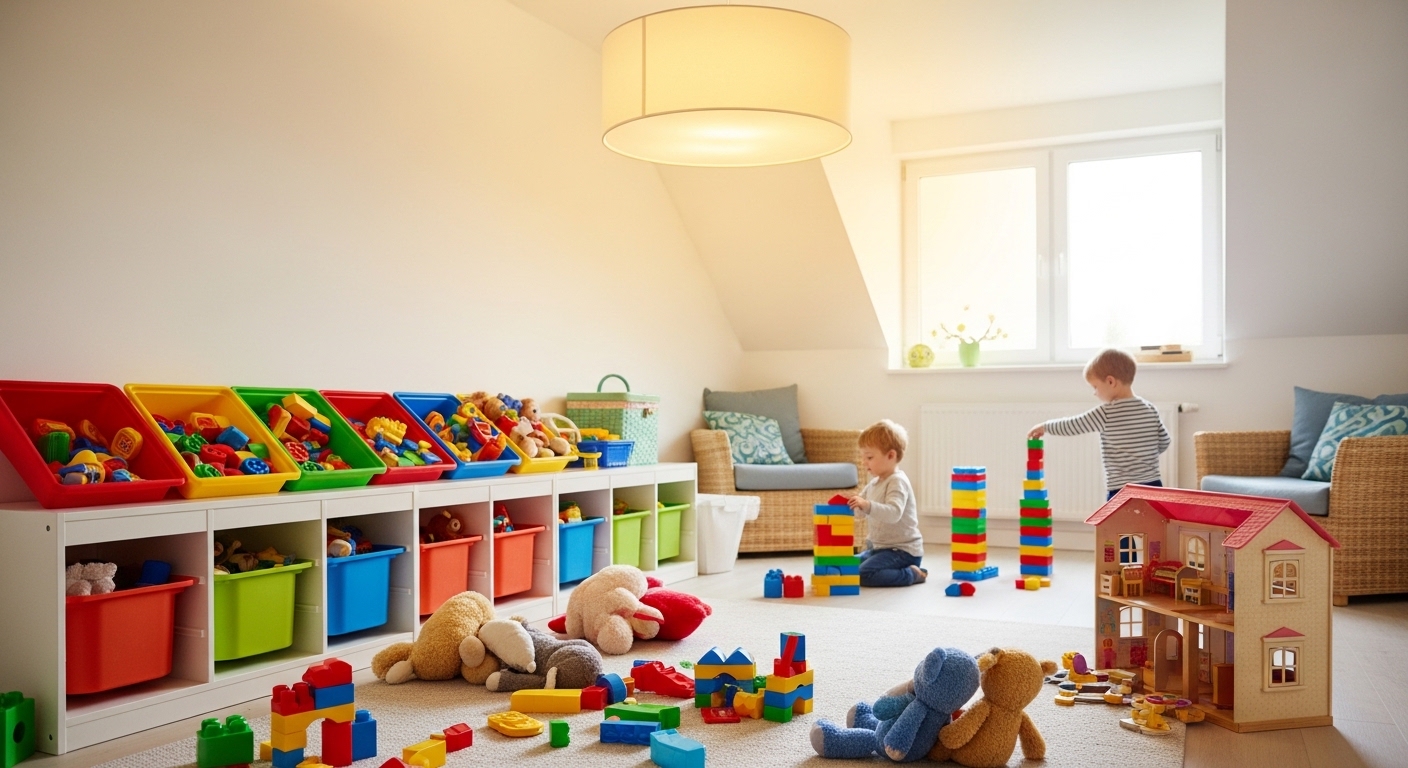
Playroom lighting that survives actual play is a flush-mount LED ceiling fixture with a frosted lens, screwed tight, on a dimmer, plus a wall sconce at reading height that no ball can reach, and nothing hanging, nothing glass, and nothing with a shade. Our playroom ceiling has taken a stuffed animal to the face more than once, and it has a dent from a toy that shall not be named; we replaced the first ceiling fixture twice before buying the right one, which is the lesson this whole post is about. This is the fixture that finally stayed, the two that didn't, the sconce for the reading corner, the lumens a playroom needs and why it's more than a bedroom, the dimmer and the three settings, the lamp rule, the window and the blinds, the nightlight for the sleepover, the outlet covers and cords, cleaning a fixture that catches foam darts, what to avoid, the playroom at three ages, mistakes, and the cost.
The fixture that stayed
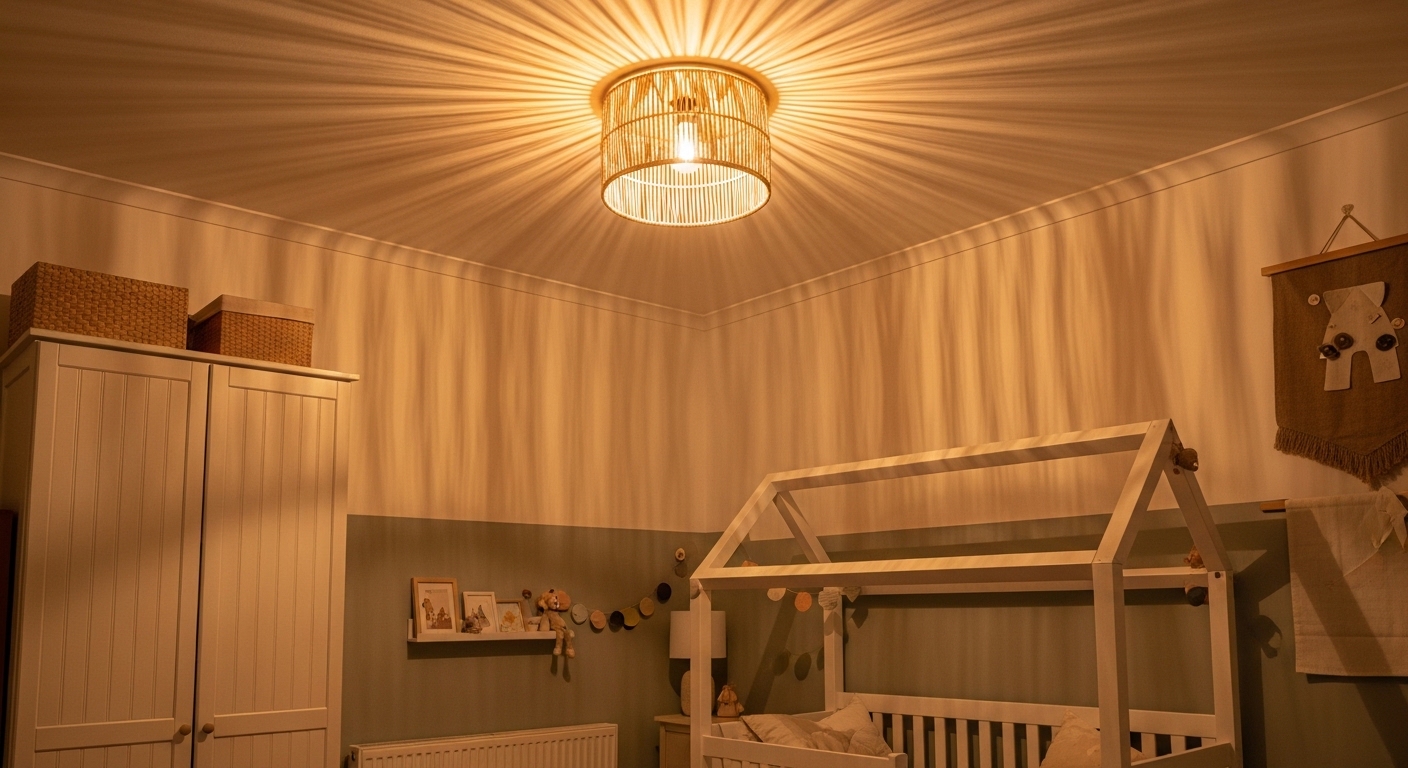
A 15-inch LED flush mount with a frosted polycarbonate lens, not glass, 1,800 lumens, 3000K, dimmable, screwed into the ceiling box with the lens twist-locked; $58 and three years without a mark. It sits 3 inches off the ceiling, so there's nothing to hit, and the lens is the kind that a ball bounces off. It's the least interesting fixture in the house and the one that's done the most work, and the ceiling lights that survive a playroom all look like it.
The two that didn't
The first was the builder's semi-flush with a glass bowl on a stem, which a foam ball knocked and which cracked in month two; a stem is a lever and glass is glass. The second was a fabric drum semi-flush, which looked lovely, collected every foam dart in the house on top of it, and came down when the 7-year-old tried to retrieve them with a broom. Both were fixtures for a room where nobody throws anything, and a playroom is a room where everybody throws everything. The semi-flush post is where a semi-flush belongs, and it isn't here.
The sconce for the reading corner
A hardwired wall sconce at 54 inches to center in the corner with the beanbag and the book ledges, with a switch on the fixture, 2700K, 450 lumens, and a metal shade with no glass; it's high enough that a ball misses it and low enough that the 9-year-old can reach the switch from the beanbag. It's the "I'm reading now" light, and it's the only light in the room that's ever on alone. The reading nook post is the corner; the sconce is its light.
The lumens
A playroom needs more light than a bedroom, about 20 lumens per square foot for play and building, so a 12-by-14 playroom needs 3,000 or so at full: 1,800 from the ceiling fixture and the rest from the sconce and the window. A bedroom gets away with 10 to 15 because nobody's building a marble run on the floor. Too dim a playroom is a playroom where the pieces get lost, and the pieces are the whole problem.
The dimmer and the three settings
A dimmer on the ceiling fixture, $22, with three settings we use: full for building and cleanup, 50 percent for the afternoon, 20 percent for the wind-down before dinner, which is the one that tells the kids the day's ending without a word. A room without a dimmer can only do one thing, and a playroom does three. The dimmer's at adult height by the door and the kids know which setting means what.
The lamp rule
No floor lamps and no table lamps in the playroom, ever, because a lamp is a thing with a cord that gets pulled and a shade that gets knocked, and the first floor lamp in this room lasted eleven days. All the light is on the ceiling or the wall, and the only thing plugged in at floor level is the nightlight. The toddler room post has the same rule for the same reason.
The window
A big south window that's the best light in the room by day, with cordless cellular blinds because a blind cord in a playroom is a hazard, and a valance to hide the top. Daylight is free and it's why the playroom is on that side of the house; the ceiling fixture is for the afternoon and for winter, and it's off until 3 on a sunny day.
The nightlight for sleepovers
A plug-in LED nightlight at 2200K with a light sensor, $9, in the outlet by the door, for the sleepover nights when the playroom floor has four sleeping bags on it; it's the only thing plugged in low and it's behind a cover plate. The sconce at its lowest is the other option, and the 12-year-old runs sleepovers with the sconce and nobody's touched the ceiling switch.
Outlets and cords
Every outlet in the playroom is covered, either with a sliding plate cover or a plugged-in nightlight; the sconce is hardwired so there's no cord; the ceiling fixture obviously has none. The playroom is the one room in the house where the "nothing with a cord" rule holds absolutely, and it's the room the 4-year-old spends the most unsupervised minutes in.
Cleaning the fixture
Twice a year the lens twists off and gets washed in the sink, and whatever's on top of it, foam darts, a marble, a sticker, comes off too. The flat flush mount collects less than the drum did and it's reachable from a step stool. It's a five-minute job that's on the seasonal list with the garage rotation.
What to avoid
Pendants and anything on a stem or a chain. Glass, anywhere. Fabric shades, which catch things. Novelty fixtures, clouds and rockets, which are adored at four and hated at nine, and which cost an electrician to change. Exposed bulbs, which get hot. Fans with lights, which is a room where kids throw things at a fan. And anything that can't be dimmed, because a playroom at one brightness is a playroom that's always the wrong brightness.
The playroom at three ages
At four, it's a floor room and the ceiling fixture at full is the whole light. At nine, it's a building and reading room, and the sconce is used more than the ceiling. At fourteen, it's a hang-out room with friends, and the dimmer at 30 percent is the setting. The same two fixtures did all three, which is the point of buying the boring one: it doesn't have to be replaced when the room's job changes, and it's changed three times in five years.
Sound and the ceiling
The dent in the ceiling is from a wooden block thrown at a foam-dart target taped up there, and it's the reason the target now lives on the wall at 48 inches, below the sconce and away from the fixture. A playroom's ceiling is a target whether you intend it or not, and the fixture up there has to be the kind that doesn't mind. The dent stays until the next paint job, as a monument.
Installing the flush mount yourself
A flush mount on an existing ceiling box is a forty-minute job for a confident homeowner: breaker off, old fixture down, the new bracket onto the box, three wires connected with nuts, the fixture onto the bracket, the lens twisted on. Matt did ours in thirty with the 14-year-old holding the fixture, and the dimmer took another twenty at the switch. The sconce was the electrician's job because it needed a new box in the wall, and that's the line: an existing box is a Saturday, a new one is a professional. Turn the breaker off, not just the switch, and check with a tester, because a playroom is the room where a kid flips a switch to see what happens.
The color temperature, and why 3000K here
Most of the house is 2700K; the playroom is 3000K, because it's a work room by day, building and drawing and homework at the little table, and a slightly cooler white shows colors true and keeps kids alert in the afternoon. It drops to 2700K in feel when the dimmer's at 20 percent, because dimmed LEDs read warmer. The sconce is 2700K because it's the reading light and reading is for winding down. Two temperatures in one room, one for each of the room's jobs.
The playroom as a guest room
Twice a year the playroom is where cousins sleep, on the floor in sleeping bags, and the lighting handles it without a change: the sconce at its lowest as the bedside light, the nightlight by the door, the ceiling fixture off, and the dimmer up to full at 7 am when Matt turns it on to get eight kids moving. A playroom that's lit for play and reading is already lit for a sleepover, which is the argument for the sconce; a ceiling fixture alone would mean a room that's either bright or black.
What the light does for cleanup
Cleanup is at full brightness, every time, because a playroom at 50 percent is a playroom where the small pieces get missed and a small piece on the floor at 2 am is a foot injury. "Lights to full" is the first step of the cleanup routine on the wall chart, the same as "lights off" is the last, and the kids do the dimmer themselves because it's a physical thing to do that starts the job. It's a teacher trick: the classroom lights going to full meant transition time, and it works at home.
The playroom fixture at the store, in five questions
Is the lens plastic? Is it within 4 inches of the ceiling? Is it 1,500 lumens or more? Is it dimmable, and does the box say which dimmers? Can the lens come off without tools for cleaning? Five yeses is the playroom fixture; four is a bedroom fixture; three is a fixture for a house with no kids. It took two wrong ones to write the list, and it's the list I text to friends who ask, which is about once a month, because every family has a playroom ceiling that's been hit.
What the sconce taught the kids
A light with its own switch at kid height is a light a kid controls, and the reading corner's sconce is the only light in the playroom the 7-year-old turns on and off himself. It made the corner his: he turns it on, reads, turns it off, and the turning off is the part that surprised me, because a kid who's given a switch treats the light as a thing to be managed and a kid who isn't leaves every light in the house on. It's the same lesson as the bike hook at his height, and it cost $64 and an electrician's hour.
Mistakes
Two semi-flush fixtures, $140 and two afternoons on a ladder. A floor lamp, eleven days. A cloud fixture in the first house that the oldest asked us to take down at eight. No dimmer for the first year, and a playroom that was either on or off. And a blind with a cord, replaced the week the 4-year-old was born.
In one paragraph
A flat LED flush mount with a frosted plastic lens, 1,800 lumens, 3000K, on a dimmer, and nothing hanging. A wall sconce at 54 inches in the reading corner with its own switch. No lamps, no cords, no glass, no novelty. A cordless blind on the best window. A nightlight for sleepovers. Two fixtures that lasted three years in a room that's dented the ceiling.
What it cost
The flush mount, $58. The sconce, $64, and the electrician's hour to hardwire it, $120. The dimmer, $22. The nightlight, $9. Outlet covers, $8. About $280 for a playroom that's lit for building, reading and winding down, and $140 of it, the two fixtures that failed first, is the part I'd have saved by reading this.
Shop this post: ceiling lights and wall sconces, the two fixtures a playroom can't break