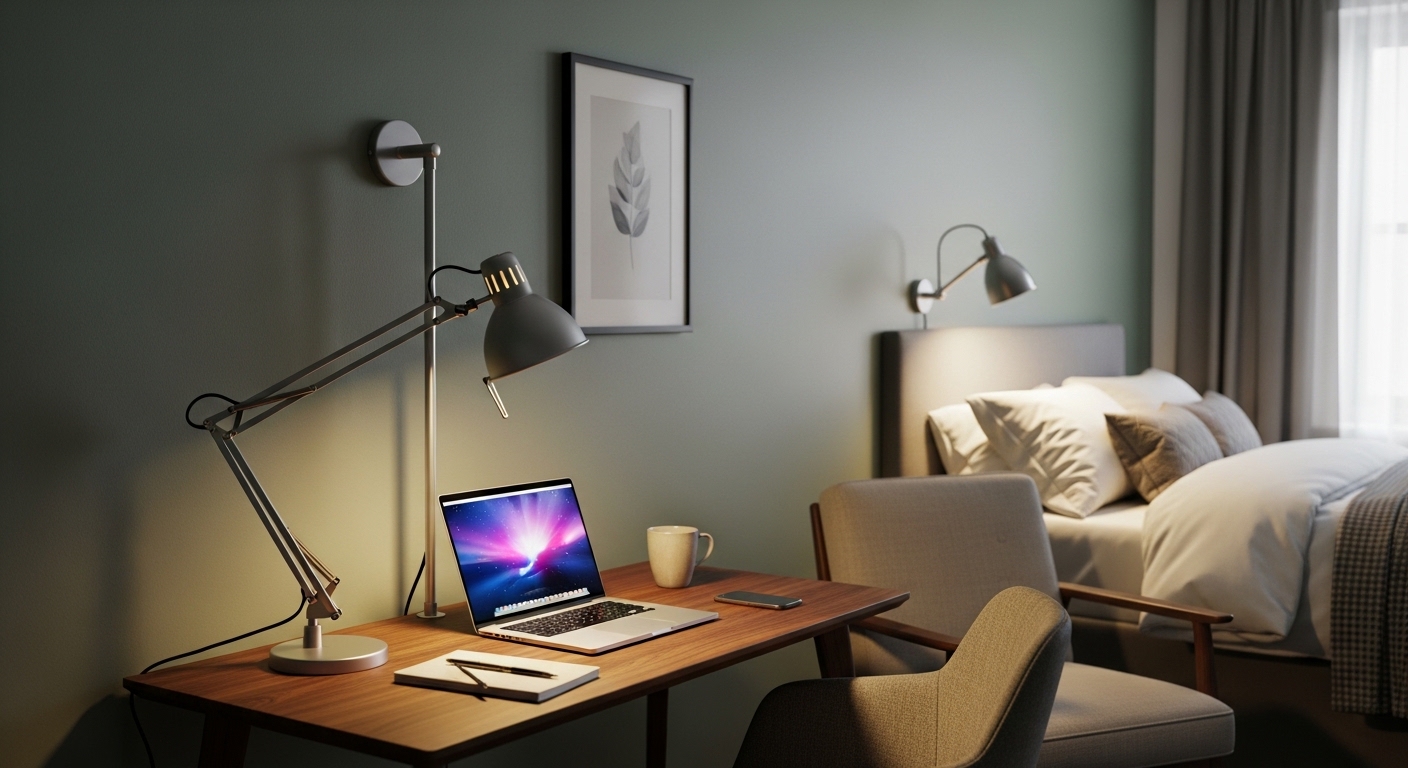
A guest room and office combo works when the room switches between its two jobs without moving furniture, and the switch is mostly lighting: a swing-arm sconce over the desk on its own switch, two bedside sconces the guest can reach from the pillow, and an overhead on a dimmer with three settings. Our fifth bedroom is 11 by 12 feet and does both jobs, out-of-town family four or five weekends a year and me the rest of the time, on the days when I need quiet from five kids. For years I picked one job and let the other suffer: a desk shoved in a corner with a lamp, and guests reading by the ceiling light. This post is how we made the room do both, the layout, the furniture that pulls double duty, the lighting plan with switches and bulbs, the storage that keeps my work out of a guest's sightline, the 30-minute changeover, what it cost, and what I'd fix.
The layout: bed on one wall, desk on the other, and a line between them
The queen bed is on the long wall opposite the door, headboard centered, with a nightstand each side. The desk is on the wall to the right of the door, under the window, 48 inches wide, with its back to the bed so that when I'm working I'm facing the window and when a guest is sleeping the desk reads as a console table. The closet is on the wall left of the door and holds the guest's things on one side and my work on the other. The rule that makes it feel like two rooms in one: nothing about work is visible from the bed. Laptop closed and in a drawer, papers in the closet, the chair pushed in. A guest should be able to lie down and see a bedroom, and I should be able to sit down and see an office, and the trick is that they're facing different walls. The eight years of classroom layouts taught me that where a person faces decides what room they think they're in, and it's as true of a guest room as a reading corner.
Furniture that does both jobs
The desk is a plain 48 by 24 inch table with two shallow drawers, in the same wood as the nightstands, so it reads as furniture rather than office equipment; a desk with a hutch or a cable tray on the back would have been an office forever. The chair is an upholstered dining chair, not a rolling office chair, which was the single biggest change in how the room feels; a task chair on wheels says "office" from the doorway. The bed is a real queen with a real mattress, because a sofa bed is a bad office sofa and a worse guest bed, and because guests notice a mattress more than anything else in the room. The nightstands are the guest's on the weekends and mine, for reference books, in the week. A bench at the foot of the bed holds a guest's suitcase and, in the week, the printer, under a lid.
The work zone lighting
A swing-arm wall sconce mounted above the desk at 48 inches from the floor, on its own wall switch by the desk. During work hours it's angled down onto the desk with a 3000K bulb, neutral and focused, and it's the only light on in the room at 10 am, because the window does the rest. When guests arrive I swing the arm up and against the wall, and the same sconce becomes a soft uplight on the window wall. The bulb swap I used to do, 3500K for work and 2700K for guests, I've stopped, because 3000K is a reasonable compromise for both and changing a bulb every other Friday is the kind of system that dies in month three. A smart bulb that shifts color temperature on a schedule is the better answer if you want both.
The sleep zone lighting
Two bedside sconces flanking the bed at 26 inches above the mattress, each with its own switch on the fixture, reachable from the pillow. Guests can read or turn off their light without getting up, and this is the detail that gets commented on more than anything else in the room; people notice when they don't have to fumble in the dark, and they say so at breakfast. 2700K, 450 lumens each, warm and dimmable. In the week those sconces are off and the bed is made, and the room from the desk looks like a bedroom in a hotel I can't afford, which turns out to be a pleasant place to work.
The overhead, and the three settings
One dimmable overhead on a third switch by the door, a flush mount with a 2700K bulb. Work hours: about 80 percent, for the days when the window isn't enough. Guest arrival: 60 percent, so the room is lit and welcoming when I open the door with their bag. Night wind-down: 20 percent, or off, with the bedside sconces doing the rest. Three switches, three zones, no lamps to move. The room changes from office to guest room with two switches and one swing of an arm, and no furniture moves, which is the whole design brief. My bedroom lighting post covers the same three-zone idea in a room that only has one job.
Storage: where work goes when a guest arrives
Half the closet has shelves with lidded boxes: one for current projects, one for the blog, one for the household admin that lives in the command center when it's active and here when it's filed. The laptop lives in the desk's top drawer. The printer lives in the bench. Cables run through a grommet in the desk to a strip on the wall behind it, so nothing trails. The rule I hold myself to: a guest opens the closet and sees hangers, a luggage rack and a shelf with towels, and nothing that's mine below eye level. The other half of the closet is theirs, with six empty hangers, because a guest who has to ask where to hang a coat is a guest who feels like they're in your office.
The 30-minute changeover
Friday afternoon, in order: laptop and papers into the drawer and the closet boxes, printer into the bench, chair pushed in, sconce swung up, desk wiped and a small lamp-free arrangement on it (a tray, a carafe, a plant). Fresh sheets, which are the same sheets we use in our room so nobody's guessing what's "guest" quality. Towels on the bench, two per person, plus a washcloth. Bedside sconce switches tested from the pillow. Overhead set to 60. The wifi card in the nightstand drawer. Thirty minutes, and it's on the chores chart for the 14-year-old as a paid job when she wants one. Sunday evening, reverse, twenty minutes, and I'm working in it Monday at 9.
Guest room office combo ideas for smaller rooms
In a 10 by 10 room, a full bed against the wall lengthwise (not centered) and a 36-inch desk on the opposite wall leaves a 30-inch walkway, which is enough; the bench at the foot goes. In a room that's really a large closet, a daybed with a trundle doubles as the office sofa and the guest bed, and it's the one case where I'd accept a sofa bed's cousin. A wall-mounted fold-down desk, 30 inches wide, on the wall beside the closet, with the sconce above it, is the smallest office that works and it disappears on Friday with one hinge. A murphy bed is the expensive answer and the best one if you work in the room five days a week and host four weekends a year; ours didn't justify it, but a friend's 9 by 11 room did, and her office is a real office 48 weeks a year. Whatever the size, the lighting plan is the same three zones on three switches; the furniture shrinks and the switches don't.
Making a guest feel at home, beyond the lighting
The things guests have thanked us for, in order of how often: the bedside sconce switches, the wifi card in the nightstand drawer, the empty hangers, a glass carafe of water, a phone charger with three connectors, a small bin, and a note with the coffee maker instructions taped inside the kitchen cabinet so they don't have to ask at 6 am. None of that costs more than $30 total. The thing nobody has ever mentioned is the art. The thing everyone mentions is that they could turn off their own light from the bed, which is the cheapest of the lot and the reason this post is mostly about sconces.
Working in a guest room with five kids on the other side of the door
The room's office job depends on a closed door and a rule, and the rule is a sign. A small wooden "working" sign on the door handle means the 9-year-old knocks and the 14-year-old texts; it means nothing to the 4-year-old, who is Matt's or the 12-year-old's during work blocks, on the same schedule as the toy rotation. The room is at the far end of the hall from the playroom, which helps, and a white noise machine on the desk, $28, does the rest. Sound was the thing I hadn't planned for and the thing that decides whether the room is an office at all. On the guest side, the same machine goes on the nightstand, because a guest sleeping twelve feet from five kids at 6:40 am appreciates it more than the towels.
The lighting plan on one line, for copying
Desk: swing-arm sconce at 48 inches, own switch, 3000K, angled down for work and swung up for guests. Bed: two sconces at 26 inches above the mattress, switch on each fixture, 2700K, 450 lumens. Ceiling: one flush mount on a dimmer, 2700K, 80/60/20 percent for work, arrival and night. Three switches, no lamps, no bulb swaps, no furniture moved. Add a smart bulb in the desk sconce if you want it cooler at 10 am and warmer at 10 pm without touching it, and a $28 white noise machine that lives on whichever surface the room's current job needs. That's the whole system, and it's the part of this post I'd copy if I were building the room again in a different house, which, with five kids, I may yet do.
What a guest room office combo costs, ours
The desk, secondhand and refinished: $110. The dining chair: $85. Two bedside sconces: $180 for the pair. The swing-arm sconce: $95. The overhead dimmer and the electrician's visit for the three switches: $260. The bench with storage: $140. Closet shelves and boxes: $120. Bedding for a queen we already owned: $0. About $990 for a room that was a desk in a corner and a bed nobody used, and the lighting is more than half of it, which is the right proportion for a room whose entire trick is light.
What I'd fix
An outlet at desk height, which the electrician could have added for $80 while he was there and which I didn't think of until the first trailing cable. A blackout blind under the curtain, because guests from two time zones west wake at 5 am Nashville time when the sun comes over the fence. A door hook for a robe, which costs $6 and which every guest has asked about. And I'd have bought the dining chair first; I worked for a year in a rolling task chair that made the room an office no matter how the lighting was set, and the day it went to the garage the room became what it is now. The lighting made the room switch. The chair let it. The white noise machine made it possible in the first place.
Shop this post: swing-arm and wall sconces and bedside wall lamps