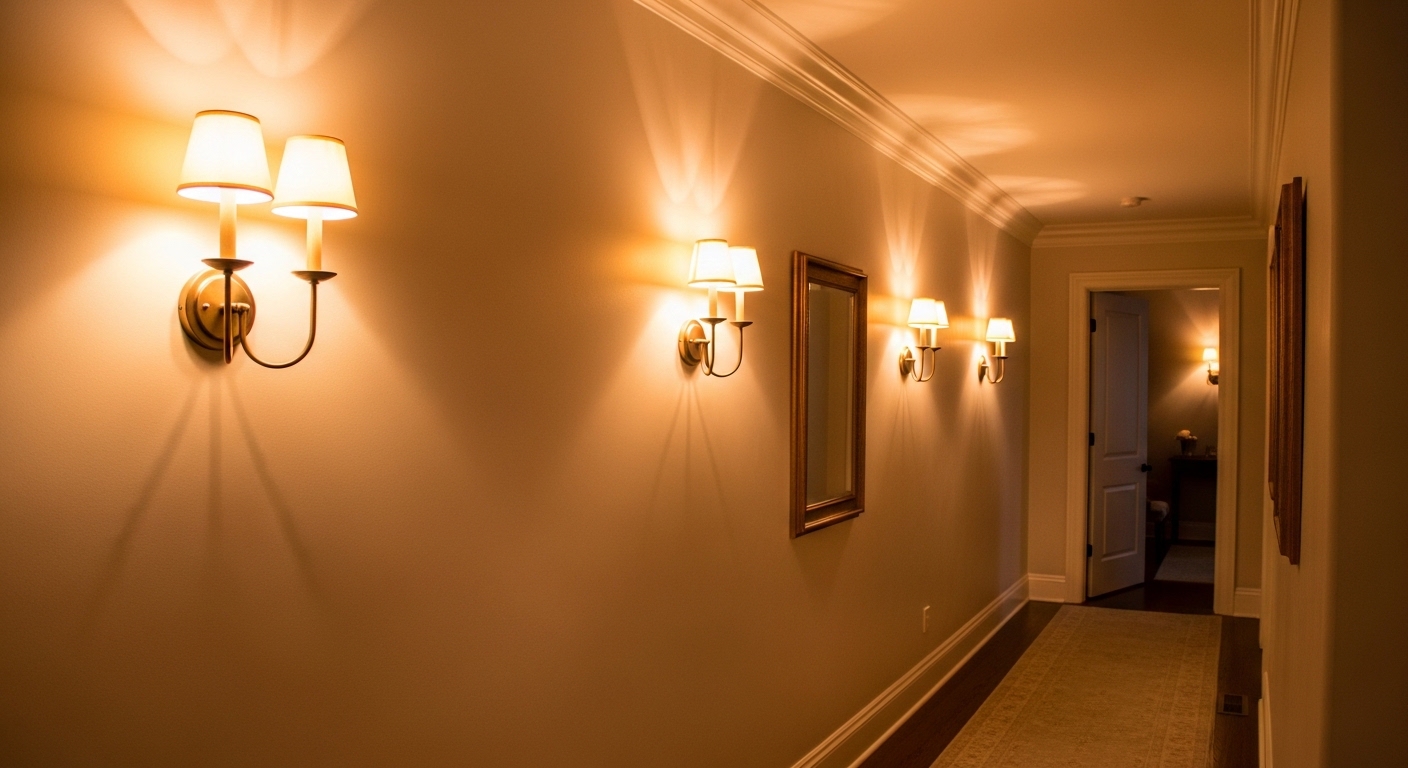
Hallway lighting ideas for a family come down to wall sconces spaced every 8 feet at 66 inches to center, on one dimmer, with a 20 percent overnight setting, and the sconces have to be the kind a shoulder can hit without breaking. Our hallway is 40 feet long, connects the bedrooms and two bathrooms, and sees about 200 person-crossings a day, most of them at a run; before the sconces it was lit by two ceiling fixtures 20 feet apart and it felt like a corridor in a hotel nobody wanted to stay in. Five sconces changed how the whole house feels. This post is the spacing rule and the arithmetic, the height and why 66, the fixture type that survives a hallway, the dimmer and the three settings including overnight, the bulb color, the one-switch-both-ends wiring, what to do with the existing ceiling fixtures, the hallway with a window and the one without, the rule about what hangs between sconces, night trips by a 4-year-old, mistakes, and the cost.
The spacing rule
One sconce every 8 feet, starting 4 feet from each end, so a 40-foot hallway gets five: at 4, 12, 20, 28 and 36 feet. Eight feet is the distance at which two sconces' pools of light meet on the wall without a dark band between them, at the 450 lumens a hallway sconce puts out; at 10 feet there's a dark patch a kid runs through, and at 6 it's a runway. The arithmetic: hallway length minus 8, divided by 8, plus one. A 24-foot hallway gets three; a 16-foot one gets two.
Which wall
All on one wall, the one with fewer doors, so nothing swings into a fixture and so the light is even; alternating walls makes a zigzag that reads as busy. Ours are on the wall opposite the bedroom doors, which means each bedroom door is lit from across the hall and a kid coming out at 2 am can see the floor. If both walls have doors, the sconces go between the door frames on whichever wall has the longer gaps.
The height
Sixty-six inches to the center of the fixture, which is above a 14-year-old's shoulder and a 6-foot husband's line of sight, and below the point where a sconce lights the ceiling instead of the hall. Sixty is the rule in a bedroom where you're sitting; a hallway is walked and the sconce goes 6 inches higher. The reading lights post is the bedroom heights; this is the standing one.
The fixture type
A wall sconce that sits within 4 inches of the wall, with a metal or frosted acrylic shade, no glass and no arm; a backpack or a shoulder hits a hallway sconce weekly and a 4-inch-deep fixture takes it. Ours are a cylinder up-and-down in brushed nickel, 450 lumens each, which throw light up the wall and down to the floor and leave the middle soft. Anything that projects more than 4 inches is a hook for a backpack strap, and we learned that with a sconce that had a 7-inch arm and lasted a month.
The dimmer and the three settings
All five on one dimmer: full for cleaning and finding the missing shoe, 40 percent for the evening, and 20 percent overnight, which is the setting that changed the house. At 20 percent the hallway is lit enough for a kid to get to the bathroom without a light coming on in anyone's room and dim enough that nobody wakes; it's on from 8 pm to 6 am on a smart dimmer, $45, and it's the reason the hall ceiling lights haven't been switched on in four years.
The bulb
2700K, 450 lumens, dimmable, in every sconce, and the same bulb in the bathrooms' nightlights so a kid walks from one warm light to another. A 3000K hallway is a hospital at 2 am; a 2200K one is too dark for finding a shoe at full. The bulbs are the same across five fixtures and it matters more than in any other room, because you see all five at once.
Wiring: one switch at each end
A three-way circuit, a switch at each end of the hall, one of them the dimmer and the other a plain three-way, so the sconces can be turned on from the kitchen end and off from the bedroom end; the electrician ran the five sconces on the existing ceiling circuit in a day, $650, and the two ceiling fixtures came off that circuit onto their own switch. If the walls are open for a renovation, run the sconce circuit then; if not, it's a day of fishing wire and it's still worth it.
The existing ceiling fixtures
Ours stayed, on their own switch, with 2700K bulbs, for the once a month someone needs the hall at full for a spill. In a hallway with sconces the ceiling fixtures are backup, and the cheapest thing to do with them is leave them and stop using them; the expensive thing is to take them out and patch the ceiling, which we didn't. A flush mount in a hallway is fine as long as it isn't the only light.
The hallway with a window, and the one without
Our upstairs hall has a window at one end and the sconces near it are off until dusk; the downstairs hall to the mudroom has no window and its two sconces are on a daylight schedule, 30 percent from 7 am. A windowless hallway needs the sconces on all day at a low level or it's a tunnel, and the smart dimmer does it without anyone thinking about it. The mudroom post is where that hall ends.
What hangs between the sconces
Family photos in matching black frames, in the 8-foot gaps, at 58 inches to center so they're lit from the sconce's side and not glared by it; the sconces light the frames and the frames give the hall a reason to be looked at. The artwork post is the rotating frames on the downstairs hall. Nothing hangs within 12 inches of a sconce, because that's the spot a sconce lights from the wrong angle.
Night trips
The 4-year-old goes to the bathroom at night on her own, and the 20 percent hallway is why: her door, the hall, the bathroom nightlight, and back, without a switch and without a wake-up. Before the sconces she'd call out, and the calling woke the 7-year-old, and the night was over. A hallway that's lit at 20 percent all night is the single best sleep investment in a house with five kids, and it costs about $3 a year in electricity.
The sconces and the backpacks
Five kids come down the hall at 7:40 am with backpacks, and the sconces are at 66 inches with nothing projecting, and in four years one has been knocked askew and none have broken. The 7-inch-arm sconce from the first month is the reason for the 4-inch rule, and it's in the garage's "outgrown" bin waiting for a house with no children in it.
The plug-in version, for renters or for no electrician
The same rule, every 8 feet at 66 inches, works with plug-in sconces on adhesive strips and cord channels down to baseboard outlets, which a hallway usually has one of every 12 feet by code; a friend in a rental did four in a 30-foot hall with two extension cords in channels and a plug-in dimmer on each, about $250, and it's the same hallway at night. The plug-in sconces need the same 4-inch-deep rule and the same 2700K bulb, and the strips get the alcohol wipe and the hour of pressure. It's the version I'd have done in this house if we'd rented it.
What the sconces did to the rest of the house
The hallway is the spine, and lighting it changed how every room off it feels: the bedrooms have a warm hall outside them instead of a black one, the bathrooms are approached at 20 percent instead of by a switch, and the kids' rooms at bedtime are lit through the door crack by a light that isn't a ceiling. It was the project that made me look at every ceiling fixture in the house and ask what it was for, and the home tour is what happened after. The sconces cost a thousand dollars and they changed a $400,000 house more than the kitchen did.
Sizing the sconces to the hall
A hallway 42 inches wide, like ours, takes a sconce 4 to 5 inches wide and 10 to 12 tall; a 36-inch hall takes a smaller one, and a wide hall of 5 feet can take a 6-inch fixture. The rule is that the sconce should read as a mark on the wall and not a thing in the hall, and in a narrow hallway anything wider than 5 inches is a thing. Five identical fixtures, because a hallway is the one place five different sconces would look like a store.
The hallway in the morning
At 6 am the smart dimmer brings the sconces from 20 percent to 60, which is the wake-up signal in a house where nobody's allowed to bang on doors; the hall gets brighter, the doors open, and by 7 the sconces are at full for the shoe search. At 7:45 the hall is empty and they drop to 30 for the day. The morning ramp was an accident of the smart dimmer's schedule feature, and it's now the thing I'd miss most, because a hallway that brightens slowly is an alarm clock that doesn't make a sound.
The bathroom nightlights, which finish the route
A kid's 2 am route is bedroom door, hall, bathroom, and the hallway sconces do the middle; the bathrooms have a plug-in 2200K nightlight each with a light sensor, $9, so the route ends in a light that's dimmer than the hall and nobody flips the vanity switch. The two bathrooms' nightlights and the five sconces are one system, and the family bathroom post has the rest of the bathroom; the nightlight is the part that belongs to the hall.
The hallway as the house's clock
Five settings a day, and the kids read them without being told: 60 percent means get up, full means find your shoes, 30 means the day, 40 means evening, 20 means it's night and you're supposed to be in bed. A hallway that changes brightness on a schedule is a house that runs on a clock nobody has to announce, which in a house of seven is the thing I'd never have thought to buy and can't now imagine living without. The teacher in me recognizes it: the classroom lights were the schedule too, and the kids who learned that at school learned this at home in a week.
Mistakes
The 7-inch arm. The first spacing, 10 feet, with a dark patch the 9-year-old called the tunnel. A 3000K bulb in one sconce for a week before anyone could say what was wrong. And two years of two ceiling fixtures, which is the mistake everyone's making in every hallway in America.
In one paragraph
Sconces every 8 feet, 4 feet from each end, on one wall, at 66 inches, within 4 inches of the wall, no glass. One dimmer with a three-way at the other end: full, 40 percent, 20 percent overnight. 2700K at 450 lumens. Photos between them at 58 inches. The ceiling lights on their own switch and never used. Five sconces, a 40-foot hall, and a house that stopped feeling like a hotel.
What it cost
Five sconces, $320. The electrician, $650. The smart dimmer, $45, and the three-way switch, $12. Bulbs, $30. About $1,060 for a hallway that's lit for 200 crossings a day and every 2 am trip, and if I could only do one lighting project in a family house again it would be this one.
Shop this post: wall sconces and modern wall sconces that sit close to the wall