Kids artwork display for a family that produces about forty pieces a week comes down to one rotating frame per kid on one wall, one bin per kid per year, and a photo of everything else before it's recycled, and the system has handled five kids' output for five years without a refrigerator door in sight. Five kids at three schools plus a preschool is a grocery bag of paper a week, and the choice is a system or a house that's wallpapered in tempera. This post is the display wall with five frames, the frame type that opens from the front, the rotation rule and who does it, the bin per kid and its yearly cull, the photo step and the book it becomes, the sconce on the wall that made it a gallery, the 3D things and the giant things, what the kids get to decide, the school's stuff versus the home stuff, the kitchen's one clip, the grandparents' mail, the wall at the end of the year, mistakes, and the cost.
The display wall
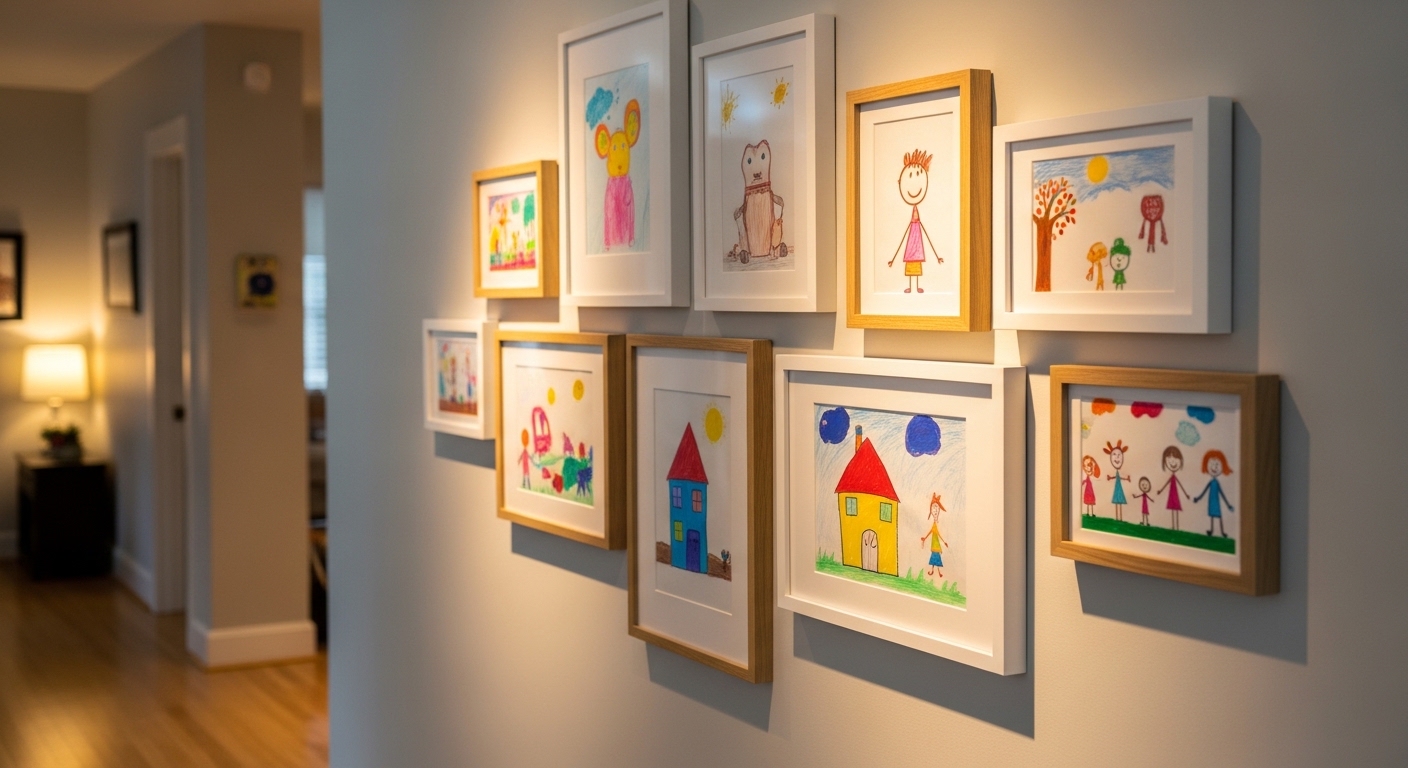
The downstairs hall between the kitchen and the mudroom, 14 feet of wall that everyone passes twenty times a day, with five front-loading frames in a row at 48 inches to center, which is the height a 9-year-old sees and a 14-year-old doesn't have to stoop for. One frame per kid, 11 by 14 with a mat for 8.5 by 11, in the same black, with a small name tag on the mat. It's the gallery, and it's the only place art hangs in the house, which is the rule that keeps the fridge a fridge and the walls walls.
The frame that opens from the front
A front-loading frame, the kind with a hinged face that swings open so the paper slides in without taking the frame off the wall, $22 each; it's the whole system, because a frame that has to come down to change the picture is a frame that changes twice a year. The 7-year-old changes his own; the 4-year-old points and I do it. The frames are screwed to the wall on two hooks each, because five kids pass them at a run and a frame on one nail is a frame on the floor.
The rotation rule
Sunday, with the kitchen reset, each kid picks the one piece from the week that goes in the frame, and the one coming out goes in that kid's bin or in the recycling with a photo. One a week, chosen by the kid, which is the part that matters: a kid who picks is a kid who looks at her own work and decides, and a kid whose parent picks learns that Mom's the judge. The 14-year-old rotates about monthly now, and the 4-year-old wants to rotate daily and is held to Sunday.
The bin per kid
One flat 12-by-18 plastic bin per kid, labeled, in the closet under the stairs, for the year's keepers: the things that came out of the frame and were too good to recycle, the report-card art, the handprint things. Once a year, the last week of summer, each kid goes through their bin with me and keeps ten, and the ten go in a portfolio box with the year on it; the rest gets photographed and recycled. Five bins, five portfolio boxes, and five years of ten pieces a year is fifty pieces a kid by high school, which is a box you can carry.
The photo step
Everything that doesn't make the frame or the bin gets a photo on my phone before the recycling, in a shared album per kid, thirty seconds a week. The album becomes a printed photo book each December, $30, one per kid, with the year's art in it, and the book is what the grandparents get and what the kid keeps; a book of two hundred pictures is a shelf, and two hundred pieces of paper is a room. It's the step that made recycling possible without guilt, mine or theirs.
The sconce that made it a gallery
A wall sconce at each end of the row of frames at 62 inches, 2700K, on the hallway's dimmer, grazing across the five frames; before the sconces the frames were five rectangles in a dark hall, and after, they're a gallery that guests stop at. A picture that's lit is a picture that's looked at, and the kids noticed the difference the week the sconces went in: the rotation got more competitive. The hallway post is the sconce spacing; the art wall is what hangs between two of them.
3D things and giant things
A shelf above the frames at 66 inches, 6 inches deep, for the clay and the papier-mache and the popsicle-stick things, one per kid, rotated the same Sunday; anything too big for the shelf gets a photo and a week on the kitchen counter and goes. The giant paper things, the 3-foot murals from preschool, get photographed on the driveway and recycled the same day, and the 4-year-old has learned to say "take a picture" as she hands one over. A house of seven can't keep 3D art, and the shelf is the compromise.
What the kids decide
Which piece goes in the frame. Which ten stay in the box at the end of the year. Whether a thing goes to a grandparent. What they don't decide is whether the fridge is a gallery, whether art goes on their bedroom walls in a heap, or whether the giant things stay; those are house rules, and they're the same for the 14-year-old as the 4-year-old, which is why the 14-year-old still participates. A kid who decides within a system respects the system; the classroom version was the same.
School stuff versus home stuff
School art comes home in the folder on Friday and gets sorted Sunday; home art, the drawings on the kitchen table, goes straight to the photo step and the recycling unless a kid claims it for the frame. The kitchen table produces more than the schools do, and it's the stuff that used to be everywhere; the rule that home art has to be claimed by the artist to be kept cut the pile in half. The homework station has a drawer for the in-progress things so they're not on the table.
The kitchen's one clip
One magnetic clip on the side of the fridge, not the front, for the one thing that has to be seen this week: the permission slip, the party invitation, the drawing the 4-year-old made for Matt and wants him to see when he gets home. One clip, one thing, and it's cleared Sunday. The fridge front is bare, which in a house of five kids is the thing visitors remark on first, and it's a rule not a miracle.
The grandparents' mail
Once a month, each kid picks one piece from their bin to mail to a grandparent, in a big envelope with a note, which is the outlet for the art that's too good to recycle and too plentiful to keep; the grandparents have their own display wall, one frame per grandkid, which they copied. The mailing is the 12-year-old's job because she likes the post office, and it's the piece of the system that turns a storage problem into a relationship.
The wall at the end of the year
The last week of school, all five frames get the year's favorite, chosen by the kid from the bin, and the wall stays that way through summer; the first week of school it starts over. The summer wall is the one that gets photographed as a group with the kids under it, and five years of that photo is the record of the house. The sconces are on for the photo, at full, which is the one time a year the hall's at full.
The rules, on the wall
Taped inside the closet door with the bins: one frame each, changed Sunday, you pick; one bin each, ten a year; a photo of everything; giant things go; one clip on the fridge. Five lines, and a babysitter can run it, and the 9-year-old has been known to enforce it on his brother. The rules are what the system is; the frames are just where it lives.
The bedroom walls
Each kid gets one cork strip, 3 feet long, above their desk or dresser, for the things they want to see daily and that don't go in the hall frame: a drawing from a friend, a certificate, a photo. The cork strip is the kid's, chosen by the kid, and the rule is that it's the strip and nothing else, no tape on the paint, which the mudroom's crayon taught us. The 14-year-old's is a collage; the 7-year-old's is his rock collection's labels. A bedroom wall with one designated place for art is a wall that stays a wall.
The art that comes with a lesson
The frame rotation is also where the kids learned to talk about their work: on Sunday the picking comes with "why this one," and a 7-year-old who can say "because the colors are better than last week's" is a 7-year-old who's thinking about it. It's a classroom habit, the gallery walk, and it takes two minutes per kid. The 12-year-old, who'd stopped drawing at ten, started again when she noticed her frame had the same piece in it for a month, which is a thing the system did that I didn't plan.
When a piece is too good for the system
About twice a year a kid makes something that's the kind of thing you frame properly, and it gets a real frame and a real place: the 9-year-old's watercolor of Biscuit is over the family room's console, and the 14-year-old's self-portrait from art class is in the dining room. Those are the exceptions the system makes room for, one or two a year across five kids, and they're the ones that get the sconce's light in a room that isn't the hall. Everything else is the frames, the bins and the book.
Running it with a babysitter or a grandparent
The five rules inside the closet door are the handoff: a grandparent staying for a week ran the Sunday rotation with all five kids from the list without a phone call, and the only question was where the label maker was. A system that needs me is a system that stops when I'm sick, and this one has run through two of those weeks. The bins are labeled, the frames are named, the photo album is shared, and the recycling bin is by the back door, which is the last rule and the one that keeps the paper moving.
Mistakes
The fridge, for the first six years of parenting. Regular frames, with the art changed twice a year and the frames off the wall each time. Keeping everything, in the first house, in a closet that became an archive nobody opened. Me picking the frame piece, which led to a 6-year-old asking why I didn't like her dinosaur. And no light on the wall for two years, which made the gallery a hallway.
In one paragraph
Five front-loading frames in a row at 48 inches on the hall everyone walks. One piece a week per kid, picked by the kid, on Sunday. One bin per kid, culled to ten a year into a portfolio box. A photo of everything before recycling, printed as a book in December. A shelf for the 3D things. One clip on the fridge's side. A sconce at each end of the wall. A bare fridge, bare bedroom walls, and forty pieces a week handled in thirty minutes on Sunday.
What it cost
Five frames, $110. Five bins, $40, and five portfolio boxes, $60. The shelf, $28. Two sconces, $128, on the hallway circuit. The photo books, $150 a year. About $370 to set up and $150 a year to run, and the frames' front-loading hinge is the $22 each that makes it a weekly thing instead of a twice-a-year thing.
Shop this post: wall sconces and plug-in wall sconces that turn a hallway of frames into a gallery