A kids' reading nook works when it has four things: a spot that feels like a destination rather than a chair in a room, a shelf of books within arm's reach, its own light that belongs to the nook and nothing else, and a name. Ours is built into the unused alcove at the top of our stairs, 40 inches wide and 30 deep, and it has done more for our five kids' reading than any book, tablet limit or bribe I've tried in twelve years. It holds two kids in theory and one kid and a dispute in practice. This post is how we built it for about $340, the measurements that made it fit a 4-year-old and a 14-year-old, the bench and the cushion, the book storage that keeps it stocked without being a library, the wall sconce that turned it into a place, the rules that keep it a reading nook and not a tablet nook, reading nook ideas for houses without an alcove, and what changed in our kids' reading in the three years since.
Why a nook works when a chair doesn't
Eight years of teaching taught me that children read where reading is the obvious thing to do, and a chair in a living room with a TV in it is not that. A nook is enclosed on at least two sides, has a defined edge, and contains books and nothing else, so sitting in it means reading the way sitting at the table means eating. It also has a name. Ours is "the Reading Corner," coined by our 9-year-old when he was 6, and the name is half the magic: "go read in the Reading Corner" is a place, and "go read" is a chore. The other half is the light, which I'll get to, because it's the part most nook posts skip and the part I'd credit for the 45 minutes a day.
The build, with measurements
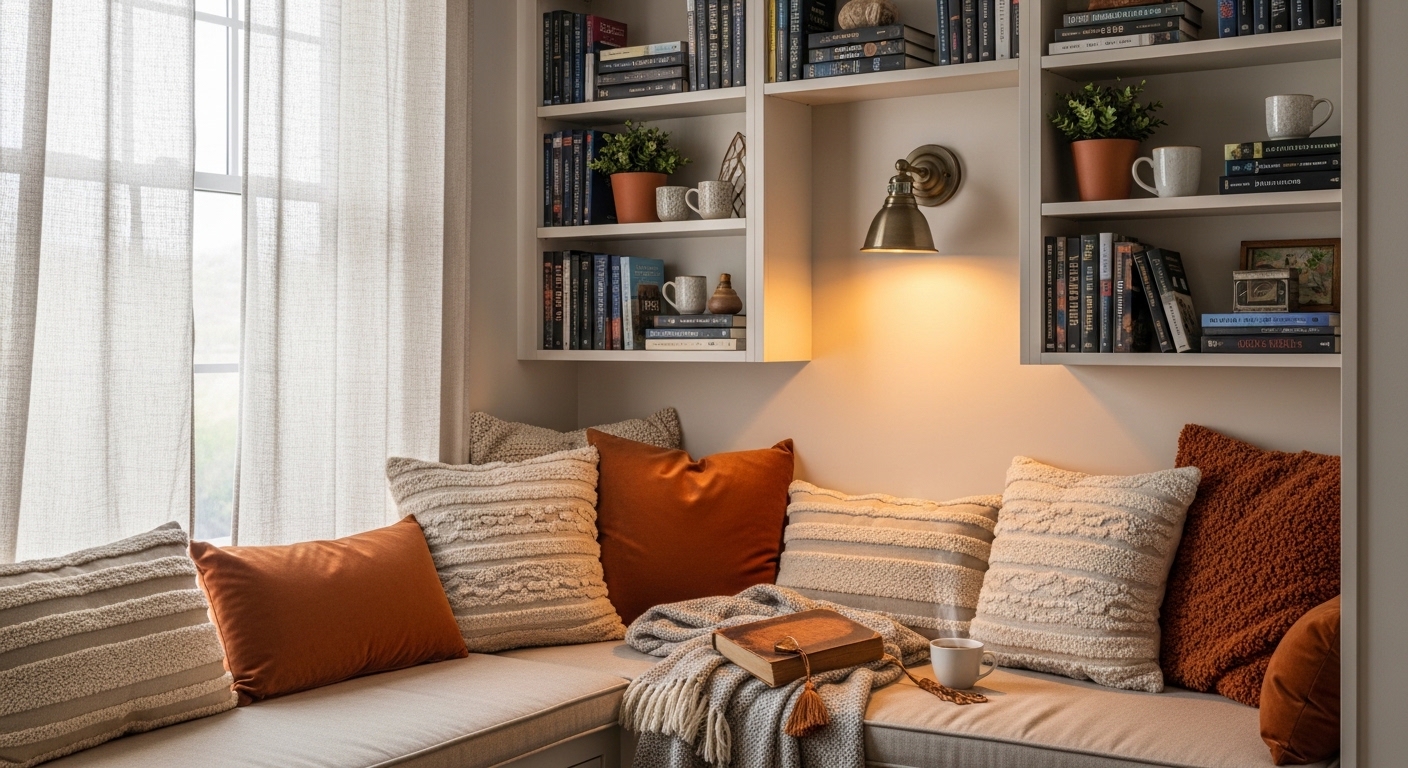
The alcove at the top of the stairs is 40 inches wide, 30 deep and open on one side to the landing. We built a bench across the back, 18 inches deep and 16 inches high, from plywood on a simple frame, with a lift-top lid over a storage box for blankets. On the two side walls, a 4-inch-deep picture-ledge shelf at 24 inches from the bench seat, so books face out and a 4-year-old can see the covers and reach them. A 4-inch foam cushion in a washable performance fabric, cut to 40 by 18, with a bolster at each end. On the back wall, above the bench at 42 inches from the floor, the sconce. A small rug on the floor in front so the nook has an edge. Matt built the bench in a Saturday from one sheet of plywood and I sewed the cushion cover from a fabric remnant, badly, which the 4-year-old considers a feature and the 14-year-old has offered to redo.
The light that makes it a destination
A small wall sconce mounted above the seat, on its own switch at kid height (36 inches) on the alcove wall, with a 2700K bulb at 450 lumens and a shade that points the light down onto the page and not up at the landing. It's not the overhead hall light. It's the nook light, and the distinction matters enormously to kids: turning it on means "I'm reading now," and it's the only light in the house they're allowed to turn on without asking. It creates a small circle of warm light that makes the nook feel private even when the house is loud around it, and five kids make a house loud. Our most screen-obsessed kid, the 12-year-old, discovered within two weeks that reading in the nook was more comfortable than reading in her room because the light was better, and she now reads for 45 minutes before dinner most nights. I'm crediting the sconce, and I've written about why in the kids' room lighting post. Where there's no wiring, a plug-in sconce with the cord dropped behind the bench, or a rechargeable one, does the same thing.
Book storage: stocked, not a library
The two picture ledges hold about 25 books face-out, which is the number that gives a kid a choice without giving them a browsing session. They're restocked every two weeks from the family bookshelves and the library basket at the drop zone, with a mix that covers the 4-year-old to the 14-year-old: picture books on the lower ledge, chapter books and graphic novels on the upper. Face-out matters: a kid picks a book by its cover, and a shelf of spines is a wall. The lift-top bench holds a blanket, two pillows, and the books that have rotated out but might rotate back. Nothing else lives in the nook. No toys, no tablet, no snacks, and the day a stuffed animal moves in is the day it stops being a reading nook and becomes a fort, which is a nice thing but a different thing.
Rules that keep it a reading nook
One kid at a time, and the timer on the wall settles whose turn it is (the 7-year-old's suggestion, which was a good one). Books only; the tablet stays in the kitchen. The light goes off when you leave, which is the one rule I still enforce. Anyone can read anything on the ledges. And it's never a punishment: nobody is sent to the Reading Corner, ever, because the classroom version of that rule ruins reading for a whole year. The dispute about whose turn it is happens roughly nightly, and it's the best argument in the house, because both sides of it want to read.
Reading nook ideas for a house without an alcove
Under the stairs, the best spot in most houses, even if it's only 30 inches high at the low end; the low end is where the 4-year-old wants to be. A closet with the door taken off, a bench across the back and a sconce inside, which is a reading nook in an afternoon for under $150. The end of a hallway with a bench and two ledges, which is what a friend built and which works because a hallway end is a place nobody else wants. A corner of a bedroom with a canopy or a bookshelf turned sideways as the second wall, a floor cushion and a plug-in sconce. A window seat, which is the version in every photo and which works if the window is low; ours would have needed the window to be 10 inches lower, and a 1960s ranch does not move its windows for a bench. The four things don't change: two sides enclosed, books in reach, its own light, a name.
Getting kids to use it, without making it a chore
Don't assign it. The first week, I read in it myself, at 4 pm, with the sconce on, and said nothing. By day three there was a 7-year-old on the other end of the bench. Keep the ledges fresh, because a kid who has seen the same 25 covers for a month stops looking. Let them turn the light on themselves; the kid-height switch was the single best $12 in the build. Put the nook on the route between the bedrooms and the kitchen, so it's passed twenty times a day, which the top of the stairs is. And let it be the place a kid goes when the house is too much, without a book, sometimes; the 12-year-old sits in it with the light on and nothing in her hands about once a week, and the reading comes back the next day. In the classroom the reading corner was never a reward and never a consequence, and that's the rule I've kept.
Reading nook lighting, in detail
The sconce sits above and slightly behind the reader's shoulder, at 42 inches from the floor for a 16-inch bench, so the light falls over the shoulder onto the page and the reader's head doesn't shadow it. A shade that's closed on top and open at the bottom, or a small dome, keeps the light in the nook and out of the landing, which matters when the nook is next to a bedroom door and it's 8 pm. 2700K, because a reading nook is a bedtime place; 450 lumens, enough for small print and not enough to feel like a desk. A dimmer if there's a switch; a bulb with a built-in dim setting if there's a plug-in sconce. No overhead in the nook at all, and if the hall light reaches it, a shade or a canopy on the open side to block it. The wall-mounted reading light post covers the fixtures I've used in three kids' rooms, and the nook uses the same one as the 12-year-old's bed.
For a 4-year-old and a 14-year-old
The nook is sized for the smallest and used by the biggest. The bench at 16 inches is a step for the 4-year-old and a low seat for the 14-year-old, who folds herself in and complains and comes back. The lower ledge is at her knee and the 4-year-old's eye. The sconce at 42 inches lights both a picture book on a lap and a novel held up. The blanket in the bench is for both. What I'd change for teenagers only is a deeper bench and a cushion with a back; what I'd change for a toddler only is a lower ledge. A nook that fits both is a nook that gets used for fifteen years, which is the return I care about, and the one the plywood was cheap enough to justify.
Keeping it clean, and what wears out
The cushion cover comes off and goes through the wash monthly, and the foam has flattened at the 4-year-old's end after three years and gets flipped; a 4-inch high-density foam lasts about five years at this use before it needs replacing, at $60. The ledges get dusted with the fortnightly restock. The rug is the thing that wears, because the landing is a hallway, and it's been replaced once. The sconce has needed one bulb. The bench lid hinge, a soft-close, is the same one as on the banquette and has been fine. Total upkeep in three years, about $90 and a Saturday.
What it cost
Plywood, frame lumber and hinges for the bench, $85. Foam, $60, and the fabric remnant, $22. Two picture ledges, $36, from the hardware store, not the catalog. The sconce, $75, plus the electrician's hour to add a box and a kid-height switch, $110, because he was at the house for the shared bedroom that week. A small rug, $28. About $415, more than the $340 I said at the top because I'd left out the electrician again. The plug-in version is $250 without him. Either way it's the cost of a few months of tablet subscriptions, and it's the thing in the house that competes with them and, most evenings, wins.
What changed in three years
The 12-year-old went from reading only when assigned to reading most evenings. The 9-year-old, who resisted chapter books, read his first one in the nook because it was the one on the ledge and there was nothing else to do in there. The 7-year-old learned that a book has a beginning and an end by sitting in the same spot with the same book for a week. The 4-year-old "reads" to Biscuit, who listens. The 14-year-old uses it when the house is loud, which is always, and pretends she doesn't. I don't have a study; I have a landing with a bench in it, a sconce, a shelf of face-out books, and a timer, and five kids who fight over it, which is the only reading data I trust, and I used to collect reading data for a living.
Shop this post: reading nook wall sconces and plug-in sconces for nooks without wiring