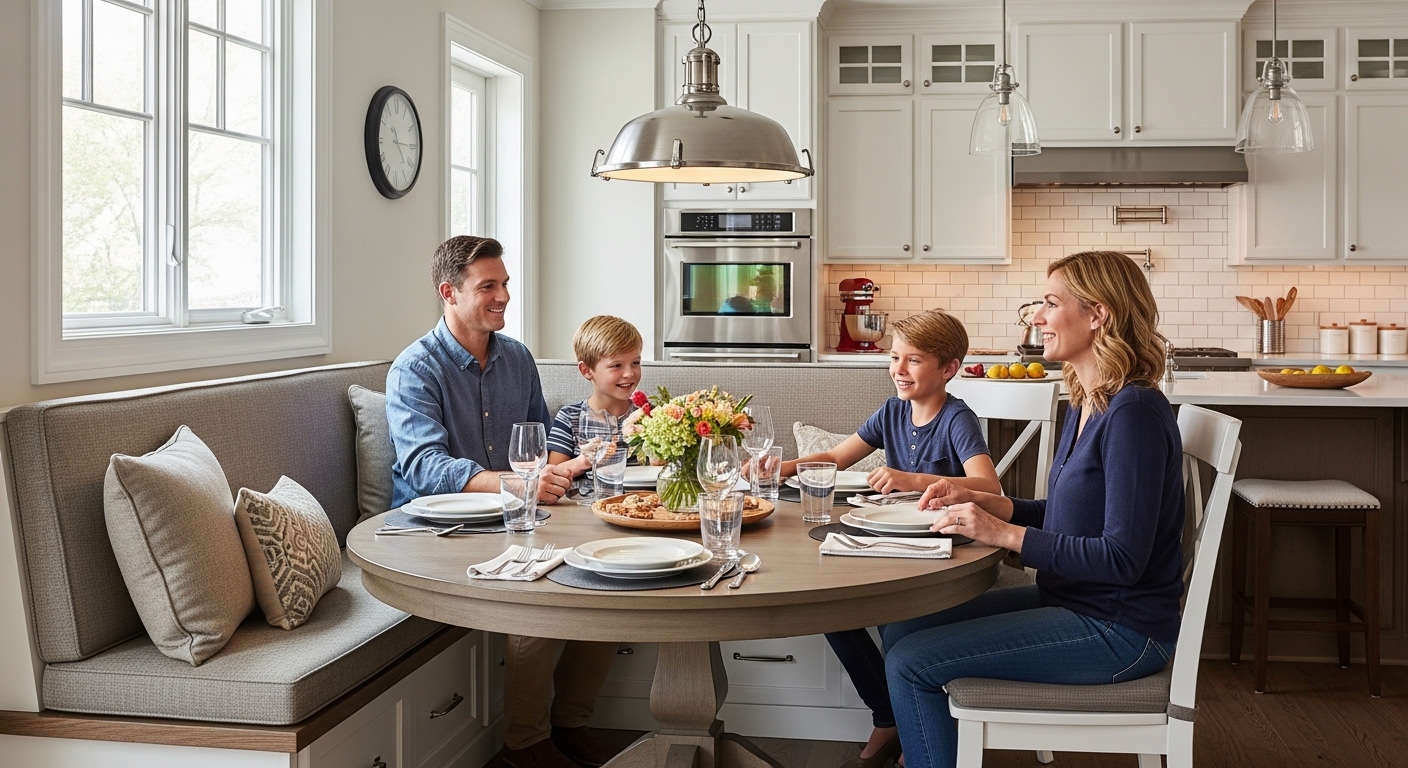
A kitchen banquette is the best way I know to seat a big family in a corner that was otherwise wasted, and ours seats all seven of us on an L-shaped bench 7 feet per side with a 36-inch table, built for about $1,900 including the storage underneath. The corner it replaced collected dog dishes, stray shoes, and every piece of paper that came home from school. Now it's the most-used surface in the house: breakfast for five kids at 6:50 am, homework at 4, dinner at 5:45, and Matt and me with coffee after everyone's down. This post is the sizing math for a family banquette, the L versus straight decision, the storage under the seats and what's in each section, the cushions that survive a four-year-old, the pendant over it and how high it hangs, the build and its cost, and the three things I'd change.
Why a banquette instead of a table and chairs
Seats. A 36-inch round table with four chairs takes about 8 feet of floor in every direction to pull the chairs out; a corner banquette seats seven in a footprint of about 7 by 7 feet, because nobody pulls a bench out and the two sides of the L share a corner. Storage, because the seats are boxes. And behavior, which the teacher in me noticed first: kids on a bench sit down and stay, because getting out means asking the person at the end to move, and dinner lasts eleven minutes longer than it did at the old table. The trade-off is that the person in the corner is stuck, and in our house that's the 4-year-old, on purpose.
Kitchen banquette sizing for a large family
Allow 22 to 24 inches of bench per adult and 18 to 20 per child under ten; our two 7-foot sides give 14 feet of bench, minus the corner where nobody sits, which comfortably seats seven and eight on a holiday with a chair at the open end. Bench height: 18 inches to the top of the cushion, matching a dining chair, so the table works at a standard 30 inches. Bench depth: 18 to 20 inches of seat, plus a back at 15 degrees or a wall with a cushion; we used the wall with a 4-inch cushion and it's fine for dinner and not for lingering. Table: 36 inches wide is the narrowest that holds seven plates and the widest that still lets the 4-year-old reach the middle; ours is 36 by 60 with a pedestal base, because a leg at each corner is the enemy of a bench. Leave 4 inches between the table edge and the front of the bench for knees, and 30 inches of walkway on the open sides.
L-shaped, straight, or U
An L in a corner is the version that earns its space: two walls, one bench each, the table in the crook. A straight banquette against one wall with chairs opposite works in a narrow kitchen and seats fewer per foot but everyone can get out. A U seats the most and traps two people, and it's for a breakfast nook with a window, not a working kitchen. We had a corner between the pantry wall and the window wall, 8 feet each way, which decided it. If your corner has a window on one side, the bench under the window is where every kid wants to sit, so put the youngest there and the reading light on the other side. Ours has the window on the long side and a wall sconce on the short one, which means the 12-year-old does homework by the sconce and the 4-year-old watches the birds, and everyone has claimed a permanent seat within a week, exactly as they do in a classroom.
The storage under the seats
Under-bench storage runs the full length of both sides, 6 inches of usable depth under a lift-top lid, in four sections per bench. Each section has a job, like a drawer: kids' coloring and craft supplies (the section nearest the open end, so the 4-year-old can reach it), tablecloths and napkins, overflow school supplies for the homework station, and sports gear that has to leave the house in the morning. The lids are on soft-close hinges, which cost $60 more and which I'd pay twice, because a slamming bench lid with a small hand nearby is the thing that stops you using the storage. Drawers on the open front, instead of lift tops, are the better design if your banquette has an open long side; ours has a wall on both, so lids it was.
Cushions and fabric that survive five kids and a dog
Performance fabric, the kind sold for outdoor furniture, in a mid-tone with a small texture, on a 4-inch high-density foam seat cushion and a 4-inch back cushion, both with zip covers. Ours is a warm grey-brown that hides everything from ketchup to Biscuit's fur, and the covers have been through the washing machine roughly forty times. Foam density: the seat cushion is 2.5-pound density, which is firm enough that the 14-year-old doesn't sink and the 4-year-old can climb it. A fitted seat cushion with a nonslip pad underneath rather than loose ones, because loose cushions end up on the floor by the second week. Avoid tufting, which collects crumbs, and avoid white, which I don't need to explain.
The pendant over the banquette
One large pendant, 18 inches in diameter, centered over the table (not over the corner of the L, which is a mistake I made on paper and caught in the tape stage), hung with its bottom 32 inches above the table surface, on a dimmer. The size rule I use: the pendant's diameter in inches is about a third of the table's width, so 12 to 14 inches over a 36-inch table would be the minimum and 18 is right for the length. Breakfast: full brightness, because five kids and a cereal spill need to be seen. Family dinner: 40 percent and warm, 2700K, which is where the eleven extra minutes come from. Homework: 80 percent. The banquette is where we start every morning and end most evenings, and the pendant is what makes both occasions feel like something worth showing up for; the rest of the kitchen's lighting is in my island lighting post.
The table: pedestal, and secondhand
A pedestal base is the only kind that works with a bench, because four legs land exactly where four knees want to be. Rectangular or a soft rounded rectangle, not round, for an L; a round table wastes the corner. Size it 4 inches shorter than the bench on each side so people can slide in past the end. Ours came from an office-furniture liquidator for $180 plus $100 in refinishing supplies and a weekend of sanding and it's solid maple with a steel pedestal that has survived a 14-year-old sitting on it. New, the same table is $700 to $1,400. The finish is a wipeable satin polyurethane, four coats, because a banquette table sees markers, glue, and the occasional science project, and a wax finish lasted six weeks.
The build, and what it cost
Matt built the benches from 3/4-inch plywood boxes with a face frame, 14 feet total, over two weekends, with the lids cut from the same sheets and the soft-close hinges from a cabinet supplier. Plywood, screws, hinges and trim: about $520. Paint, a scrubbable satin in the cabinet color: $70. Foam and fabric, cut and sewn by a local upholsterer from my measurements: $640. The table, a 36 by 60 pedestal from a secondhand office-furniture place, refinished: $280. The pendant, dimmer and the electrician's hour to move the box 30 inches to the table's center: $390. About $1,900, against quotes of $4,800 to $6,500 for a built-in from a cabinet shop. If Matt weren't handy, I'd have had the boxes built and done the paint and cushions myself, which is roughly the $3,000 version.
Family dinner, before and after
Before: a rectangular table in the dining room that we used for holidays and homework, and dinner mostly at the island on stools with two kids standing. Dinner took nineteen minutes on the evenings I timed it, and somebody was always up. After: everyone in the banquette, the dog under the table, dinner around thirty minutes, and conversation, which had been the thing missing. The 12-year-old, who had been eating in eight minutes and leaving, now stays because leaving means the whole bench shifting. I'm not going to claim a bench fixed family dinner. I'll claim it removed the easiest way out of it, and that the eleven extra minutes are where most of what I know about my 12-year-old's week now comes from.
Kitchen banquette ideas for smaller corners and smaller families
A 5 by 5 corner takes an L with 5-foot sides and a 30-inch round pedestal table, which seats four and a booster. A single 6-foot straight bench against a wall with two chairs opposite seats five and lets everyone out. A window seat that's 18 inches deep and 20 inches high is a banquette if you pull a table to it, and it's the cheapest version of all because the storage is a lift-top box and the wall does the back. In a rental, a freestanding bench with storage pushed into a corner does 80 percent of the job with zero screws in the wall, and it moves. The rule that holds at every size: 18 inches of seat height, 30 of table height, 4 inches of knee room between them, and a light centered over the table on a dimmer.
Cleaning a banquette that gets used five times a day
Crumbs go into the gap between the seat cushion and the wall cushion, and they go there every meal. A fitted seat cushion that runs edge to edge, with no gap at the back, and a handheld vacuum on a hook in the pantry, is the system; it takes ninety seconds after dinner and it's on the chores chart for the 9-year-old. The zip covers come off and go in the wash monthly, or sooner when the 4-year-old discovers a new sauce. The painted plywood face wipes with a damp cloth. What doesn't clean is the gap between the bench and the wall, so the bench is scribed tight to the wall and caulked; the old freestanding bench in the dining room had a gap that held a year of cheerios.
Is a banquette practical with small children?
More practical than chairs, in my experience, with three caveats. The corner seat is a trap, so it's the youngest's, where she can't fall off the end. The lids need soft-close hinges and a rule about not lifting them during meals. And the cushions need to be washable and fitted, not loose. A booster seat sits on a bench as well as a chair, and a high chair pulls up to the open end. The dog under the table is a feature, and it's where 30 percent of the 4-year-old's dinner goes; I've stopped fighting that one, and Biscuit has never been healthier.
What I'd change
A drawer front instead of lids on the side nearest the walkway, so the craft supplies could come out without lifting a cushion. A slightly deeper seat, 20 inches instead of 18, for the adults who linger. And the outlet: I'd have had the electrician put one in the bench face for the homework laptops, since he was already there for the pendant, instead of the extension cord that now lives under the table and that I trip on twice a week. Everything else, the size, the L, the fabric, the pendant height, is what I'd build again tomorrow in the next kitchen, and if we ever move, the first thing I'll look for is a corner.
Shop this post: pendant lights for a banquette and kitchen pendant lighting