Outdoor lighting ideas for a busy family come down to a wall light at every door that's on a dusk-to-dawn sensor, motion floods where the cars and the trash cans are, path lights that a 4-year-old can follow to the back door, and a string of lights over the patio on a switch, and the rule under all of it is that nobody carrying a kid, a bag or a cooler should ever need a hand for a light. Our house has four doors people use, a driveway that holds two cars and a basketball hoop, a back patio that's the summer dining room, and a yard that five kids are in until the fireflies come out; the builder left one porch light on a switch inside. This post is the four doors and the fixture at each, the dusk-to-dawn sensor and why every door light has one, the driveway floods and the trash-night rule, the path lights and their spacing, the patio string lights and their switch, the back door's light and the 7 pm call-in, the garage-side light, the bulb color outside, the finish that takes weather, the timer versus the sensor, the yard's dark corners and the kids' rule, what we skipped, winter, mistakes, and the cost.
Four doors, four lights
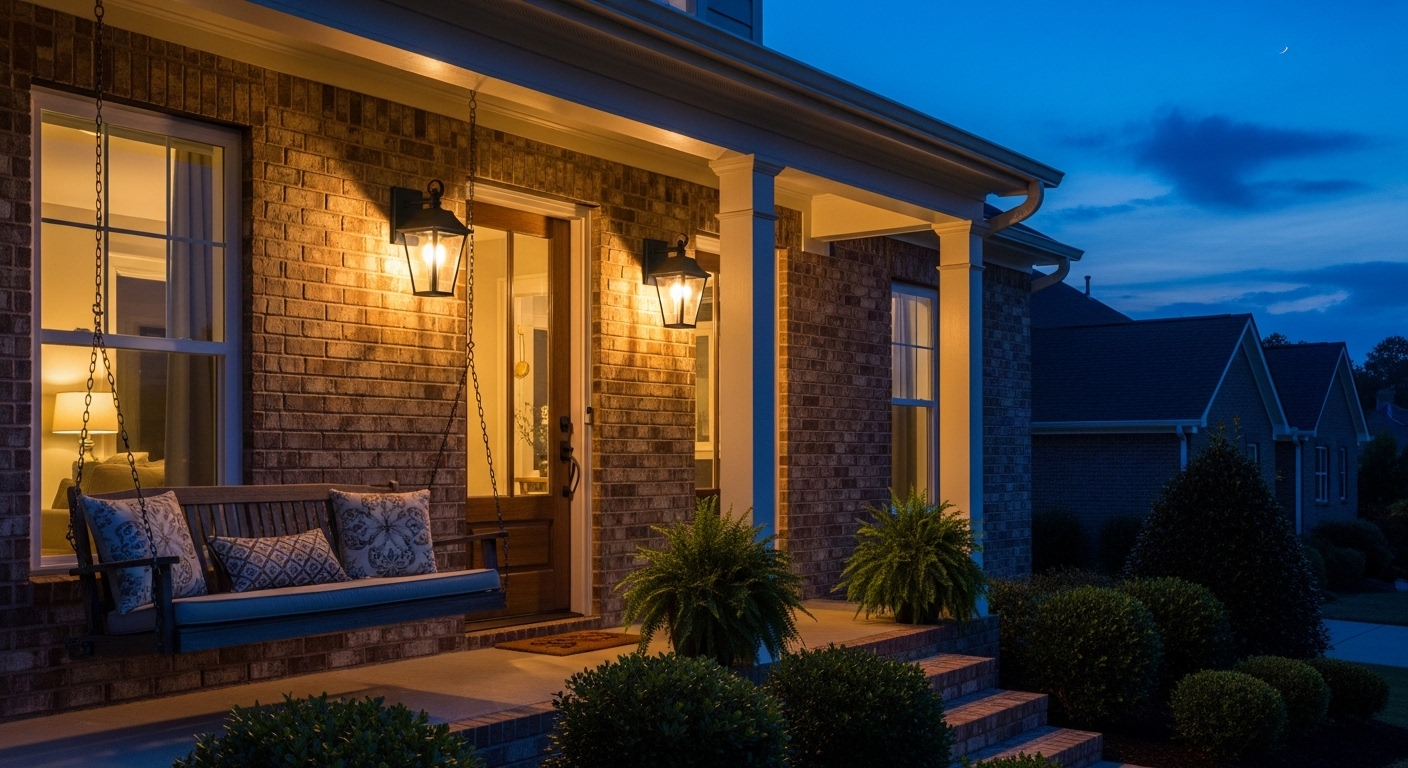
The front door, the garage's side door, the back door to the patio, and the mudroom door from the driveway, and each has a outdoor wall light beside it at 66 inches to center, on the latch side so a hand on the knob's lit; the front door's is a lantern for the street, and the other three are the same plain cylinder in black. Four doors with a light each is the difference between a house you can get into with a sleeping kid on your shoulder and a house where you fumble; the builder's one porch light lit the one door we use least.
Dusk to dawn on every door
Every door light's on a dusk-to-dawn photocell, either built into the fixture or a $12 socket adapter, so the four doors are lit from sunset to sunrise without a switch; the inside switches are taped on. A family comes home at 4:45 in December with five kids and gear, and a door light on a switch inside is a light nobody turned on. The photocell's the single most useful $12 in this post, and the four of them cost less than one fixture.
The driveway floods
Two motion-sensor LED floods, one on each front corner of the garage, 1,800 lumens each at 3000K, aimed down the driveway and at the trash cans' spot, on a 3-minute timer; they come on for the cars, the basketball at dusk, and Matt taking the trash out Thursday night, and they go off. Motion, not dusk-to-dawn, because a driveway lit all night is a light the neighbors see and a bill; a flood that comes on for three minutes when a car pulls in is the light that matters. Aimed down, never at the street, because a flood in a driver's eyes is a neighbor's complaint.
The path lights
Low-voltage LED path lights along the walk from the driveway to the back door and from the patio to the yard's play area, every 6 feet, 14 inches tall, on a transformer with a photocell, 2700K; six on the walk and four to the play area. Six feet is the spacing where a 4-year-old sees the next light from the last one and follows the path instead of the grass, and it's the spacing that lights the walk without making it a runway. A path a kid can follow in the dark is a kid who comes in when called.
The patio string lights
Commercial-grade string lights, the kind with a heavy cord and replaceable bulbs, zigzagged over the patio from the house's eave to two 10-foot posts in planters, 2700K at 11 watts a bulb, on a switch by the back door and a smart plug for the schedule; they're the summer dining room's chandelier and they're on from 6 to 10 from May to September. The posts in planters instead of in the ground, because the patio's concrete and because the planters move for the basketball hoop's off-season. It's the fixture guests photograph, and it's $80 of string and $60 of posts.
The back door and the 7 pm call-in
The back door's light comes on at dusk and the string lights come on at 6, and the patio's the lit place the yard's kids are called to; a lit patio at 7:45 in June is a lighthouse, and "come to the patio" works where "come inside" doesn't. The back door's light's the one that gets the most use, because five kids go through it forty times a day in summer, and it's the one with the sturdiest fixture and the frosted glass, because a ball's hit it.
The garage-side light
The door from the driveway into the garage's side is the door we use most, and its light's the cylinder at 66 inches with a photocell plus a motion flood above the garage door for the cars; the garage post is what's inside that door. It's the door where a kid's dropped off from carpool at 6 pm in January, and its light's on before the car pulls in.
The bulb color outside
2700K at the doors and the patio, because warm light at a door reads as home and cool light reads as a parking lot; 3000K on the driveway floods, because they're for seeing a car and a trash can and cool light shows a curb. Never 4000K or above outside a house, which is the light most motion floods come with and the light that makes a house look like a gas station. The bulbs are outdoor-rated LEDs, and they've been changed once in five years.
The finish
Black powder-coated aluminum on every fixture, because Nashville's summers and the sprinkler take the finish off anything else, and because black hides the pollen and the dirt; brushed nickel outside is a fixture that's spotted in a month. The front lantern's the same black in a shape the street likes. Four door lights, two floods, ten path lights and the posts, all black, and the house reads as one house from the street.
Timer versus sensor
Doors: photocell, dusk to dawn, because a door's used at any hour. Driveway: motion, because a driveway's used in bursts. Patio: a switch and a smart plug's schedule, because the patio's on when we're on it. Path: photocell on the transformer, dusk to 11 on its own timer, because nobody walks the path at 2 am. Each light's on the control that matches how it's used, and a house where every outdoor light's on the same switch is a house where they're all on or all off.
The yard's dark corners
The yard's back corners are dark on purpose, because a yard lit to the fence is a yard where the fireflies don't show and the kids don't wonder; the rule is that the patio and the path are lit and the yard's play area has one path light at its edge and nothing else. The kids come to the light when it's time, and the dark's where the game is until then. A family yard needs a lit edge and a dark middle, and the string lights are the edge.
What we skipped
Uplights on the trees, which are for a house that's looked at more than lived in. Floods on the back corners, for the reasons above. Solar path lights, which are dim by October and dead by January in a shaded yard. A smart bulb in every fixture, which the photocells made pointless. And a front-door camera light, which is a camera with a 5000K bulb, and the camera's a separate thing beside the lantern.
Winter
The string lights come down in October and go up in May, on the garage rotation's weekend; the path lights stay and their timer moves to dusk to 9. The door lights and the floods don't change, and the photocells adjust to the earlier dark themselves. The front lantern gets a wreath in December and a 2200K bulb for the month, which is the one seasonal thing the outdoor lights do, and the 4-year-old thinks it's for her.
The fixtures and five kids
The back door's light's taken a ball, the driveway floods have taken a basketball's rebound, and a path light's been run over by a scooter; the door light's frosted glass was replaced once at $9, the floods didn't notice, and the path light was $14. Outdoor fixtures in a family yard get hit, and the ones to buy are the ones with replaceable glass and a body that doesn't care. The front lantern's the one fixture that's never been touched, because nobody plays in the front.
Carpool, and the light that's on before the car
Five kids at three schools is four carpool drop-offs a day, and the driveway's motion floods and the garage door's light are what a carpool parent sees at 6 pm in January: a lit driveway and a lit door, and a kid who gets out and walks to a light. The floods come on for the car's headlights and the door light's been on since 4:45, and the kid's inside before the flood's 3 minutes are up. It's the one place the outdoor lighting's for other people's kids too, and the one place a carpool parent's said thank you for a light.
The patio as a room
From May to September the patio's the dining room four nights a week, and its lighting's the string lights over the table at 2700K, the back door's light beside it, and a rechargeable lantern on the table for the center; the string lights are the chandelier and they're on a switch by the door the way the dining room's is. The dining room post's rule that the table's the lit thing applies outside, and the yard around the patio's dark by the same rule that keeps the dining room's walls soft. A patio lit like a stadium is a patio nobody lingers on.
The photocells and the seasons
A photocell adjusts itself: on at 4:45 in December and 8:15 in June, with no schedule to update, which is why the doors are on photocells and not timers; a timer's the fixture that's on at 6 pm in June with the sun still up. The path lights' transformer has a photocell and a timer both, on at dusk and off at 11, which is the one place the two are combined. Nothing outside needs the clocks changed in March, which for a house with five kids' schedules is the point.
Mistakes
One porch light on an inside switch, for two years. Solar path lights, one winter. A 5000K motion flood that lit the driveway like a lot for a season. String lights from the hardware store's seasonal aisle, which lasted one summer. And no light at the garage's side door, which is the door we use most, for a year of fumbling.
In one paragraph
A wall light at each of four doors at 66 inches on a photocell. Two motion floods on the garage's corners, aimed down, 3000K. Path lights every 6 feet from the driveway to the back door and the play area, on a photocell and a timer. Commercial string lights over the patio on posts in planters, on a switch and a schedule. 2700K at the doors and patio, black on everything. The yard's corners dark. Nobody with a kid on their shoulder needs a hand for a light.
What it cost
Four door lights, $260. Two floods, $90. Ten path lights and the transformer, $210. String lights and posts, $140. Photocell adapters, $36. The smart plug, $12. About $750 for a house with four lit doors, a lit driveway, a lit path and a summer dining room, and the $36 of photocells is the part that made it work without anyone touching a switch.
Shop this post: outdoor wall lights for the four doors