Master bedroom lighting ideas for parents with no time come down to two wall sconces at 24 inches above the mattress with switches on the fixtures, a ceiling fixture on a dimmer that's off by 8 pm, and nothing on the nightstands but a phone and a glass of water, and it's a setup that takes one afternoon and costs less than a good mattress. Our bedroom is the last room in the house we did and the one we live in least awake, and the lighting plan was written around the four minutes a night we're in it with our eyes open: one of us reads late, one of us is asleep at 9:30, and a lamp on a nightstand was the thing we knocked over most in the first year. This post is the two sconces and why they're the whole plan, the height and the switch, the reading side and the sleeping side, the ceiling fixture and its dimmer, the closet and dresser light, the 6 am light, the bulb color, the nightstand rule, the sconce finish, the plug-in version for a room the electrician can't reach, what we skipped, the room in a power outage, mistakes, and the cost.
Two sconces are the plan
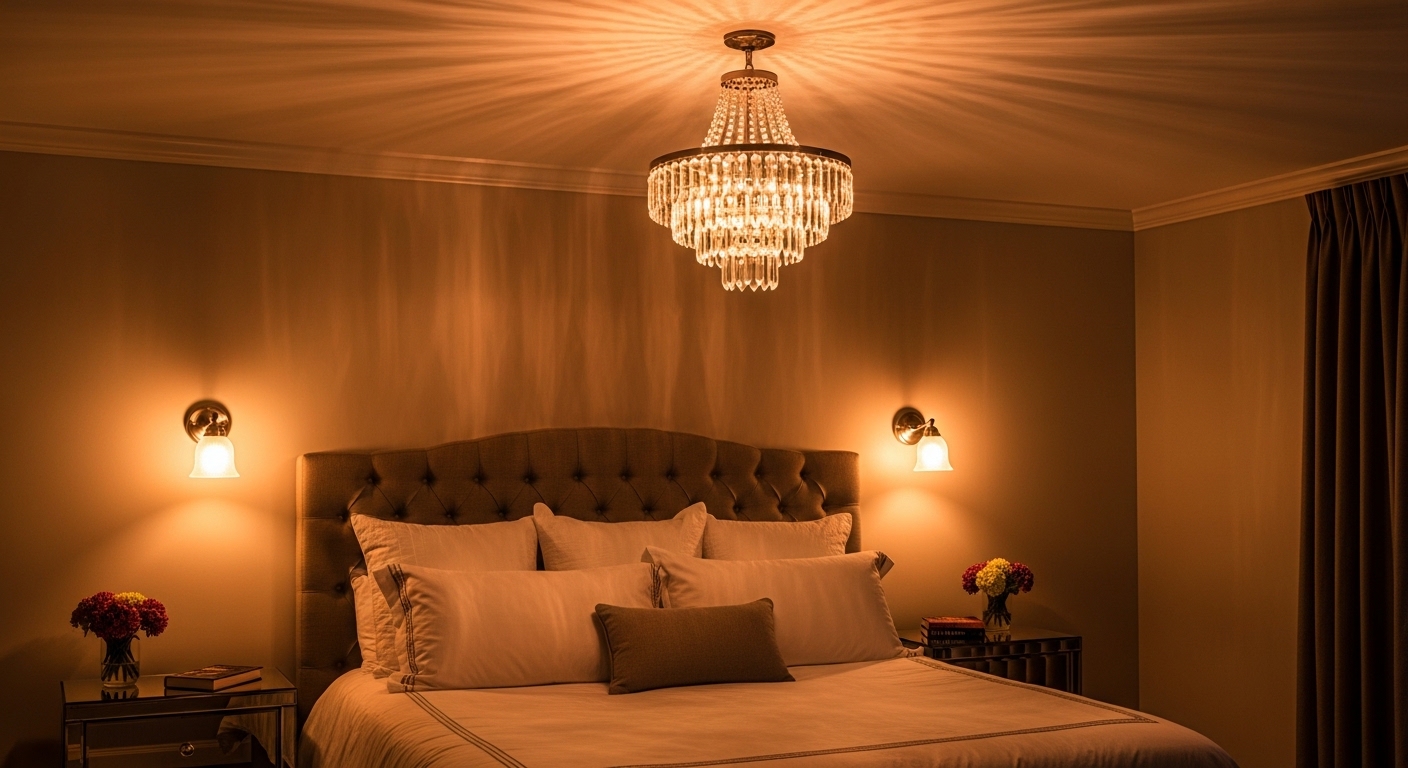
A bedroom wall sconce on each side of the bed, 24 inches above the mattress, centered on each nightstand, with an on-off switch on the fixture, 2700K, 450 lumens, dimmable at the wall; that's the plan and everything else is optional. The sconces do reading, the 3 am toddler visit, getting dressed at 6, and the middle of a night where someone's sick, and they do it without a lamp on the nightstand, which is the thing that made the nightstands clear. Every other room in the house is a project; the bedroom was two fixtures and an electrician's afternoon.
The height and the switch
Twenty-four inches above the top of the mattress, measured with the mattress on the bed and the pillows off, which puts the light on the page of a sitting reader and below the eye of the person lying down next to them; 20 inches for the kids' rooms, because they're smaller. The switch is on the fixture, at arm's reach from the pillow, so nobody gets up to turn off a light. The wall switch by the door controls both sconces for arriving, and the fixture switches control each for reading. The reading lights post is the heights across the house.
The reading side and the sleeping side
Matt reads late and I don't, and the sconces solve it because his shade points down and its light stops at the edge of his pillow. A sconce with a directional shade, a swing arm or a cylinder pointing down, lights one person's book and not the other's face; a sconce that glows in every direction lights the room. Ours are swing-arm cylinders in brushed nickel, and the arm is the thing that lets a reader pull the light to the page and push it away to sleep. Twelve years of one reader and one sleeper, and the swing arm is the fixture that ended the argument.
The ceiling fixture and the 8 pm rule
A semi-flush drum in the center of the ceiling, 1,600 lumens, on a dimmer, at full for making the bed and finding the other sock and at 30 percent for the evening, and off by 8, because the ceiling light in a bedroom after 8 is the thing that tells your body it's noon. It's the fixture that was already here, with a better bulb and a $22 dimmer. The semi-flush post is why a semi-flush and not a chandelier in a room with a 9-foot ceiling and a bed under it.
The closet and the dresser
A motion-sensor LED strip inside the closet along the top shelf, battery, $24, that comes on when the door opens and lights the clothes from above, and a small plug-in puck under the dresser's top edge for the drawers at 6 am; the closet strip is the light that gets used most in the room and the one nobody plans for. Getting dressed in the dark while the other person sleeps is a daily thing in a house where one person's up at 5:45, and the closet strip and the dresser puck are how it's done without the ceiling.
The 6 am light
The sconce on my side, at its lowest, is the 6 am light: enough to find the clothes laid out the night before and not enough to wake Matt. In winter, the closet strip and the dresser puck are the whole morning, and the hallway sconces at 60 percent are the next room. A bedroom lit for the person who's up early is a bedroom lit low from the sides, and a ceiling fixture at 6 am is a divorce.
The bulb color
2700K in the sconces and the ceiling fixture, 2200K if the sconces take a warm-dimming bulb, and nothing cooler, because the bedroom is the one room where nobody needs to see color accurately and everybody needs to fall asleep. The closet strip is 3000K because it's for matching socks. A bedroom at 3000K or above is a hotel room, and the fix is $6 a bulb.
The nightstand rule
A phone, a glass of water, a book, and a drawer for the rest. No lamp, because the sconce is the lamp; no clock, because the phone is; no tray of things, because a tray is a shelf for the 4-year-old's toys by Tuesday. The nightstand is 18 inches wide and the rule is what makes it usable; the sconce above it is what made the rule possible. It's the same rule as the kitchen counter's five things, applied to a surface the size of a placemat.
The finish
Brushed nickel, matching the closet handles and the bathroom, because it hides fingerprints and dust and never looks dated; matte black if the room's dark and the furniture's light; not polished anything, for the same reason as the kitchen sink. The sconces are the only fixtures in the room anyone touches daily and the finish has to take a hand every night for a decade. Ours are five years in and look like the day they went up.
The plug-in version
If the wall behind the bed can't be opened, the same two sconces as plug-in sconces with the cords run down behind the headboard to the outlet the nightstand hides, on plug-in dimmers, at the same 24 inches; the 12-year-old's room has had this since she was seven and nobody's seen a cord. It's the version for a rental, a plaster wall or a weekend with no electrician, and it costs the same as the hardwired one minus the electrician.
What we skipped
A chandelier, because it's a bedroom with a bed under the ceiling fixture and a chandelier over a bed is a thing you look up at. Lamps, obviously. A fan with a light, because the fan's on and the light's off in every fan-light in America. Recessed cans, which in a bedroom are a runway. And a TV, which is a light too, and which is in the family room where the makeover made room for it.
The room in a power outage
A rechargeable puck in the nightstand drawer, charged monthly, and the phone; a bedroom with no lamps is a bedroom with nothing to light when the power goes, and Nashville loses power in a storm twice a year. The puck's the same one that's under the dresser, and there are two, and it's the one item in this post that's about not having light.
The sconces and the kids
A kid in the bed at 3 am, which is nightly with five, is handled at the lowest setting of the sconce on whichever side the kid climbed in, and the kid's asleep again before the light's off; a lamp would have meant a fumble for a switch on a cord and a knocked-over glass, which was the first year. The sconce's switch at pillow height is the parent fixture, and it's the reason the sconces went in before anything else in the room was chosen.
What it took
An electrician's afternoon to run two boxes behind the bed on the existing switch circuit, $380; a Saturday for Matt to hang the sconces and the dimmer; ten minutes for the closet strip and the puck. The bedroom was done in a weekend, five years after we moved in, and it's the room that took the least time and got the most nightly use, which is the argument for doing it first in the next house.
The bedroom with a sitting corner
A chair in the corner by the window with a swing-arm sconce at 48 inches beside it, on the wall switch's circuit, for the one parent who gets up to read when the other's asleep, or for folding laundry at 9 pm with the ceiling light off; it's the third sconce in the room and the one added in year five when the chair arrived. A bedroom corner with a chair and a light is the only private room a parent of five has, and it's 4 feet square. The same fixture as the bedside, same finish, same bulb, on the wall not the floor, because a floor lamp in a bedroom is a thing the 4-year-old walks into at 3 am.
The bathroom door and the light through it
Our bathroom opens off the bedroom, and its vanity light at 6 am through a cracked door lit the whole room until the vanity got a dimmer and a 20 percent morning setting; the bathroom post has the fixture, and the bedroom's rule is that no light through that door is brighter than the sconce. A nightlight in the bathroom, 2200K, is the 3 am setting, and the dimmer at 20 is the 6 am one, and the person asleep doesn't know either happened.
The bedroom during a renovation, which is when it gets done
The sconce boxes went in while the bathroom was open for its renovation, because the electrician was already in the wall on the other side; if there's a renovation anywhere adjacent, that's the week to run bedroom sconce wiring, and it cut the cost by half. If there isn't, it's a $380 afternoon and it's still the cheapest room in the house to do. The bedroom is always last on a family's list and it's the room with the highest use per dollar, because it's the one everyone's in for eight hours a night.
Mistakes
A year of nightstand lamps, three glasses of water and one lamp. A sconce at 30 inches on the first try, lighting the wall and not the book. A chandelier in the first house's bedroom, admired by guests and looked at from the pillow. No dimmer on the ceiling fixture for four years. And the closet with no light until the strip, which was $24 and a decade late.
In one paragraph
Two swing-arm sconces at 24 inches over the mattress with switches on the fixtures, 2700K, on a wall dimmer. A ceiling fixture on a dimmer, off by 8. A motion strip in the closet and a puck under the dresser for 6 am. Nothing on the nightstand but a phone, water and a book. Brushed nickel. A rechargeable puck in the drawer. One electrician's afternoon and a Saturday, and a bedroom that works for a reader, a sleeper, and a 3 am four-year-old.
What it cost
Two sconces, $170. The electrician, $380. The dimmer, $22. The closet strip, $24, and two pucks, $28. Bulbs, $18. About $640 for a bedroom that was two fixtures and a weekend, and the sconces' switches at pillow height are the $170 that made the nightstands empty.
Shop this post: bedroom wall sconces and bedroom wall lamps with a switch on the fixture