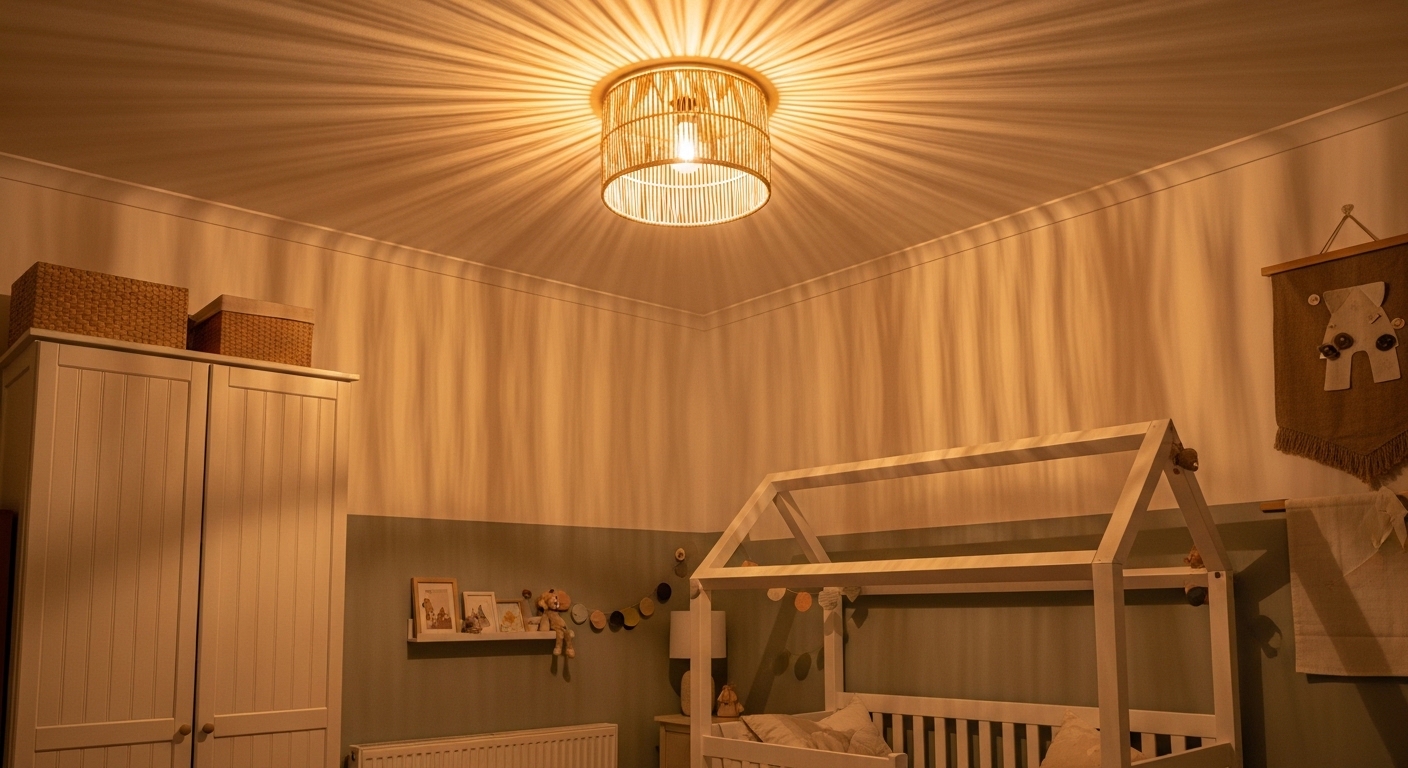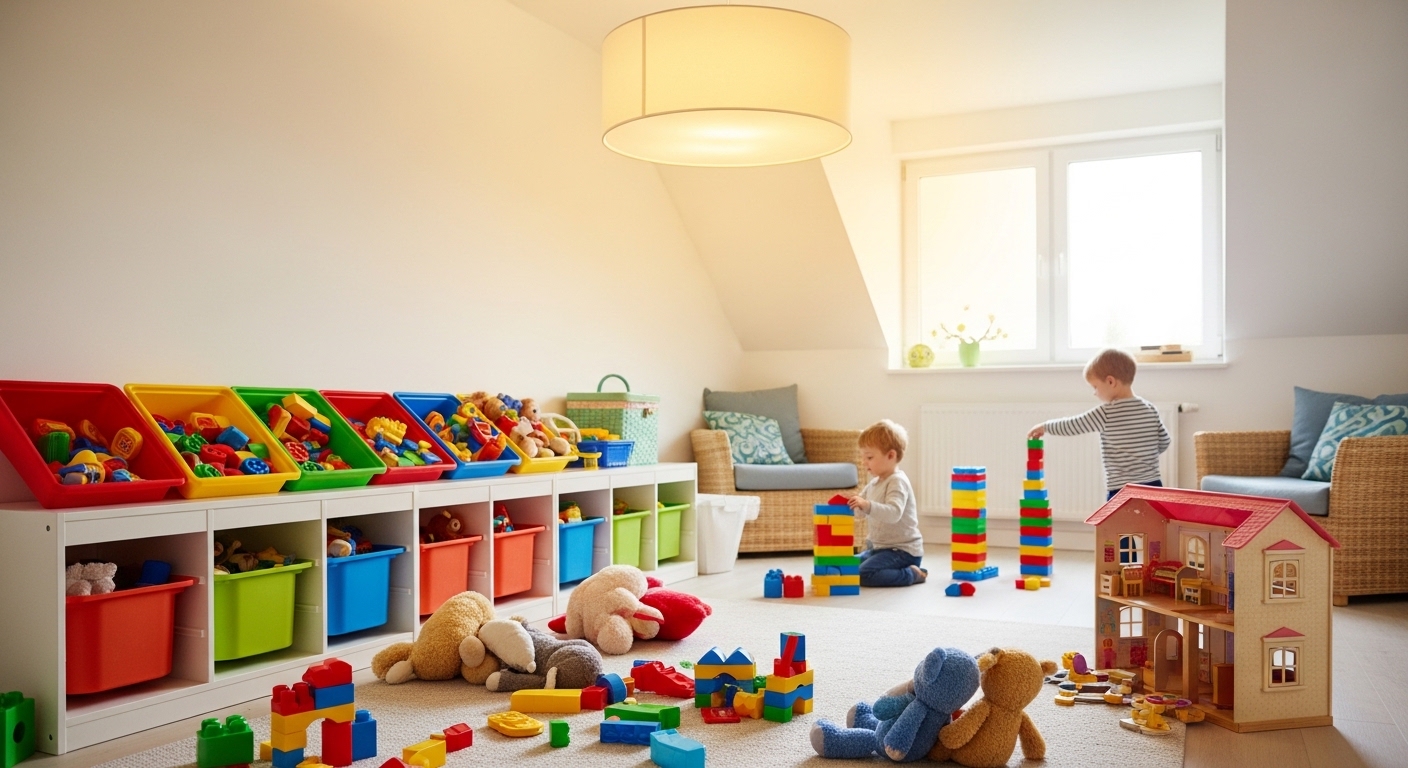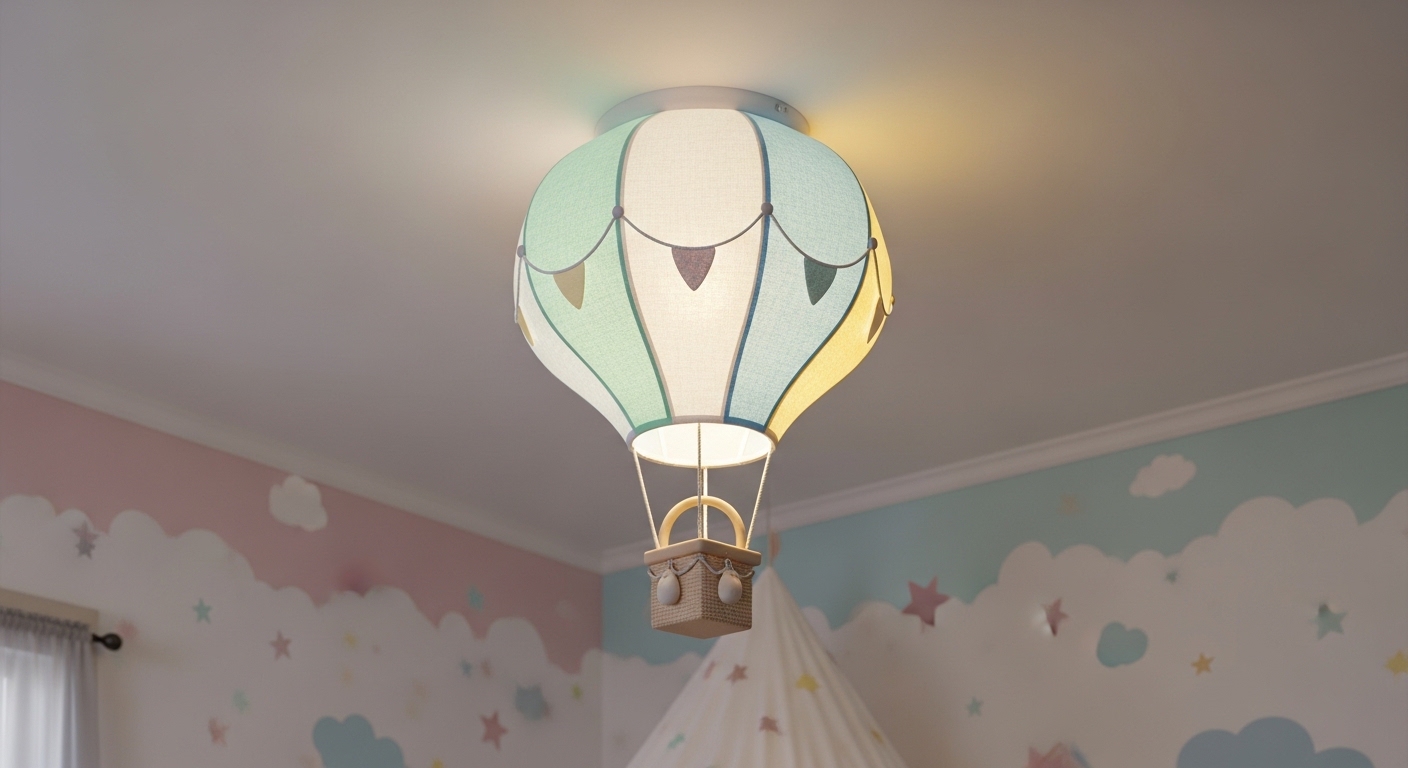
Toddler room lighting that's safe, functional and still looks like a room is a dimmable flush-mount ceiling fixture, a hardwired wall sconce above the crib or bed at 20 inches over the mattress with no cord and no reach, a plug-in nightlight behind a cover, and no lamps at all, and it's the setup that has lit three toddler rooms in this house across five kids. Our youngest is four and in the last toddler room we'll ever set up, and the rules were written after the first toddler pulled a lamp off a dresser by its cord at fourteen months. This post is the three fixtures and why exactly three, the no-lamp rule and what it cost us to learn it, the sconce height and switch, the nightlight and the 2 am rule, the dimmer and the bedtime sequence, the blackout blind, the bulb color and why 2700K for a toddler, the ceiling fixture that grows with the kid, the outlets and cords, the monitor's light, the shared room version, what to skip, the room at two and at four, mistakes, and the cost.
Exactly three fixtures
The ceiling fixture for daytime and cleanup. The wall sconce for stories and for the middle-of-the-night check. The nightlight for the hours in between. Three, because every light in a toddler room is a thing a toddler will try to interact with, and three is the number that covers every hour of the day with nothing left over to pull, climb or chew. A fourth light is a lamp, and a lamp is the one thing this post is against.
The no-lamp rule
No table lamps, no floor lamps, no clip lamps, nothing with a cord a toddler can reach, because a toddler who can stand can pull, and a lamp is a cord attached to a heavy thing with a hot bulb; ours came off a dresser onto the floor with a fourteen-month-old under it, and it missed her by a foot. Every light in a toddler room is on the ceiling or on the wall above reach, hardwired, and the only cord in the room is the monitor's, which is zip-tied up the wall behind the dresser. The playroom post has the same rule for the same reason.
The sconce: height and switch
A hardwired wall sconce centered above the crib, 20 inches above the top of the mattress, which is out of reach from a standing toddler in the crib and low enough to light a book on a lap in the chair beside it; a shade that closes over the bulb, metal or frosted, and a switch on the fixture for the adult plus the wall switch by the door. It's the story light, the diaper-change-at-3-am light, and the only light on in the room after 7 pm. When the crib becomes a bed at three, the sconce stays where it is, because the mattress height is roughly the same.
The nightlight and the 2 am rule
A plug-in LED nightlight at 2200K, the color of a candle, with a light sensor, in the outlet farthest from the bed and behind a cover plate that only exposes the light; $9. The 2 am rule is that nobody turns on anything brighter than the nightlight during a night check unless there's a mess, because a toddler who sees a bright light at 2 am is a toddler who's up; the sconce at its lowest is for the mess. The hallway's 20 percent sconces from the hallway post do the walk to the room, and the nightlight does the room.
The dimmer and the bedtime sequence
The ceiling fixture on a dimmer, $22, and a bedtime sequence that's the same every night: full for pajamas and cleanup, 30 percent for teeth, off, sconce on for stories, sconce off, nightlight. The lights are the routine's signal, the way classroom lights were, and a two-year-old learns in a week that the sconce coming on means the book and the sconce going off means the end. The bedtime board post is the routine; the lights are its clock.
The blackout blind
A cordless cellular blackout blind inside the window frame, $60, because a toddler room that's dark at 7 pm in June and at 6 am in July is a toddler who sleeps, and because a blind cord in a toddler room isn't allowed. Cordless is not optional here; it's the one thing in the room that a safety rule and a sleep rule agree on. A blackout curtain over the blind for the summer, on a tension rod, and the room is a cave from 7 to 6.
The bulb color
2700K in the ceiling fixture and the sconce, 2200K in the nightlight, and nothing cooler anywhere in the room, because a toddler's bedtime is a wind-down and cool light is the opposite. A 3000K or 4000K fixture in a toddler room is a fixture that keeps a kid up, and it's the first thing I change in a friend's nursery. The ceiling fixture dimmed to 30 percent reads even warmer, which is why 30 is the teeth setting.
The ceiling fixture that grows with the kid
A 13-inch LED flush mount with a frosted lens, 1,200 lumens, 2700K, dimmable, in white or brushed nickel, and nothing with a theme, because the toddler room becomes the 7-year-old's room and the fixture shouldn't have to change. The kids' room post is the fixture at every age; the toddler version is the same fixture with a dimmer and a stricter cord rule. Every toddler room in this house has had the same $52 flush mount, and all three are still up.
Outlets and cords
Every outlet covered with a sliding plate, the nightlight's outlet with a cover that exposes only the nightlight, the monitor's cord zip-tied up the wall behind the dresser to an outlet the dresser blocks, and the dresser anchored to the wall. The sconce is hardwired so there's nothing to pull; the ceiling fixture is on the ceiling. A toddler room has one cord, and it's behind furniture that's bolted down.
The monitor's light
A video monitor has a status light, and the status light is a thing a toddler stares at; a square of black electrical tape over it, and the monitor on the dresser's back edge where the sconce's light reaches it so the camera can see. The monitor's infrared works in the dark and the nightlight is enough for the picture. It's the smallest light in the room and the one that took longest to notice.
The shared toddler room
Our 4-year-old shares with her 12-year-old sister, and the room has two sconces, one over each bed, each with its own switch on the fixture, so the older one reads at 9 pm and the younger one sleeps at 7; the 12-year-old's sconce is a plug-in with the cord behind the headboard, because the wall wasn't open, and the 4-year-old's is hardwired. The ceiling fixture and its dimmer serve both, and the nightlight is on the little one's side. The shared room post is the rest of the room.
What to skip
Lamps of every kind. String lights, which are a cord with hot points. Projector nightlights that throw stars on the ceiling, which are lovely and which every toddler I've known stays awake to watch. Fixtures with fabric shades, which collect dust in a room where a kid's face is 3 feet from the ceiling for a decade. Fans with lights, until the kid's out of the crib. And anything with a pull chain, which is a cord.
The room at two and at four
At two: the crib under the sconce, the chair beside it, the nightlight across the room, the ceiling fixture at full for ten minutes a day. At four: a bed where the crib was, the sconce at the same height because the mattress is, the nightlight still on, and the ceiling fixture at full for the floor puzzles. Nothing moved and nothing was bought between two and four, and the same three fixtures will do until she's seven, at which point the sconce gets a reading kid and the nightlight comes out.
The sconce as a bedtime object
A toddler who knows the sconce means the story asks for the sconce, which is the point: the light is part of the routine, not just how you see the book. Ours points at it at 6:55 and says "book light," and the switch on the fixture is the adult's, so it's a light she asks for and doesn't control, which at two is the right arrangement and at seven becomes hers. It's the same fixture that's above the 7-year-old's bed, and he's had the switch since he turned six.
The nursery version, before the toddler
The same three fixtures from day one, because a nursery becomes a toddler room in eighteen months and the sconce over the crib is the 2 am feeding light long before it's the story light; the difference is the settings, with the ceiling fixture almost never on and the sconce at its lowest for months. A nursery with a lamp on the dresser is a nursery that has to be re-lit when the baby stands, and ours was, once, in the first house. Set the room up for the toddler and the baby gets the same room with the dimmer lower.
Installing the sconce over a crib
An electrician for the box, because it's a wall with a crib against it and the wiring has to be right; $120 for the hour, and the sconce hung by Matt after. If the wall can't be opened, a plug-in sconce with the cord in a channel down the wall behind the crib's headboard to an outlet the crib blocks, which is fine as long as the cord is fully covered and the outlet's behind furniture that's anchored; the 12-year-old's plug-in has been that since she was seven. Either way the sconce's center is 20 inches above the mattress top, measured with the mattress at its lowest setting, because the crib's mattress drops when the baby sits up and the sconce shouldn't have to move.
The light and the nap
A daytime nap in a toddler room is the blackout blind's job, and the nightlight is on under it because the light sensor thinks it's night, which is fine; the room at 1 pm looks like the room at 8 pm and the toddler's body agrees. The ceiling fixture at full for the five minutes after the nap is the wake-up, the same way the hallway's morning ramp is for the older kids. Light is the routine's signal at every age in this house, and the toddler room is where it starts.
Mistakes
The lamp on the dresser, once. A corded blind in the first house. A star projector that kept a two-year-old up until nine. A 4000K bulb in a nightlight that was the wrong nightlight. And a sconce at 26 inches over the crib in the first room, which a standing eighteen-month-old could reach with a stretch, and which came down 6 inches the day she did.
In one paragraph
A dimmable frosted flush mount at 2700K. A hardwired sconce 20 inches over the mattress with a closed shade and a switch on the fixture. A 2200K nightlight behind a cover plate. No lamps, no cords, a cordless blackout blind, tape over the monitor's light. Full for pajamas, 30 for teeth, sconce for stories, nightlight for the night. Three fixtures, three toddler rooms, five kids, and one lamp that fell once.
What it cost
The flush mount, $52. The sconce, $58, and the electrician's hour, $120. The dimmer, $22. The nightlight, $9, and the cover plates, $12. The blackout blind, $60. About $330 for a toddler room lit for two years of the same bedtime, and the electrician's hour is the part that makes it a room with no cords.
Shop this post: wall sconces and ceiling lights, the two hardwired fixtures a toddler room needs