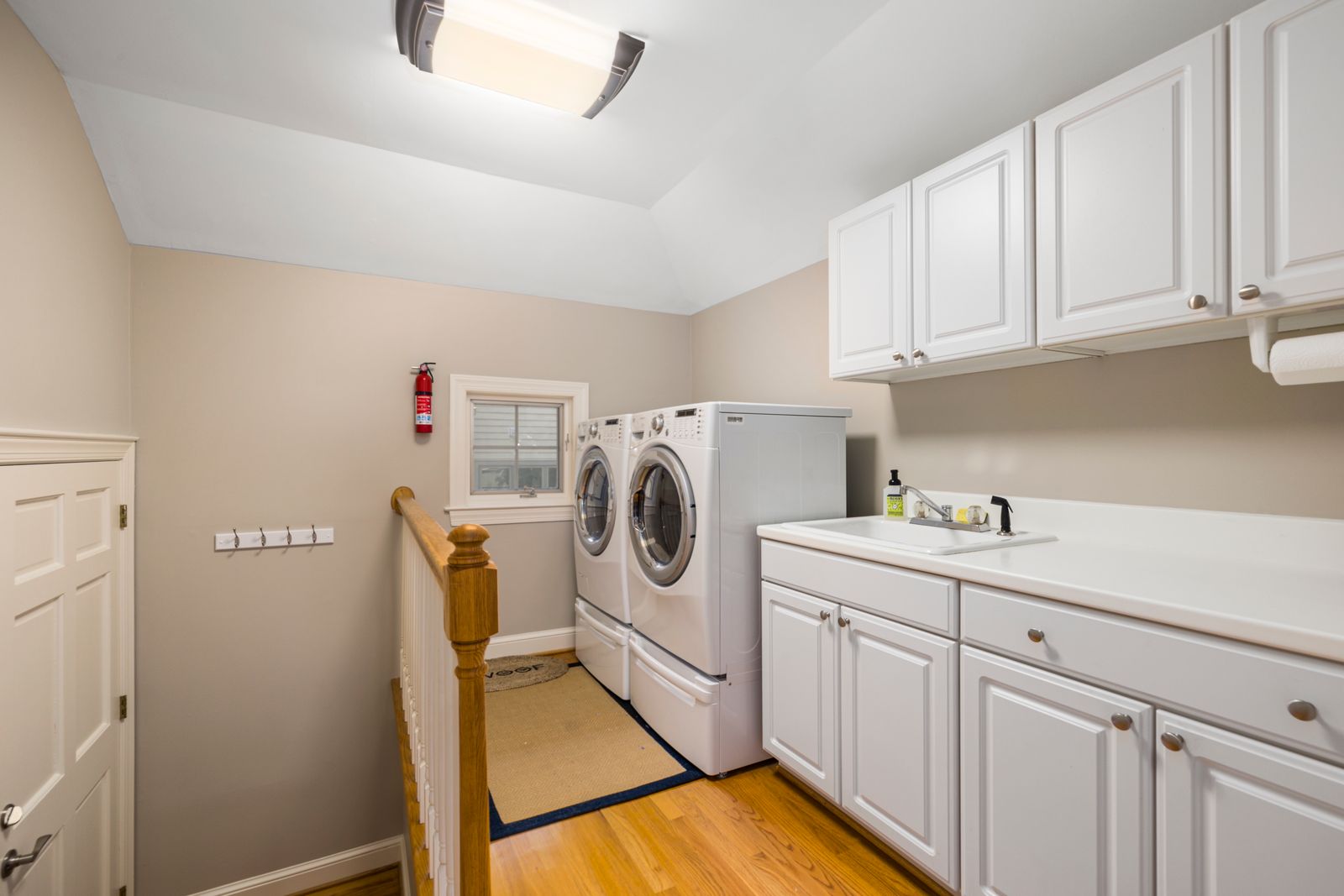
The best laundry room lighting is bright, cool and layered: one overhead fixture giving at least 1,600 lumens per 100 square feet at 3500K to 4000K, a task strip over the folding counter, and a small light over the machines so you are not loading a washer drum in your own shadow. That is the whole answer. Our laundry room is 65 square feet with one window and, until last year, one original overhead fixture that gave about 800 lumens of yellow light and showed nothing. We run fourteen loads a week for seven people. I was carrying shirts into the kitchen to check stains under better light, then walking them back to wash. That is backwards, and fixing it cost $84 and one Saturday morning. Here is everything we changed, in the order I would do it again, with the numbers.
Why Laundry Room Lighting Is Different From Every Other Room
Everywhere else in our house I buy 2700K bulbs. Warm light is right for a bedroom, a family room, a dining table. The laundry room is the exception, and it took me a long time to understand why. Warm light is yellow light, and yellow light flattens colour. A tomato sauce stain on a white school polo and a clean white school polo look almost the same under a 2700K bulb. Under 4000K, which is close to daylight, the stain is obvious from across the room.
The laundry room is a work room. You are sorting, checking, treating and folding. Every one of those jobs depends on seeing colour accurately. So the rules flip: cooler colour temperature, more lumens, and a bulb with a high colour rendering number. I buy bulbs with a CRI of 90 or above for this room, which is printed on the box. It costs maybe a dollar more per bulb and it is the difference between catching grass stains before the dryer sets them and finding them afterwards.
Step One: Change the Bulbs Before You Change Anything Else
If you only do one thing after reading this, swap your laundry room bulbs to 3500K or 4000K. Do it today. It costs less than $15 and takes two minutes. I did this before buying any fixtures and immediately started catching stains I had been missing for years. My 12-year-old asked why the laundry room suddenly looked "like a store." That is roughly the point.
Check the lumens while you are at it. A typical old builder fixture with one 60W-equivalent bulb gives about 800 lumens. For a 65 square foot room that is about half of what you need. The target I use is roughly 50 foot-candles at the counter, which works out to 1,600 to 2,000 lumens for a room our size and around 2,000 to 2,500 for a 100 square foot laundry room.
Step Two: The Overhead Laundry Room Light Fixture
We replaced the original flush mount with a plain two-bulb utility ceiling light. Nothing decorative. White, frosted lens, two sockets. The fixture was $34 and the two 1,600-lumen 4000K LED bulbs were $12 together, so the room went from 800 lumens to 3,200 lumens for $46. The frosted lens matters. A clear lens with bright LEDs throws hard glare when you look up to grab detergent off the shelf, and a frosted one spreads it.
When you choose a laundry room light fixture, three things matter more than looks. First, a closed or frosted lens, because laundry rooms are humid and lint gets everywhere; an open fixture collects both. Second, a damp rating if your room has a utility sink or poor ventilation. Ours has a sink and the dryer vents outside, so damp-rated was the right call. Third, two or more sockets, so one dead bulb does not leave you in the dark with a basket on your hip.
If your ceiling is low, under 8 feet, stick with a flush mount. If you have a taller ceiling and want something with more character, a semi-flush fixture works well and still keeps the light up and out of the way. For flush and semi-flush options, ceiling lights are where I would start, then choose based on the lens and the lumens rather than the photo.
Step Three: Task Lighting Over the Folding Counter
We have a folding counter above our front-loading washer and dryer, with a wall cabinet above it. Even with the new overhead, the cabinet threw a shadow right across the counter, which is exactly where I check stains and fold. I added a plug-in LED strip under the wall cabinet, set back about 2 inches from the cabinet face so the light falls on the front of the counter instead of shining into my eyes. It runs the full 36-inch width. I used 4000K to match the overhead. The kit was $22, including the adhesive clips and an inline switch.
The setback detail is the part people skip. If you stick the strip at the very front edge of the cabinet, you see the individual LEDs when you stand at the counter. Two inches back hides them and puts the light where your hands are. Run the cord along the back corner of the cabinet and down behind the counter to the outlet. Nobody will ever see it.
This is the same trick I used in our kitchen, and I wrote more about getting under-cabinet strips right in the kitchen renovation planning post. The rule is the same in both rooms: light the work surface, not the room.
Step Four: Light Over the Machines
This is the spot every laundry room gets wrong. The washer and dryer are deep, and when you lean in to load or unload, your own body blocks the overhead light. You end up fishing a single sock out of a dark drum by feel. We stuck a small battery puck light on the wall above each machine. Tap on, tap off. A pack of two was $16. They take AAA batteries, and I have replaced them once in a year.
If you are renovating and have the walls open, a hardwired wall light above the machines is the cleaner version. Either way, the goal is light coming from in front of you and slightly above, not from behind. Placement is about 18 inches above the top of the machines, centred on each one.
The Total: $84 and No Electrician
Here is the full list. New overhead utility fixture, $34. Two 1,600-lumen 4000K bulbs, $12. LED strip kit for under the cabinet, $22. Two battery puck lights, $16. Total, $84. The fixture swap was the only part that touched wiring, and it was a straight replacement on the existing box, which my husband Matt did with the breaker off in about 20 minutes. If you are not comfortable swapping a fixture yourself, an electrician will typically do a like-for-like replacement quickly, and the rest of this list is plug-in or battery.
This is the most useful lighting money we have spent in this house. Not the prettiest, the most useful. I use this room every day, twice a day, and every load now gets checked properly.
Best Lighting for a Laundry Room by Size
People ask me how bright is bright enough, so here are rough numbers. For a laundry closet or a stacked unit behind bifold doors, around 20 to 30 square feet, one 1,100 to 1,600 lumen fixture is enough, plus a small battery light inside the closet frame. For a small laundry room of 40 to 70 square feet like ours, 1,600 to 3,200 lumens overhead plus a task strip. For a large laundry and mudroom combination over 100 square feet, plan on 3,000 to 4,000 lumens across two fixtures so you do not have one bright spot and dark corners, plus task lighting at the counter and sink.
Whatever the size, keep the colour temperature consistent across every fixture in the room. Mixing a 4000K overhead with a 2700K puck light looks odd and defeats the stain-checking purpose. Pick one number and buy everything at that number.
Laundry Room Lighting Ideas If You Rent
Everything except the overhead fixture swap works in a rental. Bulbs, plug-in under-cabinet strips, battery puck lights and a plug-in wall sconce all go in without touching the wiring and come out without a trace. If your landlord will not let you change the overhead, change the bulbs in it to 4000K at the highest wattage-equivalent the fixture is rated for, and add more light at the counter. You will get most of the benefit.
What About Windows and Daylight?
Our laundry room has one small window facing east. In the morning it helps a lot, and I do most stain checking before 10 a.m. for that reason. But you cannot plan a laundry room around daylight, because most laundry in a family of seven happens after school and after dinner, when it is dark. Treat the window as a bonus. Keep it clear of stacked baskets, and use a light, washable shade rather than heavy curtains so the daylight you do get reaches the counter.
Lighting and Organization Work Together
Better light changed how we organise the room too. Once I could see clearly, I could see how much clutter had built up on the shelves: three half-used stain sprays, two kinds of detergent, a box of dryer sheets nobody liked. We cleared it to one of everything. I wrote about the full system, including the basket per kid and the two-loads-a-day schedule, in our laundry room organization post. The lighting is what made that system possible, because you cannot keep a room organised when you cannot see into its corners.
Flush Mount, Semi-Flush or Pendant in a Laundry Room?
I get asked this a lot, usually by someone who has seen a pretty laundry room online with a glass pendant over the sink. Here is how I think about it. A flush mount is the practical choice for most laundry rooms: it sits tight to the ceiling, nobody hits their head on it carrying a basket, and lint has nowhere to settle. A semi-flush fixture drops 8 to 12 inches and works if your ceiling is 8 and a half feet or taller; it spreads light a bit wider and looks more finished. A pendant only makes sense over a sink or a counter that nobody walks under, in a room with at least a 9-foot ceiling, and even then it should be a closed glass or metal shade that you can wipe down. An open fabric drum in a laundry room is a lint trap.
We went flush because our ceiling is 8 feet and the room is narrow. If we ever redo it, I would still go flush or semi-flush and spend the money on a second fixture instead of a fancier single one. Two plain fixtures beat one fancy one in a work room every time.
Switches, Timers and Kids
With five kids, the laundry room light was on all day. Somebody would grab a towel at 7 a.m. and nobody would turn it off until bedtime. Our fix was a simple wall switch timer that turns the overhead off after 30 minutes. It cost about $25 and replaced the standard switch. The under-cabinet strip and the puck lights are manual, so they only come on when someone is actually folding or loading.
The 9-year-old and 7-year-old now move their own baskets to the laundry room on their days, and they can reach the switch and see what they are doing. That sounds small. It is a big part of why the kids actually do their part instead of dumping clothes in the hallway. A room people can see in is a room people will use properly.
Mistakes We Made Along the Way
We tried a 2700K "soft white" bulb at 1,600 lumens first, thinking brightness alone would fix it. It did not. The room was brighter and still yellow, and stains were still hard to see. Colour temperature mattered more than brightness.
We put the first strip right at the front edge of the cabinet. The LEDs were visible from the doorway and glared at the counter. Moving it 2 inches back fixed it.
We bought a cheap puck light with a motion sensor. It turned off every time I stood still to fold, which in a laundry room is constantly. Manual tap lights are better here.
And we waited too long. We lived with the 800-lumen fixture for six years. The fix took one morning.
The One-Paragraph Version
Swap to 4000K bulbs with a high CRI, aim for 1,600 or more lumens per 100 square feet, use a frosted, damp-rated overhead fixture with two sockets, add an LED strip 2 inches back under the cabinet over your folding counter, and put a light above the machines so you are not working in your own shadow. Keep every fixture at the same colour temperature. In our 65 square foot room that was $84, and it is the room in the house where good light pays off every single day.
Shop the light: ceiling lights for the overhead, and wall sconces if you want a hardwired light above the machines.