Good teenage bedroom lighting starts with the desk, not the mood lights. Our 14-year-old's room now has four sources: a 4000K adjustable desk lamp for homework, a tall floor lamp that bounces warm light off the ceiling, a warm 2700K strip behind her headboard for reading in bed, and the wall sconce by her bed that she has had since she was little. The overhead light is now the least-used light in the room. A year ago it was the only one. She was doing homework under the ceiling fixture on full and then scrolling her phone in the dark, which is hard on the eyes, bad for focus and bad for sleep. We sat down together, figured out what she actually did in that room hour by hour, and bought for that. Here is the whole setup, what each piece cost, what we got wrong, and what I would tell any parent of a teenager who is about to buy a 30-foot roll of colour-changing LEDs.
Start by Asking What They Do in the Room
I assumed she would want colour-changing strips everywhere. Every teen bedroom on social media has purple light along the ceiling. When we actually talked, her list was different. In order: a better light for homework, a way to read in bed without the big light, something softer for evenings when friends are on video calls, and then, maybe, something fun. That conversation saved us from buying a lot of mood lighting and still missing the real problem, which was that she had nowhere to do homework with decent light.
So the order we bought in was: task light first, then ambient light, then the bed light, and decorative last. If you are lighting a teenage bedroom, I would do it in the same order. A teenager spends far more hours at a desk than anyone admits, and if that light is bad, everything else is decoration on top of a problem.
The Desk Lamp: The Most Important Purchase
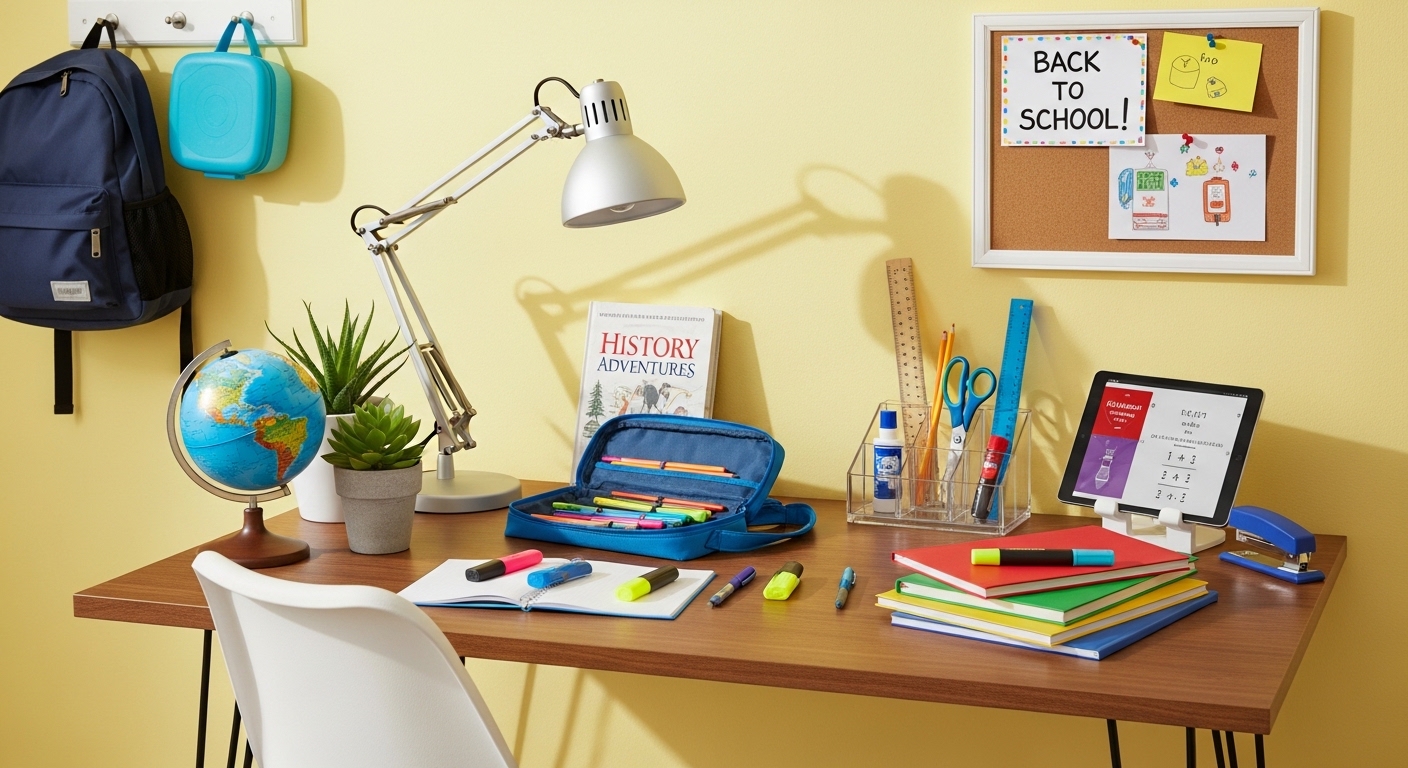
We got an adjustable-arm desk lamp that clamps to the edge of her desk, with a built-in dimmer and a USB charging port in the base. It runs at 4000K, which is cooler and crisper than the rest of the room, and that is on purpose. Cooler light helps with focus and makes text sharper on paper. At full brightness it puts roughly 600 lumens on the desk surface. She uses about 60 percent for homework and 30 percent for drawing. It cost $42.
Placement matters. She is right-handed, so the lamp sits on her left and the arm reaches across. That way her writing hand does not cast a shadow on the page. If your teen is left-handed, flip it. The head of the lamp should sit about 15 inches above the desk and slightly in front of her, angled so she never sees the bulb directly. If the bulb is in her eye line, she will turn the lamp off within a week and go back to the overhead.
This one lamp changed her study evenings more than anything else we bought. Homework that used to drag on with complaints about headaches now happens without the complaints. I am not going to claim a lamp raised her grades. I will say she stopped asking to do homework at the kitchen island, which, with five kids, frees up real space. Our homework station post covers how the younger ones work at the island instead.
The Floor Lamp for Ambient Light
For general light that is not the ceiling fixture, she has a tall floor lamp in the corner, about 72 inches high, with a wide linen drum shade. The shade is open at the top, so a lot of the light goes up and bounces off the ceiling, which fills the room softly instead of pointing a hot spot at the floor. It has a foot switch with three brightness steps, which she can reach from her desk chair without getting up.
On evenings when she is reading on the bean bag or on a video call with friends, this is often the only light on. It makes the room feel calm instead of clinical, and she says she looks better on camera with it, which in her world counts for a lot. We use a 2700K bulb in it, the same as the rest of the house. Floor lamps are the easiest win in any teen room because they need no installation and move with them when the furniture moves, which with a teenager happens every few months.
The Bed Light: Sconce Plus a Warm Strip
She has had a wall sconce beside her bed since she was in a toddler bed. I wrote about why every one of our kids has one in kids' room lighting that grows from 3 to 13. It has a switch on the fixture itself, and at 14 she uses it every night. It was the one light in the room she said not to touch.
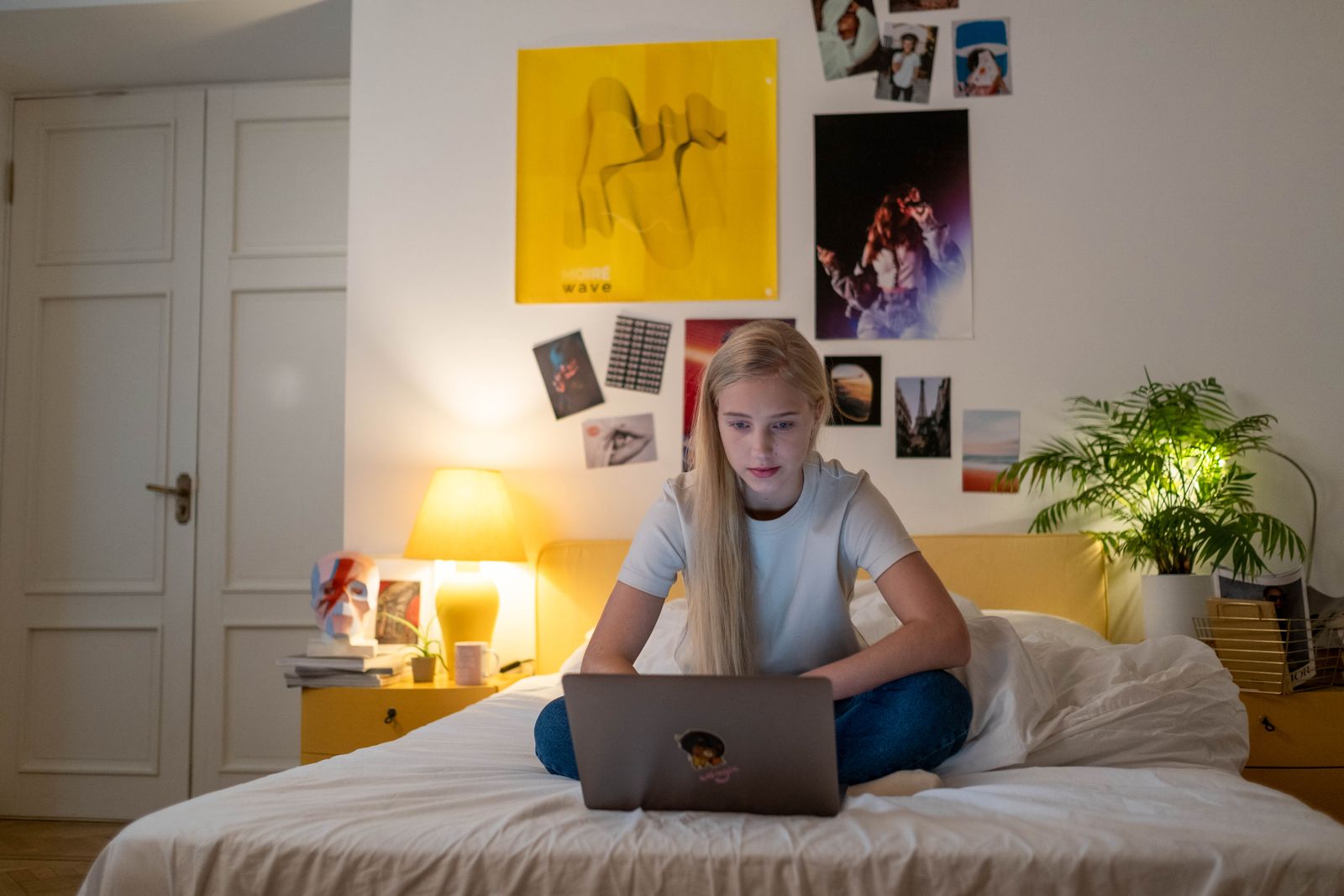
What she added was a warm white LED strip behind her headboard. Warm white, 2700K, not colour-changing, and that was her choice, not mine. She wanted it for reading in bed with the sconce off, because the strip throws a soft glow up the wall behind her rather than a direct beam. At its lowest dimmer setting, it is enough to read a paperback and soft enough that it does not keep her awake. The strip cost $18 and went on an adhesive channel on the back of the headboard in about 20 minutes. Because it is on the headboard and not the wall, there is nothing to peel off the paint later.
If your teen wants a plug-in option for the wall instead, plug-in wall sconces go up with two screws and no electrician, and they are a lot easier to move than a hardwired fixture when the bed moves to the other wall.
Her Three Modes
She now has names for her lighting. Study mode is the desk lamp at 60 percent with the overhead on low. Chill mode is the floor lamp only. Wind-down mode is the headboard strip at 20 percent and nothing else. Naming them sounds silly, but it turned her lighting from one switch by the door into something she uses on purpose. She knows which mode she is in, and wind-down mode has become a signal for her that the day is over, the same way the bedtime board does for the younger kids. Our bedtime routine board post has that system.
What About Colour-Changing LED Strips?
Most teenagers want them, and I do not think they are a bad idea in a bedroom, as long as they are not the main light and they are not blue at bedtime. Blue and white light in the hour before sleep tells the brain it is daytime. Red, amber and warm white do not. If your teen wants colour strips, a fair compromise is: fun colours are fine until an hour before bed, then the strip goes to amber or off. Many strips have a schedule in their app that can do that automatically, which avoids the nightly argument.
Put them where they bounce, not where they glare. Behind a headboard, behind a desk hutch, along the top of a wardrobe facing the ceiling. Never at eye level where you see the dots. And check the adhesive. Cheap strips stuck directly to painted walls in a hot room tend to fall down within a few months and take paint with them when you peel them off. Mount them on an aluminium channel or on furniture instead.
The Overhead Light
We did not replace her ceiling fixture. It is a plain flush mount, and it is now on a dimmer switch, which we added for about $30. She uses it at low for study mode and at full only when cleaning her room, which is not often. Dimming the overhead was a small change that made a big difference, because full overhead light at 9 p.m. was half of the original problem.
If we were replacing it, I would look for a fixture with a diffuser that hides the bulb, at 2700K or 3000K, and keep it on the dimmer. A teen room does not need a statement ceiling light. It needs one that can be turned down.
Teenage Bedroom Lighting Ideas on a Budget
Here is what the whole room cost. Desk lamp, $42. Floor lamp, $65. Headboard LED strip with channel, $18. Dimmer switch for the overhead, $30. The bed sconce was already there. Total new spend, $155. If you only have $50, buy the desk lamp. If you have $100, add the floor lamp. The strip and the dimmer are the third and fourth priorities.
Skip anything that is mainly decoration until the task light is right. A neon sign looks fun in a photo and does nothing for homework.
Letting Them Own It
The biggest change was not a fixture. It was handing over control. She chose the lamp colours, she decided where the floor lamp went, and she set her own modes. I set two rules: the desk lamp stays on the desk, and nothing blue after 9:30. Everything else is hers.
Teenagers who feel ownership of their room keep it in better shape. Our 12-year-old watched all of this and has already presented me with a list for her own room. I expect the same order: desk first, then everything else.
Screens, Sleep and the Lighting Rules We Agreed On
Lighting and screens are tied together in a teenager's room. Phone and laptop screens are bright and blue, and scrolling in a dark room makes them feel brighter still, which is harder on the eyes and keeps her awake. Having a warm light on in the room while she uses her phone in the evening helped more than any screen-time argument. We also agreed on three rules that she helped write: the desk lamp goes off when homework is done, nothing blue after 9:30, and the last light on is the warm one at the bed. She sticks to them most nights, which with a 14-year-old is about as good as it gets.
The phone charges on the dresser across the room now, not the nightstand. That was her idea after she noticed she read more when the phone was out of reach.
When Friends Sleep Over
With five kids, sleepovers are frequent. The lighting plan needed to handle three or four teenagers in one room. The floor lamp at 40 percent is the sleepover light: enough to see sleeping bags on the floor, soft enough that someone can fall asleep while the others are still talking. The headboard strip stays at its lowest as a night light for anyone getting up. The overhead, which would wake everyone, stays off. The hallway sconces stay at their 20 percent overnight setting, so nobody trips on the way to the bathroom at 2 a.m. In the morning, opening the blinds does the rest; a room full of teenagers wakes up faster with daylight than with any light switch.
Lighting for a Shared Teen Room
Our 12-year-old and 4-year-old shared a room for two years before the move-around, so I have done this the harder way too. In a shared room, each person needs their own light they control, at their own bed, so one can read while the other sleeps. A sconce at each bed with a switch on the fixture is the best answer. The overhead goes on a dimmer and is used only when both are awake. A desk lamp belongs to whoever owns the desk. And a warm night light low on the wall, not at bed height, lets either child get up without waking the other.
Mistakes We Made
I almost bought a 30-foot colour-changing strip kit before we talked. That would have gone around the ceiling, looked purple, and solved nothing.
Our first desk lamp was a cheap one with a fixed head, set to 6500K. It was harsh and bluish, she hated it, and it lasted two weeks before going under the bed.
We put the first strip directly on the wall. It fell down in July when the room got hot. The channel on the headboard has stayed put.
And we left the overhead without a dimmer for months, so she kept using it at full brightness at night. The $30 dimmer should have been the first thing.
What I Would Tell Another Parent
Ask your teenager what they do in the room before you buy anything. Buy the desk lamp first, at 4000K, adjustable, with the head below eye level and on the opposite side from their writing hand. Add a floor lamp for warm ambient light. Give them a bed light they control, warm and low. Put the overhead on a dimmer. Colour strips are fine as a bonus, but not as the main light and not blue at bedtime. Then let them own it. A teenage bedroom with good lighting is a room they will actually study, read and sleep in, which is the whole point.
Shop the bed light: bedroom wall sconces and plug-in wall sconces that move with the bed.